German court rules Samsung, Motorola do not infringe on Apple 'touch event' patent
 AppleInsider Staff
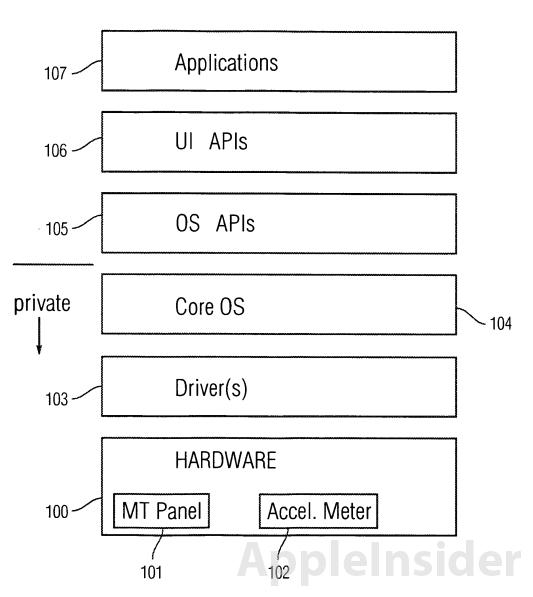
Diagram of input/output processing stack in Apple's EP2098948 patent. | Source: Espacenet
The Mannheim Regional Court on Thursday ruled against Apple's claim that Android devices infringe on the company's patent regarding how a multitouch device handles so-called "touch events."
According to FOSS Patent's Florian Mueller, the panel's ruling of non-infringement technically applies to two separate suits, one against Samsung and another against Motorola.
Apple asserted its European Patent EP2098948 for a "Touch event model" against both companies, with the property covering how a device's software recognizes or ignores touch events, a necessity in creating a usable multitouch system.
Judge Andreas Voss, who presided over the Mannheim Court panel, agreed with Samsung and Motorola's first non-infringement argument, which claims Android does not store a "multi-touch flag" with each UI window.
Mueller said the ruling comes as no surprise as the German court expressed skepticism to Apple's claims in related trials. He notes that Samsung successfully objected to the bond Apple posted to cover the Korean company's legal fees in a separate trial in April, forcing the Cupertino company to post a new bond to move forward with a second court proceeding.
In early April, the High Court of England and Wales cleared HTC of infringing Apple's paten, ultimately declaring the IP invalid due to the "statutory exclusion of patents on computer programs."
On Wednesday, the Munich I Regional Court held two trials and one hearing regarding Apple's assertion of slide-to-unlock, photo gallery page-flipping and "rubber-banding" patents against HTC. According to Mueller, "nothing spectacular" happened during those proceedings, and the first two cases are scheduled to be decided in January.






 William Gallagher
 Andrew Orr
 Sponsored Content
 Malcolm Owen


 Mike Wuerthele