 Aidan Malley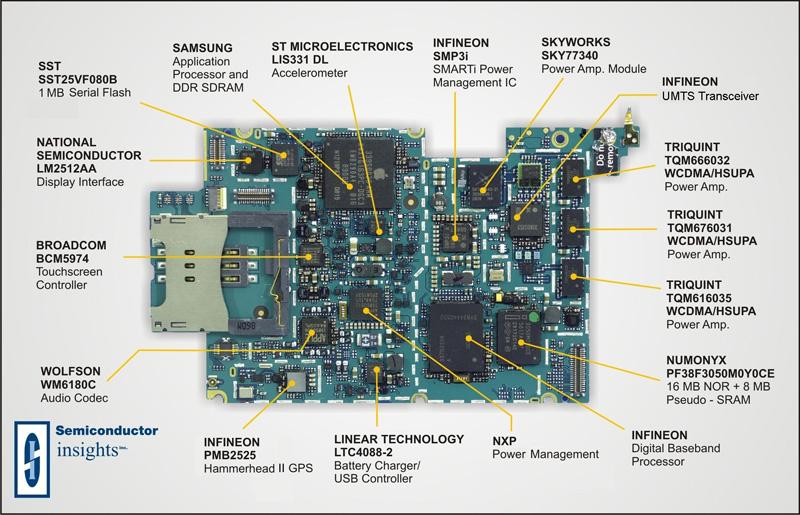
Many have made guesses as to what chipsets are inside iPhone 3G, but research firms Portelligent and Semiconductor Insights have cracked the mystery and have explained each chip in one of the most detailed Apple product teardowns yet.
That's not Infineon's only win for the new iPhone, however. It also handles the power management and, more importantly, the GPS chipset. Apple uses a PMB 2525 Hammerhead II chipset rather than examples from SiRF and other common GPS chipmakers. The component is accurate to "within meters" and prevents major positioning errors in cities, where buildings can bounce the signal and miscalculate the phone's location.
The teardown also reveals that Apple has switched providers for the NAND flash memory that serves as permanent storage. Although Samsung has been tapped for large memory orders, it's Toshiba that is supplying the 8GB or 16GB of memory in each phone and uses a single chip for each 8GB of flash on the device. Samsung now provides only the system RAM.
"To see Toshiba makes me wonder if that [Samsung] deal is no longer in place," says Greg Quirk of Semicondutor Insights. "Does this mean that Samsung is playing second string to Toshiba?"
Many components remain the same. The Samsung ARM11 is still the iPhone's main processor, while Wolfson still provides audio through its own audio codec hardware even as it's rumored to be cut out of future iPods. These are signs that the iPhone 3G is "incrementalism at play" rather than an overhaul, says Portelligent's David Carey, even if Apple has learned from the iPod touch by consolidating everything into one board.
Other companies involved with the iPhone 3G include Broadcom for the touchscreen controller, Marvell for Bluetooth support, as well as Linear Technology, National Semiconductor, Numonyx, NXP, Skyworks, SST, ST Microelectronics, and Triquint.

-m.jpg)


 Christine McKee
 Amber Neely
 Andrew Orr
 Sponsored Content

 William Gallagher

36 Comments
1) I've read the sound quality through the headphones is much better. Are both new and old iPhone using the same Wolfson chip or is this one newer?
2) The mention of WCDMA/HSUPA is nice since the previous mention of the Inferion chips beign used did not have HSUPA capabilities. While HSUPA does nothing for my usage in the US right now it may help sell iPhones in other countries if this does mean that it has HSUPA.
3) "Uses a single chip for each 8GB of flash on the device." If the current 16GB model is really just 2x8GB chips sandwiched together, then in 6 months Apple could do an incremental update from 8/16GB to 16/24GB by using the same method. This is much better than having to wit an extra long time for Flash prices to fall for the denser, higher capacity chips.
I was hoping for a Sony Felica RFID chip
Marvell for Bluetooth support
This is not correct. Marvell supply the WiFi chip, Bluetooth is provided by Cambridge Silicon Radio (CSR).
This is not correct. Marvell supply the WiFi chip, Bluetooth is provided by Cambridge Silicon Radio (CSR).
Why do you Dumb Asses continue to go to this site, Boy Toy Genius & MacRumors to get your info.
IT'S ALWAYS WRONG.
Mod Edit: For those looking to take a temporary vacation from posting privileges, please look to this user for advice on how to be relieved of them. For the rest of you: please carry on. Thank you!
I thoroughly enjoyed this article; very informative. Thanks!