 Daniel Eran Dilger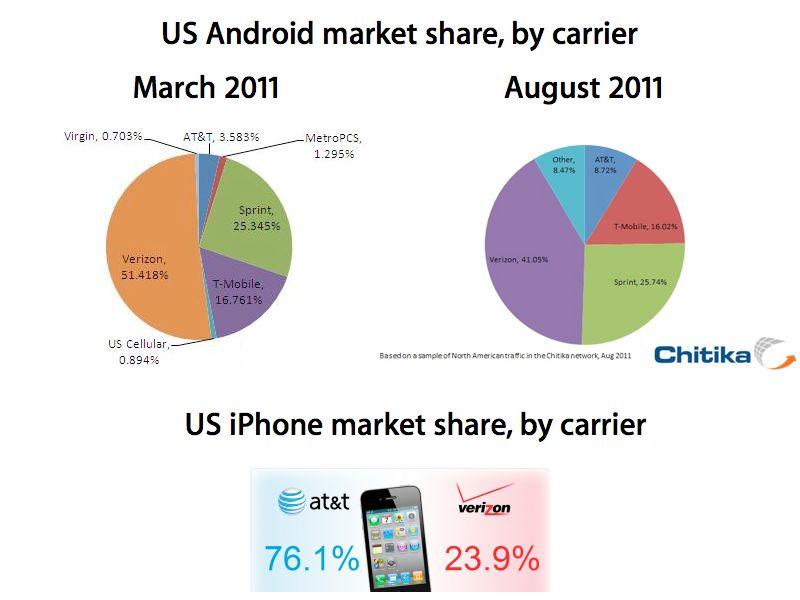
A breakdown of US Android providers published by Chitika Insights at the end of March showed Verizon to be the largest Android carrier, largely due to that carrier's migration from RIM Blackberry to Droid branded Android smartphones throughout 2010.
A new study by Chitika, looking a the same market just five months later, shows a huge decrease in Verizon's slice of the US Android pie after it launched iPhone 4.
Despite a new wave of promotion of Android devices, AT&T's share of Android users is up just 5 percentage points. Figures by T-Mobile and Sprint indicate both have maintained a static ratio of the nation's Android users as Verizon moved millions of its subscribers to the iPhone.
The largest growth comes from other carriers, including MetroPCS, Virgin andUS Cellular, who amounted to less than 3 percent of the US Android market in March, but now collectively claim 8.5 percent, nearly as large of a share as AT&T.
Chitika estimates that Verizon carries about 23.9 percent of American iPhones, leaving AT&T with 76.1 percent.
The company noted, "Verizon’s share of iPhone traffic continues to increase, but it seems that Verizon is gaining market share in Apple’s prominent smartphone at the expense of its other, Android-running devices."


 Wesley Hilliard
 Marko Zivkovic

 Christine McKee
 Amber Neely
 Malcolm Owen

68 Comments
Doesn't this really reflect on the growing Android market and it's participants and less on anything to do with the iPhone? In order for it to really reflect on the iPhone your pie chart should just show a comparison of just Verizon before and after it had the iPhone. The charts are really showing that more companies are selling Android devices. Is it also possible that the Other is including things like Tablets and Nooks? I don't think you can make the conclusion that you have from those charts.
And many more of us trapped on AT&T are waiting for iphone 5 to switch to verizon!
It's really the only phone that actually puts carriers on the map and makes news about them somehow relevant. No other device does that.
Another regurgitation of a "research report" by AppleInsider with no critical thinking. As another commented noted, there's no way to use the percentages in those pie graphs to draw the conclusion that Verizon's carrying the iPhone 4 caused the reduction in Verizon's share of the Android handset market or that its customers shifted from Android to iPhone. +1 for Bruce.
I'm part of the 23% of iPhones on Verizon. But i'm surprised that ATT has such a little android %. What the hell are they selling other than iPhone? It's crazy to think that 92% of ATT's smartphone users are iPhone, or is it?