Apple earned $1 out of every $5 US consumers spent on electronics this holiday
 AppleInsider Staff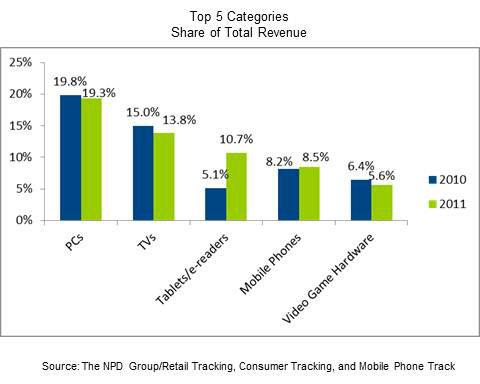
Apple's market dominance ensured that the iPhone maker remained the largest consumer electronics brand for the second year in a row, NPD's Retail and Consumer tracking Services and Mobile Phone Track found. With year over year domestic sales growth of 36 percent, Apple's 19 percent of all sales dollars was almost twice as much as the second-place finisher, Hewlett-Packard.
All of the other top five brands beyond Apple actually saw a year over year decrease in revenue in 2011. HP's sales dropped by 3 percent, third-place while Samsung dipped 6 percent, fourth-place Sony slid 21 percent, and Dell, in fifth, lost 17 percent.
Total U.S. technology hardware and consumable sales fell one-half of a percent in 2011, finishing the year at nearly $144 billion. Nearly 60 percent of all sales were represented by the top five categories: PCs, TVs, tablets/e-readers, mobile phones, and video game hardware.
"U.S. hardware sales growth is becoming harder and harder to achieve at the broad industry level," said Stephen Baker, vice president of industry analysis at NPD. "Sales outside of the top five categories fell by 8 percent in 2011 as consumers shifted spending from older technologies to a narrow range of products."
Apple also had a strong showing among retailers, finishing in third only behind first-place Best Buy, and second-place Walmart. Staples and Amazon tied for fourth place, behind Apple, leaving the top five identical to how they were positioned in 2010.
"While in-store sales fell about 2.5 percent in 2011, the growth in online volumes for retailers meant that retail name plates still accounted for well over four of every five dollars spent on CE hardware in the US," Baker said. "Despite their sales strength, retail stores still face serious challenges in 2012 as volumes in the traditional CE categories, which once carried these stores, continue to slide. It shouldn’t be forgotten, however, that a large majority of mobile phones and tablets/e-readers (the two fastest growing CE categories) have mostly been driven through in-store experiences."
The holiday quarter was Apple's best three-month period ever, as the company sold a record 37 million iPhones, along with 15 million iPads and 5.2 million Macs. Total revenue for the period was $46.33 billion, while earnings hit $13.06 billion.
 Mike Wuerthele
 Malcolm Owen
 Chip Loder
 William Gallagher
 Christine McKee
 Michael Stroup


25 Comments
Interesting datapoint if you dig into these numbers.
Apple had less than 10% of U.S. PC sales. So 2% of U.S. electronics revenues were on Apple PCs if Apple's revenue share matched their market share.
Apple had something like 60% of tablet/ereader sales. So about 6.5% of U.S electronics revenues were Apple iPads if Apple's revenue share matched their market share.
Apple had around 40% of total phone sales. So 3.3% of total revenues were Apple phones if Apple's revenue share matched their market share.
So only about 11.8% of total sales would have been Apple if Apple's revenue share matched the commonly reported market share (that is, if Apple's average selling price were the same as the market average). If Apple had 19%, then Apple's average selling price was 60% higher than the average in the market.
Of course, before we hear all the whining about an "apple tax", it must be pointed out that Apple doesn't participate in the low end of any of these markets and is consistently offering only high end products, so this really doesn't say how much (if any) premium Apple gets over EQUIVALENT products.
Because of apple's genius...I've taken quite a minimalist approach to electronics lately. I'm reluctant to "mess around" with other manufacturer's clunky software and plasticky assembly.
I'm quite happy with the few Apple products I own, iMac, iPad2, iP4, express router. Sold my MacBook to get ipad2.I know it's personal...but I would rather go without a piece of electronic gear than buy something from an electronics manufacturer other than Apple.
I jumped at the first iPhone, buying two, one for my daughter and myself. $1,200, if memory serves...I deliberately did not buy a stand-alone GPS unit b/c the screen and interfaces were subpar compared to the iPhone. I waited and got TomTom with my ip4.
Sold my Casio exlim camera and reluctant to get a DSLR. iPhone is ok, for now, especially for outdoors. I gave away all my iPods.
I only buy Apple routers. I don't have a TV...waiting for the AppleTV (this is hard as I love to watch Formula One)
I have no stereo...don't like all the wires and cables. Relatively content with iMac for music and iPhone, of course.
I suppose, I have to use Brother for a printer, MFC.
Best
P.S. In 2012 i'll be swapping iMac for 11" MBA, ip4 for ip5, ipad2 for ipad3 (3G) and express for a time capsule...and getting an AppleTV, of course.
The beauty of the iPhone is that it is a versatile device. More and more people realize that it easily replaces a camera, a camera recorder, etc , etc ...
Because of apple's genius...I've taken quite minimalist approach to electronics lately. I'm reluctant to "mess around" with other manufacturer's clunky software and plasticky assembly.
Good choices -- I too have been spoiled with Apple gear and will not touch junky equipment anymore.
I still have to use a Wintel work laptop -- and man do I loath it.
Frankly I'm more amazed that $1 in every $10 of electronics spending was on HP products.