 Victor Marks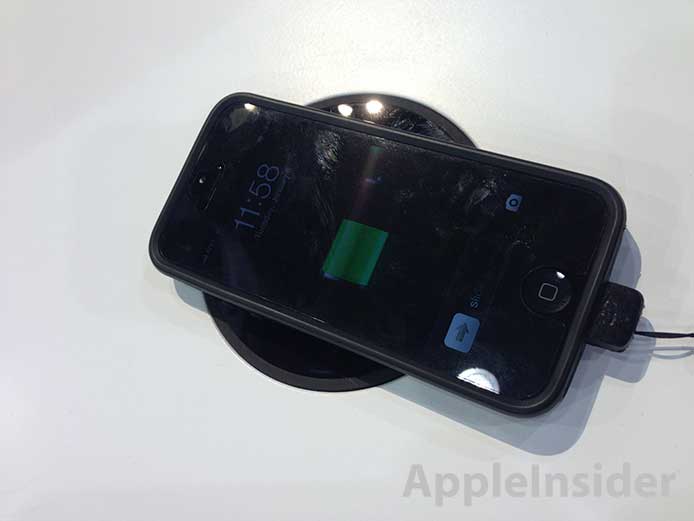
Skech, an Israeli case company, debuted a prototype iPhone 5 case that works with Powermat technology to wirelessly charge the handset
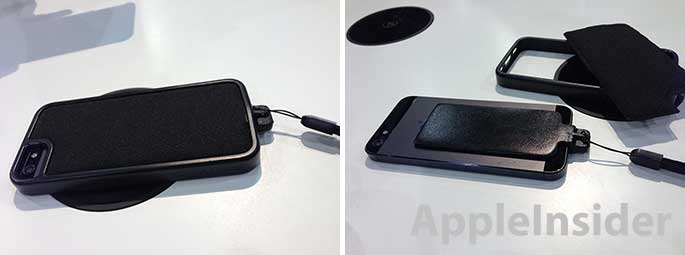
With its new design, Skech managed to shrink down the bulk seen in previous Powermat cases by removing the "chin" below the phone and replacing it with a small plug for the lightning connector. The plug also has a wrist strap connected to it for added protection.
Other than the simple design tweak, the case is reminiscent of Apple's bumper with interchangeable fabric back plates that have been molded to allow for the Powermat technology. This sample is not perfect or pretty, but it’s important to remember it is a prototype.
Wireless charging hasn’t really taken off until recently despite early attempts to build in the technology as did the now defunct Palm Pré. A major obstacle to market-wide adoption was that proprietary tech introduced by one company required charging pads and cases to be built by the same manufacturer. As more OEMs license Powermat Technology, or other standardized tech from members of the Qi Wireless Power Consortium, this should become less of a problem.
Still, consumers don’t want unsightly cases from charging mat manufacturers, but perhaps Skech's design will speak to a wider audience with its sleek modular format. The company's new iPhone 5 case is slated to ship this spring, though it is unclear if the product will be distributed in the U.S.







 William Gallagher
 Christine McKee
 AppleInsider Staff
 Chip Loder

 Malcolm Owen






14 Comments
As was the case the last 1000 times AI posted a story about wireless charging, I hope this never catches on. While efficiencies are improving, there is always some loss when using wireless charging. With good current designs, that can be as much as 30% of the applied power. With the less efficient designs, the power losses can be much higher. We don't need to be wasting energy and building new power plants because people are too lazy to spend the 0.5 seconds it takes to plug in their iphones.
My family and friends have had a lot of nice phones that stopped working because of their power socket going bad due to repeated plug/unplug sequences. Inductive charging is one solution for that problem.
Placing a Palm Pre on its Touchstone inductive charger was simply luxurious... there's no other word that describes it.
The base magnet held it upright on the slanted surface, and automatically put it into speakerphone mode to boot.
We don't need to be wasting energy and building new power plants because people are too lazy to spend the 0.5 seconds it takes to plug in their iphones.
Or too lazy to unplug their charger that's vampiring current all on its own. Or too cheap to buy room switches that automatically turn off the lights if no one is in the room. Etc.
Okay, how about a middle solution? Something like a MagSafe connector for the phone? That would also allow direct non-power connections too.
This was one of the best features of the the Palm Pixi I had before iPhone. Really hope to see wireless charging catch on this year.
I don't see this type of a technological solution going popular anytime in the future. By wireless charging, people imagine placing their iPhones on some pod.. that's it. As simple as it is.
I like my iphone 5 plug, takes 5 seconds. Now, the Isis Incipio case revealed at CES, on the other hand... :-) Be interesting to see that for the iPhone 5. Especially if the next iphone doesn't have some method of mobile payments.