Portfolio of over 300 patents underscores Steve Jobs' attention to detail
 Chris Smith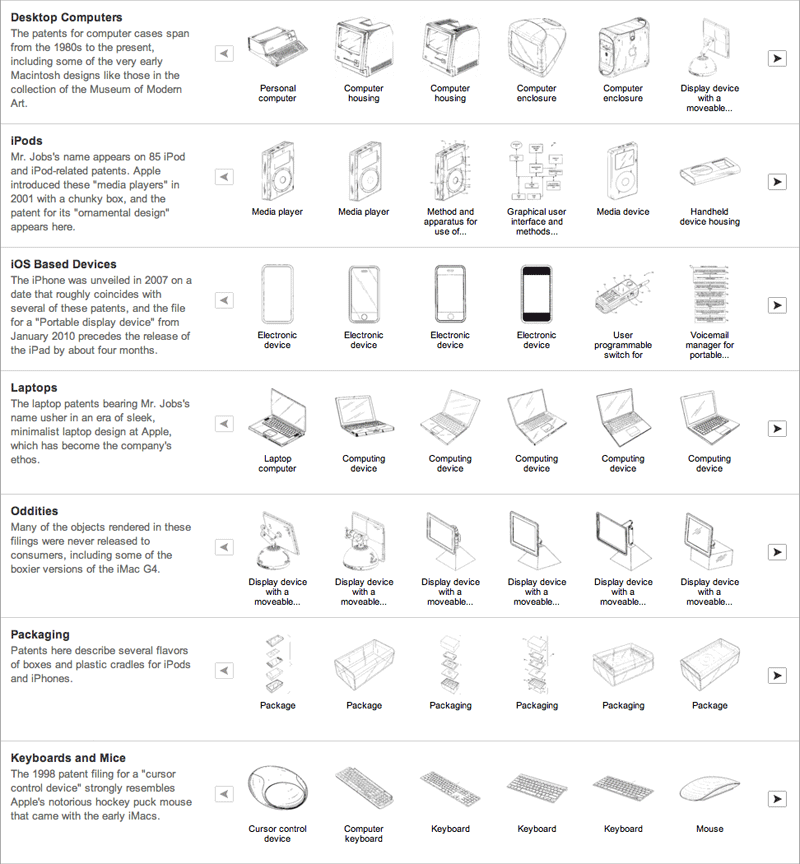
Besides managing day-to-day operations while acting as Apple’s leader for the better part of his career, Jobs took an active role in the various development stages of most iconic products launched by the company, from the first Macintosh computer to the various generations of iPod, iPhone or iPad devices. Unsurprisingly, New York Times’ Miguel Helft recently noted that Jobs is credited as the “principal inventor†or “one inventor among several†on a record 313 Apple patents.
By comparison, Microsoft’s co-founder and former CEO Bill Gates is only listed on nine patents while Google’s co-founders Larry Page and Sergey Brin appear in just “more than a dozen Google patents.â€
Apple isn’t likely to have added Jobs’ name on these patents in an attempt to “bolster the image of the visionary chief executive,†as some claim, Helft writes. As Standford University law professor Mark Lemley further points out, “if you put someone’s name who didn’t participate, your patent could be invalidated.â€
To better put in perspective the involvement of Apple’s former iconic leader, the Times also revealed that Jobs “was likely to have had an especially prominent role" in the 33 patents "where his name appears first."
Most patents Jobs where Jobs was heavily involved “cover the look and feel of a product.†More than 200 Apple patents that are shared by Jobs with industrial design chief Jonathan Ive back up this detail.
Jobs is also among the authors of various “utility patents†which can cover technical details such as “a software algorithm or computer chip,†and it’s worth noting that not all of the devices described in these fillings have been released to consumers.
Of those 313 patents awarded to Apple, Jobs has been credited as the principal inventor in the following cases:
Personal computer
Filed in Nov., 1980, and awarded in Apr., 1983, the “Personal computer†U.S. Patent No. D268,584 describes a “personal computer, substantially as shown†and it reveals a device similar to the Apple III, launched by the company in 1981 without a monitor.
Highly portable media device
U.S. Patent No. 7,593,782 contains a “detailed description of the design and workings of the first iPod shuffle,†Apple’s first iPod that didn’t feature a display. The patent filed in Aug. 2005 was awarded in Sept., 2009. Steve Jobs’ name appears in 85 iPod-related patents.
Touch screen device, method, and graphical user interface for determining commands by applying heuristics
This U.S. Patent No. 7,479,949, awarded in Jan., 2009, describes “a computer-implemented method for use in conjunction with a computing device with a touch screen display comprises: detecting one or more finger contacts with the touch screen display, applying one or more heuristics to the one or more finger contacts to determine a command for the device, and processing the command." More generally speaking, the filing covers how touchscreen-based iOS devices such as the iPhone or iPod touch work.
Laptop Computer
Awarded in Oct., 2002, U.S. Patent No. D464,344 covers “the ornamental design for a laptop computer, as shown and described†and the images it contains resemble Apple’s Powerbook G4 laptop, the Titanium PowerBook, launched by the company in 2001.
Telephone interface for a portable communication device
Awarded in Dec., 2010, U.S. Patent No. 7,860,536 describes “a method of using a portable communications device†which “includes displaying a first image of a rotary dial in a display of the portable communications device in response to a first contact by a user with a click wheel.â€
Computer Keyboard
The United States Patent and Trademark office awarded Apple Patent No. D421,976, which describes “the ornamental design for a computer keyboard,†in Mar., 2000.
Computer interface having a single window mode of operation
Filed in Jan., 2000 and awarded more than five years later, in Oct., 2005, U.S. Patent No. 6,957,395 describes a system to “manage the available space of a computer display in a manner which reduces clutter and confusion caused by multiple open windows.â€
Staircase
U.S. Patent No. D478,999 was awarded to Apple in Aug., 2003 and it describes the “ornamental design for a staircase†which has been related to the glass staircases currently found in several of the company's retail stores.
After working a full day at Apple’s headquarters in Cupertino, Calif., Jobs announced his resignation Wednesday and recommended to the company's Board of Directors that Tim Cook be named as his successor, in line with the company’s previously undisclosed succession plan.





 Mike Wuerthele
 Malcolm Owen
 Chip Loder

 William Gallagher
 Christine McKee
 Michael Stroup