Benchmarks show Core i7 MacBook Pros offer 50% speed boost
 Slash Lane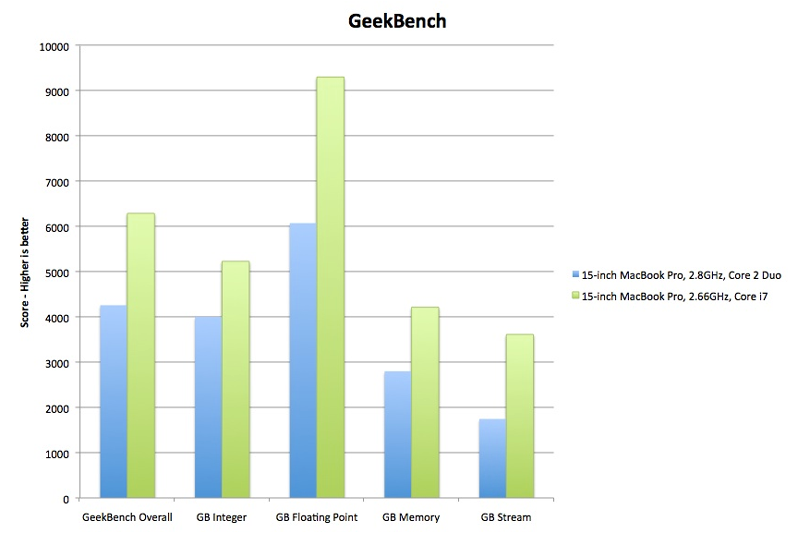
In a series of quick benchmark tests conducted by Gizmodo, the 15-inch MacBook Pro with a Intel Core i7 2.66GHz processor came in significantly faster than the previous-generation notebook, powered by a Core 2 Duo processor. The April 2010 hardware performed about 50 percent better than a previous-generation 15-inch MacBook Pro with a 2.8GHz Core 2 Duo when compared head-to-head in Geekbench tests.
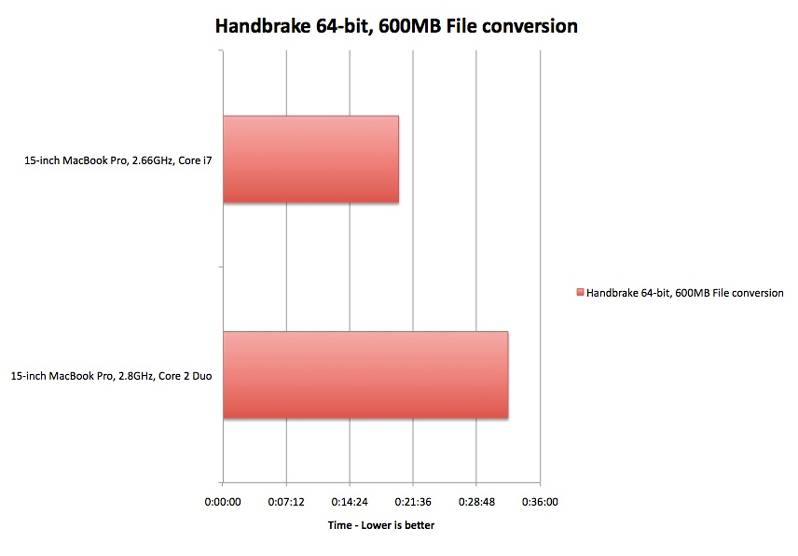
The latest hardware also posted significant performance gains in tests with Xbench, and re-encoding a file with Handbrake 64-bit improved a time of 32:19 on the Core 2 Duo processor to 19:54 on the Core i7. Results in Xbench were not as consistent, because the software has not been updated.
The initial tests confirm claims by Apple that its new Core i5 and Core i7 MacBook Pro models are the fastest Mac notebooks the company has ever released. The high-end models, announced Tuesday, start at $1,799 for the 15-inch MacBook Pro and $2,299 for the 17-inch MacBook Pro.
The tests also fall in line with previous benchmarks done with the processors on Windows PCs. Across the board, Intel's new mobile processors based on the Arrandale architecture offer improved speed and lower power consumption. Unlike the Core 2 Duo CPUs, Arrandale processors have the major northbridge chipset memory controller components built in.
Benchmarks credited to Gizmodo.
Tuesday's comparison tested only the CPUs of the computers, and did not take into account the upgraded Nvidia GeForce GT330M found in the latest 15-and 17-inch MacBook Pros.
In all, the new 15-inch and 17-inch MacBook Pro models are up to 50 percent faster than the previous systems, Apple has said. Intel's 32 nanometer process employed in the Intel Core i5 and i7 processors integrates the memory controller and Level 3 cache for faster access to system memory. In addition, "Hyper-Threading" technology improves data throughput by creating virtual processing cores, while Turbo Boost optimizes performance between the two processor cores, accelerating the system from 2.66 GHz to 3.06 GHz for intensive dual core tasks, and up to 3.33 GHz for single core tasks.
Even with the performance improvements, Apple claims the battery life on its latest notebooks has improved to between 8 and 9 hours on a single charge — the longest-lasting Mac notebook battery ever. This is due largely to a new proprietary graphics switching feature developed by Apple and implemented in the high-end systems. The 15- and 17-inch MacBook Pros will dynamically switch between an integrated, low-power Intel graphics processor and a discrete Nvidia graphics chip, depending on the needs of the user and the power required by the application in use.
The Nvidia 330M is said to be more than twice as fast as the low-end 320M found exclusively in the new 13-inch model.






 Malcolm Owen
 Chip Loder

 William Gallagher
 Christine McKee
 Michael Stroup
 William Gallagher and Mike Wuerthele