Apple investigating advanced displays, motion sensing headset
 Slash Lane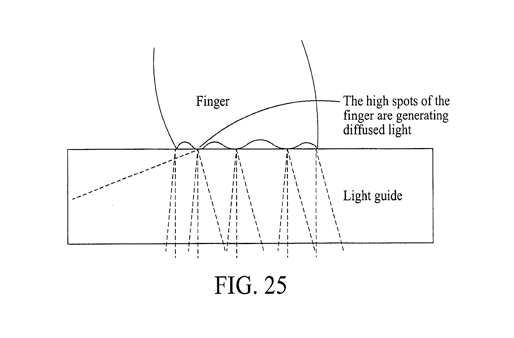
Superior screens
A pair of Apple patent applications revealed by the U.S. Patent & Trademark Office this week relate to LCD screens on mobile devices. One of the described inventions, entitled "LED Backlight Driver Synchronization and Power Reduction," comes just a day after Apple unveiled its LED-backlit iPad, sporting a 9.7-inch with in-plane switching technology.
The applications notes that that backlights from light emitting diodes are more efficient and durable, have a long operating life, low power consumption and broad color range. However, it said that LCD refresh signals can become out of phase with the LED drive signal and cause undesired visual effects like shimmering and banding.
"Shimmering resembles a 'sparkling effect' that typically occurs when a moving dark object meets or intersects with a lighter one," the application reads. "For example, when tree leaves are blowing in the wind, the leaves may appear to artificially shimmer at the edges of the leaves."
One implementation of Apple's system would have a plurality of LED strings, rather than a single LED string, allowing them to be driven at a higher frequency than that of the LCD refresh signal. Through this method, unwanted visual effects like flickering, shimmering or banding in LED-backlit LCD screens could be avoided.
The invention is credited to Eric Smith and was filed for on July 23, 2008.
A second application, entitled "Light Sensitive Display with Switchable Detection Modes," offers a number of modes to detect objects on or near the surface of a touchscreen panel, based on a given sensitivity to light. A new technology, Apple said, could improve contrast ratio and reduce glare without making the display costlier.
The invention is credited to Willem Den Boer and Adiel Abileah. It was applied for on Sept. 28, 2009.
Motion-sensing headset
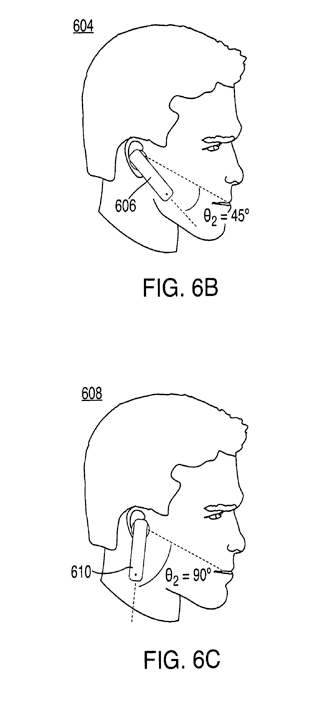
Another application refers to a wireless headset equipped with an accelerometer. This would allow the hardware to offer superior noise cancelation, allow adaptable controls for the headset's physical buttons, or preserve battery life by determining when the headset is idle.
Buttons could be changed based on the orientation of the device, which could vary depending on how the user wishes to wear it.
"The system can use the accelerometer to determine which side of the wireless headset is currently facing upwards, and direct the button on the upwards-facing side of the wireless headset to perform the volume-up function," the application reads. "Similarly, the system can use the accelerometer to determine which side of the wireless headset is currently facing downwards, and direct the button on the downwards-facing side to perform the volume-down function."
The invention is credited to Jeffrey J. Terlizzi, and was filed on July 25, 2008.
When the iPhone first arrived, Apple sold its own Bluetooth headset compatible with the hardware. However, in 2009, that hardware was discontinued.
However, Apple has continued to explore the possibilities with wireless headsets, including one patent application for a standalone MP3 player that could be paired with a cell phone via Bluetooth.










 Malcolm Owen
 Amber Neely

 Marko Zivkovic
 David Schloss
 Wesley Hilliard
 Mike Wuerthele and Malcolm Owen



5 Comments
New patent applications from Apple this week reveal an accelerometer-equipped wireless headset and new display technology with superior LED backlighting and improved ambient light detection....
Given that the last three years of Apple patents related to how to improve the experience of tablet computing turned out *not* to be included in the eventual device, or to even have any bearing on the real world product, what's the point of printing every little whisper of a patent rumour like this?
I'm sure IBM has patents on spaceships. It doesn't mean that any of this is relevant to todays computers or that any of it is likely to come to market in the net ten years, if ever.
You guys could at least wait a tiny bit after the great tablet let-down, to start publishing this speculative crap. It's not like there will be a dearth of visitors to your site today anyway.
Seriously - who cares anymore?
Have to agree, we're still digesting the news from yesterday good and bad.
I am starting to understand why so many people buy PCs.
The kind of responses to the ipad that everyone is having is a symptom of PC withdrawal.
Comments like "it is just a big ipod touch". Really?
Does that make sense when I say that a Mac Pro is just a big Macbook air? A PS3 is just a big PSP?
A computer is just a box; they are all just boxes; should just go buy any box; nothing special to see here.
dum-dee-dum-dumb
great exciting apple patent news !!
the first two patents may allow for fast paced high content 3d movie games play back in real time with no lag or UN-SYNCED frames
and the 3rd would give us a game playing head set that which ever way you are looking your gun will fire in that direction or you can steer you ship/car whatever way you want . the only problem is >if you buddy calls your name and you turn towards him he may get shot
so a all hands free system would be great
of course with a screen visor you could expand it uses to open ing closing app with a simple dbl nod of your head
thank you eric smith
peace 9