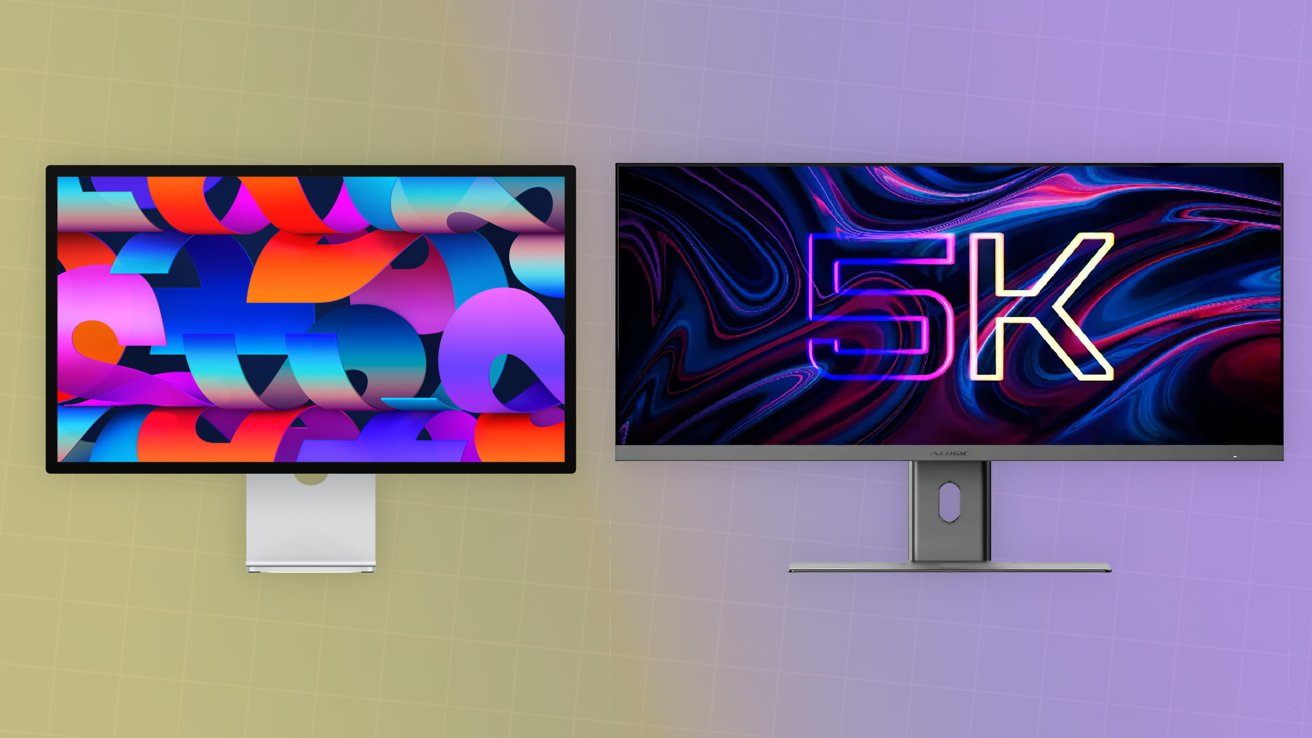
The Alogic Edge 5K display delivers widescreen high resolution and impressive styling for Apple Studio Display money. Here's how the specs of two screens compare.
Alogic has a fairly good pedigree when it comes to monitors. Its first monitor, the Alogic Clarity, was a more budget-focused and flexible counterpart to the Apple Studio Display when it first came out.
A few years later, the Alogic Edge 5K is another attempt to attract the typical Apple Studio Display customer. This time, the screen is much larger and with impressive styling, while also raising the price closer to Apple's monitor.
This time, it has to take on an updated version of the Apple Studio, which brings with it some audio and port-based updates as part of its 2026 refresh.
This is a breakdown of how the two screens compare, with Alogic attempting to take on Apple with a sizable high-resolution monitor. Sometimes, size matters.

Apple Studio Display (2026) vs Alogic Edge 5k - Specifications
| Specifications | Apple Studio Display (2026) | Alogic Edge 5K |
|---|---|---|
| Size (inches) | 27 | 40 |
| Resolution (pixels) | 5,120 by 2880 | 5,120 x 2,160 |
| Color range | P3 | 100% sRGB 99% DCI-P3 |
| Backlighting | LED | LED |
| HDR | None | None |
| Peak brightness | 600 nits | 400 nits |
| Contrast Ratio | 1,200:1 | 1,200:1 |
| Refesh Rate | 60Hz | 60Hz/100Hz |
| True Tone | Yes | No |
| Webcam | 12MP ultra-wide, Center Stage | None |
| Ports | 2xThunderbolt 5 2xUSB-C | 2x USB-C input (DP-Alt) USB-C 3.0 Gen 1 Output HDMI 2.0 DisplayPort 1.4 3.5mm Headphone RJ45 Ethernet |
| Audio | 6-speaker system | 2x 3Watt |
| Microphone | Yes, array of three | None |
| Nano-texture | Yes, Optional | None |
| Stand options | tilt, tilt + height, VESA | Height-swivel-tilt, VESA |
| Other Features | "Hey Siri" support (Mac), 96W host charging | Kensington Security Lock, 90W host charging |
| Retail price | $1,699 | $1,699 |
Apple Studio Display (2026) vs Alogic Edge 5k - Design and Dimensions
While our 2022 look at Alogic and Apple's monitors involved two screens of a similar size, the 2026 comparison has quite a few differences. The biggest similarity may be in retail price.

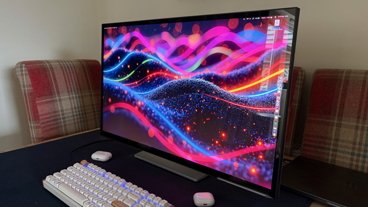
Apple Studio Display sitting on a desk
The Apple Studio Display is a flat aluminum slab of a display, looking quite a lot like a large and thick iPad has been put on a stand. At 27 inches, it's a fairly conventional display size for the current marketplace.
Alogic has used more of the available budget to create a display with a much larger footprint. Measuring 40 inches, doesn't quite look like an iPad, but it does other things that are very Apple-like.
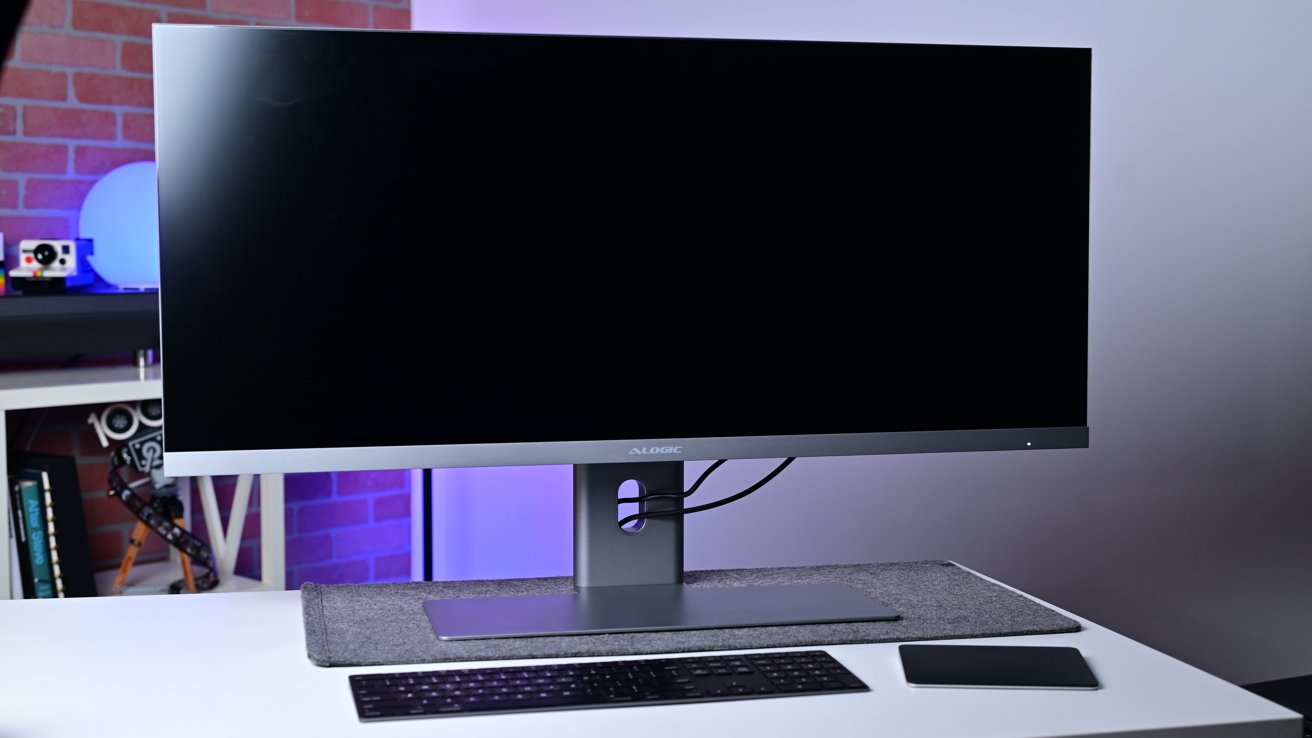
Alogic Display is a 5K2K ultra-wide monitor
For example, Alogic sells the Edge 5K in Silver and Space Grey, matching its own Mac color options. It also takes the aluminum slab approach to the extreme, with the display being made with tempered glass and a thickness reminiscent of an iPhone.

Alogic uses very thin bezels, but it does have a chin on the bottom, while Apple has a thick 1/2-inch border around the entire display
There's a narrow chin on Alogic's effort, while Apple errs towards using an even bezel around the outside. Apple dispenses of the chin entirely, though its bezels are nearly twice as thick around the entirety of the display.
Apple Studio Display (2026) vs Alogic Edge 5K - Screen
The difference in size was mentioned earlier, with Alogic providing a 40-inch screen versus the 27-inch Apple Studio Display's smaller stature. However, bigger isn't always better.

Apple's updated Studio Display has better speakers, a better camera, and Thunderbolt 5
There are comparable resolutions at play, with the Apple Studio Display running at 5,120 by 2,880 and the Alogic Edge 5K at 5,120 by 2,160. Apple's screen packs in more pixels into a tighter space, though this hasn't changed in the new model to be any more dense.
On a pixel density basis, this would be 218 pixels per inch for Apple, 139 pixels per inch for the Alogic.

Alogic Edge has a lower pixel density, but the bigger screen size means you sit further away
For refresh rates, Apple falls behind here. The Studio Display hits a maximum of 60Hz, while Alogic goes up to 100Hz.
On the all-important picture support, Apple includes a capability to display a billion colors, including Wide Color (P3). Apple also has a number of reference modes built-into the display, allowing it to recreate different color gamuts depending on the user's target format.

Apple Studio Display
This includes the Apple Display mode as well as HDTV Video BT.709, NTSC BT.601, PAL and SECAM, Digital Cinema P3-DCI and D65, Design and Print P3-D50, Photography P3-D65, and sRGB.
Alogic includes coverage of the sRGB spectrum to 100%, Adobe RGB to 94%, and P3 to 99%. This is quite comparable to the Apple Studio Display when it comes to capability, though its somewhat lower 16.7 million colors are a lot less than creatives may want.

The ultra-wide design is great for split screen apps or linear projects — like video editing
The relative lack of profiles may also work against it in the eye of professionals.
For brightness, Alogic isn't quite there with 400 nits to Apple's 600. For contrast, both are identical at 1,200:1, though neither manufacturer mentions HDR support either.
If you really want, you can take advantage of Nano-texture, a glass treatment on the Apple Studio Display to reduce screen glare. This is not available on the Alogic Edge 5K.
Apple Studio Display (2026) vs Alogic Edge 5K - Connectivity
Port selection dictates what you can connect to the display. As usual for Apple's hardware, it's a bit lacking here.
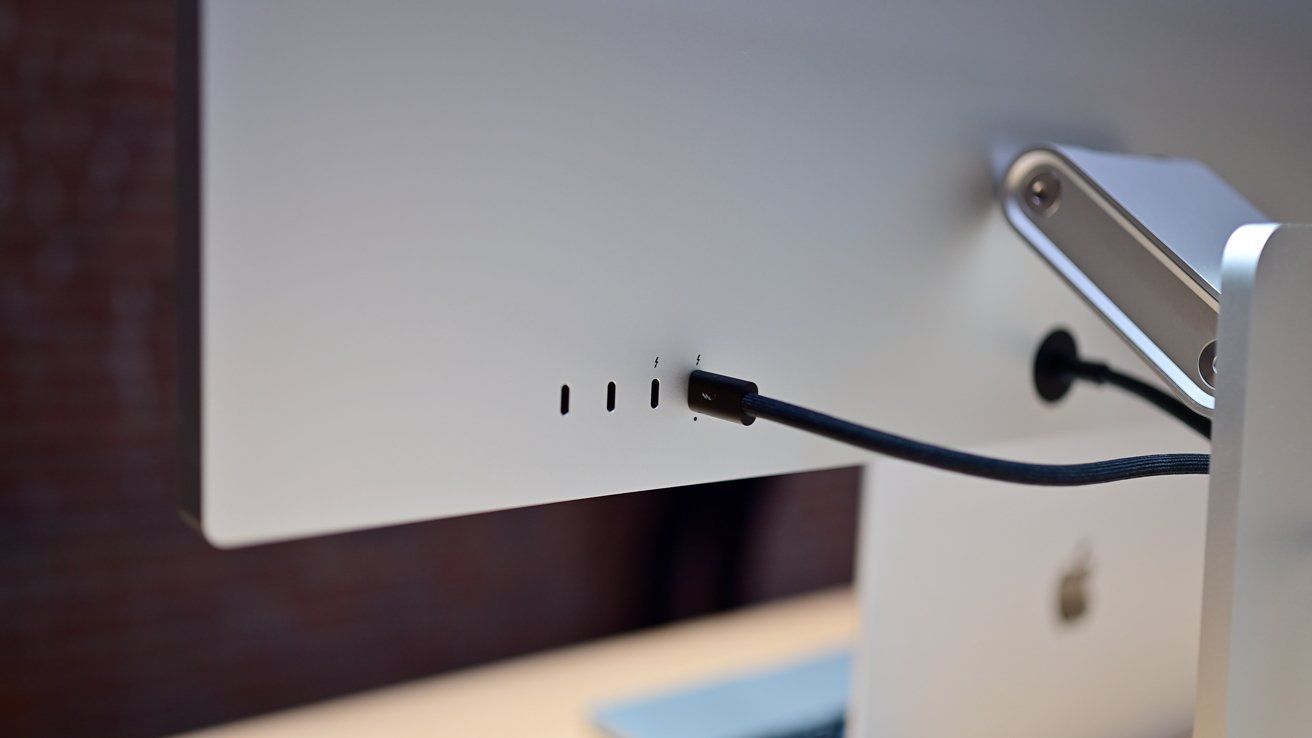
Studio Display uses Thunderbolt 5
The Apple Studio Display has just four connections on the back, with one of the two Thunderbolt 5 USB-C ports connecting to the host Mac, complete with 96W of power delivery. The other can be used to daisy-chain with other hardware at up to 120Gbps.
The other two ports are downstream USB-C, capable of up to 10Gb/s. They are more suitable for accessories, like a keyboard and mouse, rather than anything that could benefit from massive Thunderbolt bandwidth.
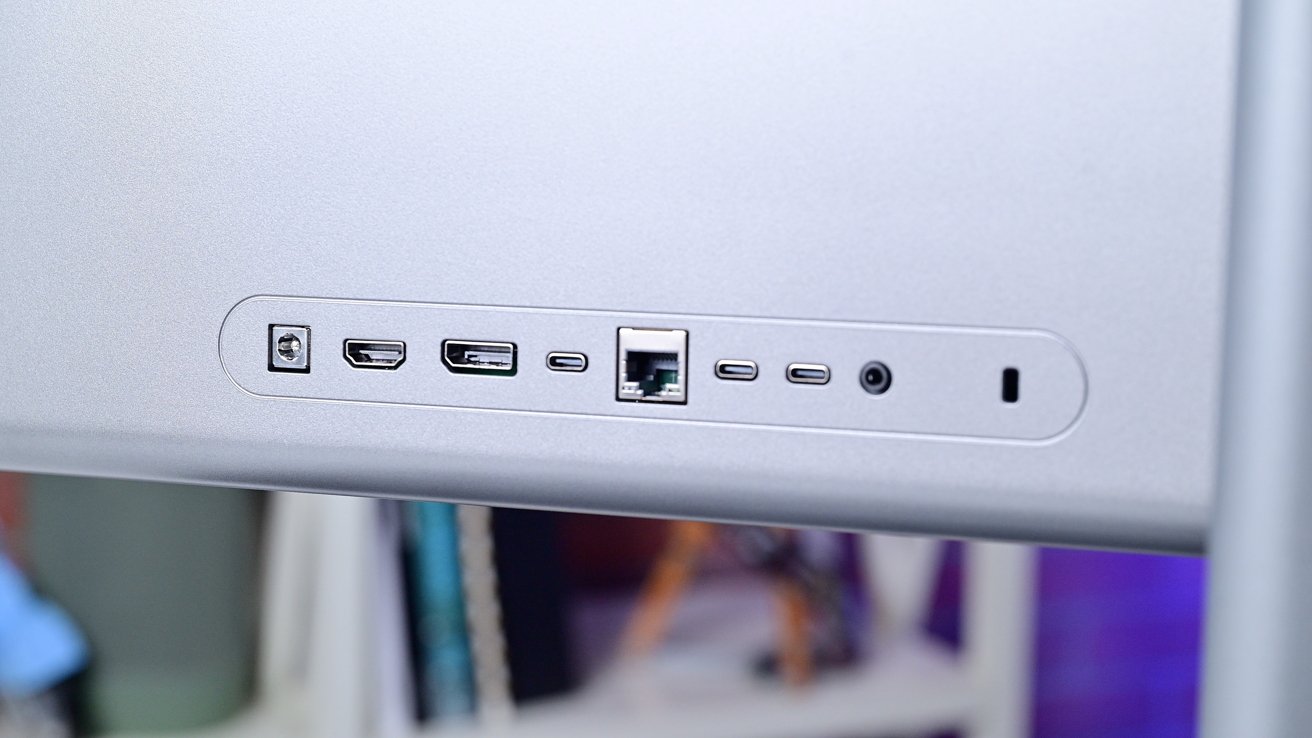
Alogic Edge connects via USB-C, HDMI, or DisplayPort and can act as a hub
Alogic has two USB-C connections for upstream connections, complete with DisplayPort Alt Mode support, as well as HDMI 2.0 and DisplayPort 1.4 and 90W of power delivery. The other ports include a USB-C 3.0 Gen 1 downstream connection for accessories, and a 3.5mm headphone jack.
More unusually for the Alogic, it includes a physical Ethernet port. This is an oddly useful connection to have, as it provides wired network access to a connected MacBook Pro, which doesn't have its own built-in port.
In both cases, the ports are on the back, off to the side for ease of access without any stand interfering with the cabling.
Apple Studio Display (2026) vs Alogic Edge 5K - Cameras and Audio
If you want the monitor with the most built-in audio-video capabilities for videoconferencing, the Apple Studio Display may be the better bet.
For a start, it includes a 12MP Ultra Wide camera with added image signal processing from Apple Silicon. The camera includes support for Center Stage, Apple's reframing tech that keeps you in the middle of the camera view, as well as a new addition in the form of Desk View.

Studio Display has a new six-speaker array with support for Spatial Audio
Apple also includes a trio of "studio-quality" microphones with a high signal-to-noise ratio, directional beamforming, and "Hey Siri" support.
Alogic doesn't include a camera nor microphone. You will instead have to use the headphone jack and bring your own webcam to the party.

Side view of the Alogic Edge that is very thin with a chin at the bottom
For audio output, Apple has a six-speaker system with force-cancelling woofers with 30% more bass this time, and support for Spatial Audio for Dolby Atmos. Alogic has a pair of 3-Watt speakers instead.
Apple Studio Display (2026) vs Alogic Edge 5K - Stands and Rotation
The default Apple Studio Display includes a tilt-adjustable version with an L-shaped bracket and a simple hinge mechanism. There's no height adjustment, unless you pay the extra $400 for the tilt and height-adjustable stand, which lets you move the monitor from 18.8 inches to 23 inches tall.

Alogic Edge is very thin with an easily adjustable stand
All this and no rotation adjustments from Apple.

Studio Display can be daisy chained to your Mac
Alogic's included stand includes the ability to shift from a 22.4-inch height to 27.3 inches, but bear in mind that we're dealing with a larger screen here. Tilt and swivel adjustments are also provided, giving you a lot of freedom of motion.
Apple Studio Display (2026) vs Alogic Edge 5K - Pricing
The Apple Studio Display costs $1,599 with the Tilt-adjustable display or in the VESA-mountable configuration. The Tilt- and height-adjustable stand version is $1,999, while the Nano-texture upgrade is a $300 add-on.

Alogic Edge looks great and has a premium aluminum build
Alogic is selling the Edge 5K for $1,529.99, a 10% discount from its $1,699 list price at the time of review.
Apple Studio Display (2026) vs Alogic Edge 5k - Which to buy
It's safe to say that the Apple Studio Display has its intended user base in creatives demanding accuracy. At least, doing so without paying the nosebleed rates for the Pro Display XDR, now Studio Display XDR.
With a capability for a billion colors, built-in reference modes, and improved audio and webcam capabilities, the Apple Studio Display is a very good package on its own. If not with a massive screen size.

Studio Display looks great, even if the 2026 upgrade was minor
While the Alogic Edge 5K doesn't quite live up to audio or camera capabilities, it does have a lot going for it. The thin profile and styling is very Apple-inspired, complete with the multiple colorway options.
Then there's the sheer size. Alogic's gone for a screen that's even bigger than the Studio Display XDR, and with a fairly similar 5K resolution to the Apple Studio Display. Both the old model and the new version.
While this does mean a smaller pixel density overall, at this resolution, the extra size helps keep things readable at least.
What we have here are two monitors that seem to be aimed at the same audience, but really, it's for two.
Creative professionals will do well to stick to the Apple Studio Display for their perfection-centric visual work. The Alogic is more for those who want an impressive Apple-like display, without paying the Apple premium.
Or, at least here, being able to spend as much as that premium, and seem to get a bit more screen space for your money.
Apple Studio Display (2026) vs Alogic Edge 5k - Where to buy
Apple's second-generation Studio Display starts at $1,599 on Amazon, with it also appearing at other retailers if you check out the deals in our Monitor Price Guide.
The Alogic Edge 5K, meanwhile, normally sells for $1,699.99, but Alogic direct is knocking $170 off the 40-inch monitor, bringing the price down to $1,529.99. B&H at press time has the lowest price at $1,299.99.