The iPhone Air is both an ultra-thin addition to the iPhone 17 range but also a device that offers some of the benefits that seem Pro-like. Here's how the new slimline model compares against the iPhone 17 Pro.
The iPhone Air is a standout introduction for Apple's 2025 smartphone roster. A slimmer smartphone that boasts titanium for the enclosure and high performance, too.
However, to get that impressively thin, there were always going to be compromises. Though elements of the iPhone Air are seemingly competing with the iPhone 17 Pro, some bits aren't quite up to the same level.
This does give consumers a new device to consider for their next iPhone purchase or upgrade. Why go for the more expensive Pro if the Air can do enough of what they need.
Here, based on the spec sheets, is what to look for when comparing the thinnest iPhone with the most powerful of this generation.
iPhone Air vs iPhone 17 Pro - Specifications
| Specifications | iPhone Air | iPhone 17 Pro |
|---|---|---|
| Starting Price (launch) | $999 | $1,099 |
| Dimensions (inches) | 6.15 x 2.94 x 0.22 | 5.91 x 2.83 x 0.34 |
| Weight (ounces) | 5.82 | 7.27 |
| Processor | A19 Pro, 6-core CPU, 5-core GPU | A19 Pro, 6-core CPU, 6-core GPU |
| Storage | 256GB, 512GB, 1TB | 256GB, 512GB, 1TB |
| Display type | 6.5-inch Super Retina XDR, ProMotion, always-on display, 3,000 nits max | 6.3-inch Super Retina XDR, ProMotion, always-on display, 3,000 nits max |
| Resolution | 2,736 x 1,260 at 460 ppi | 2,622 x 1,206 at 460 ppi |
| True Tone | Yes | Yes |
| Biometrics | Face ID | Face ID |
| Connectivity | 5G (Sub-6GHz) Gigabit-class LTE Wi-Fi 7 Bluetooth 6 Ultra Wideband Gen 2 NFC Emergency SOS via Satellite Roadside Assistance via Satellite USB-C | 5G (Sub-6GHz and mmWave) Gigabit-class LTE Wi-Fi 7 Bluetooth 6 Ultra Wideband Gen 2 NFC Emergency SOS via Satellite Roadside Assistance via Satellite USB-C |
| Rear Cameras | 48MP Fusion, Camera Control | 48MP Fusion, 48MP Ultra Wide, 48MP Telephoto with 8x optical zoom, Camera Control |
| Video | 4K 60fps HDR with Dolby Vision, 1080p 120fps Slo-Mo, Dual Capture 4K Dolby Vision 30fps Action Mode | 4K 120fps, 4K 120fps HDR with Dolby Vision, 1080p 240fps or 4K 120fps Slo-Mo ProRes 4K 120fps with external recording, Cinematic Mode, Dual Capture 4K Dolby Vision 30fps Action Mode |
| Front Camera | 18MP Center Stage | 18MP Center Stage |
| Battery Size (Video playback time) | Up to 27 hours | Up to 33 hours |
| Colors | Sky Blue, Light Gold, Cloud White, Space Black | Cosmic Orange, Deep Blue, Silver |
iPhone Air vs iPhone 17 Pro - Physical dimensions
The first element to consider is the physicality of the two models. Despite being Pro-tier, the iPhone 17 Pro is the most conventionally styled of the two.
The iPhone 17 Pro moves away from the line's use of titanium for a new aluminum construction. The new iPhone Air, due to how it is styled, uses titanium instead because of its inherent strength.
At 5.91 inches by 2.83 inches, the iPhone 17 Pro has a fairly typical footprint. The Air is much larger at 6.15 inches by 2.94 inches. This is mostly due to having a larger display, but also the bigger footprint accentuates the thin design.

iPhone Air vs iPhone 17 Pro: The Air is bigger but considerably thinner.
At 0.22 inches thick, the iPhone Air is incredibly thin for an Apple smartphone. The iPhone 17 Pro is hefty in comparison at 0.34 inches, 55% thicker.
This also translates into the weights, with the iPhone 17 Pro being heavier at 7.27 ounces. The 5.82-ounce iPhone Air isn't feather-like.
iPhone Air vs iPhone 17 Pro - Display
The physical size difference is in part driven by Apple's choice of display for each device.
The iPhone 17 Pro has a 6.3-inch Super Retina XDR display, an always-on OLED screen. The iPhone Air also does the Super Retina XDR thing, but at a size of 6.5 inches.
This puts the Air in the middle between the iPhone 17 Pro and the larger 6.9-inch iPhone 17 Pro Max.

iPhone Air vs iPhone 17 Pro: Size is the only real difference for the displays.
The Pro models have been known to use ProMotion, a variable refresh rate technology that was previously exclusive to that tier of device. For 2025, Apple has expanded its use, so now the iPhone Air can pull off the same trick.
The Dynamic Island is also present on both models, cleverly using UI elements to try to disguise the TrueDepth camera array.
The different physical sizes also tie into the resolution, with the iPhone 17 Pro at 2,622 by 1,206 pixels. The iPhone Air is higher at 2,736 by 1,260 pixels, but both models have the same pixel density of 460 pixels per inch.
The rest of the display specifications are identical across both devices, including a 2,000,000:1 contrast ratio, True Tone and Wide Color (P3) support, and Haptic Touch.
The brightnesses are also the same, with 1,000 nits for typical content, 1,600 nits peak brightness for HDR, and up to 3,000 nits peak brightness for outdoor use. The other end of the scale is also identical, with both capable of a minimum of 1 nit.
iPhone Air vs iPhone 17 Pro - Cameras
One of the biggest differences between the iPhone 17 Pro and the iPhone Air is the cameras. Specifically, how many each has.
The iPhone 17 Pro has a trio of Fusion cameras, all at 48 megapixels. The Main has an f/1.78 aperture, second-gen Sensor Shift optical image stabilization (OIS), and 100% Focus Pixels.
The Fusion Ultra Wide has an f/2.2 aperture, a 120-degree field of view, and Hybrid Focus Pixels. The Fusion Telephoto, the camera upgrade for 2025, has a 4x optical zoom with an f/2.8 aperture, Hybrid Focus Pixels, 3D sensor shift OIS, and uses Tetraprism.

iPhone Air vs iPhone 17 Pro: The iPhone Air has one rear camera, the iPhone 17 Pro has three
The Telephoto also pulls off the same cropping trick as the Main camera to pull off a 12MP zoom, so now the Telephoto has an "optical-quality" 8x zoom. There's also a digital zoom, which brings the overall magnification to 40x.
The iPhone Air has just one camera, the 48MP Fusion Main. This version has an f/1.6 aperture, sensor-shift OIS, and 100% Focus Pixels, as well as Apple's 2x "optical-quality" zoom-crop trickery and a 10x digital zoom.
Both models do benefit from Apple's usual array of camera features, including a True Tone flash, Photonic Engine and Deep Fusion computational photography elements, Portrait Lighting, Night Mode, and Photographic Styles.
However, the still photography on the Pro also excels by having Macro support, Spatial Photos, and ProRAW support, which the iPhone Air lacks.
It becomes a similar story of haves and have-nots for video. Both can do 4K Dolby Vision video, but while the iPhone Air can do it at 60fps, you can get up to 120fps on the iPhone 17 Pro.
There's the new Dual Capture in 4K 30fps Dolby Vision for both, as well as 2.8K 60fps Dolby Vision Action Mode, and features like Wind Noise Reduction and Audio Mix.
However, for Slo-mo, the iPhone Air can support 1080p at 240fps. The Pro can do that, as well as 4K Dolby Vision at 120fps.
iPhone 17 Pro
The Pro line also has many other elements that are for prosumer and professional videographers that the iPhone Air doesn't have. Such as Spatial Video recording, ProRes and ProRes RAW support, Academy Color Encoding System support, Apple Log 2, and Genlock support.
You even get Macro video on the iPhone 17 Pro.
The story's a bit better for the front, as both use the same new 18MP Center Stage front camera. It's a new square sensor, which means you can rotate from portrait to landscape orientation with a tap of the screen instead of manually twisting your wrist around.
Both also have Center Stage support for video calls, video stabilization, Photonic Engine, Deep Fusion, Portrait Mode, Night Mode, Photographic Styles, and other features.
Front camera video goes up to 4K Dolby Vision at 60fps on both, as well as 1080p 120fps Slo-Mo, QuickTake video, and video stabilization up to 4K.
Where the Pro pulls ahead is in having Cinematic Mode support at 4K 30fps with Dolby Vision, as well as ProRes video recording.
It's obvious that the iPhone 17 Pro is more suited for videographers and photographers, beyond simply having more cameras to choose from.
iPhone Air vs iPhone 17 Pro - Processing and Performance
As the replacement for the iPhone 16 Plus, you would expect for the iPhone Air to go down the same route as the iPhone 17 and use the A19 chip. However, for a new model launch, Apple has decided to lean more in the direction of the Pro models.
The iPhone Air and iPhone 17 Pro both use the A19 Pro, Apple's latest and fastest chip for mobile use. It's a chip that has a CPU with two performance and four efficiency cores, as well as a 16-core Neural Engine.
On the GPU side, Apple is using Neural Accelerators with each core, which help improve performance not just for graphics, but for machine learning tasks too.
There is a minor difference here, in that the iPhone Air uses a 5-core GPU while the iPhone 17 Pro uses a six-core version.

iPhone Air vs iPhone 17 Pro: An illustration of the Pro's vapor chamber cooling - Image Credit: Apple
A bigger difference is the fact that the iPhone 17 Pro also benefits from a vapor chamber system. It's a thermal management system that shifts heat away from the chip and other sensitive components, helping maintain performance for longer.
The upshot is that Apple says this translates to 40 percent better sustained performance versus the A18 Pro.
A key to remember here is that the vapor chamber mechanism is in the iPhone 17 Pro, but there's no space for it in the iPhone Air. Ultimately, this means performance may be curtailed in the thinner model, despite using almost the same silicon.
At this early launch stage, there are no benchmarks to ultimately test performance yet, outside of Apple's claims. We will update this post when benchmarking becomes an option.
iPhone Air vs iPhone 17 Pro - Connectivity
On the cellular side of things, Apple includes 5G and gigabit-class LTE in both models. However, while the iPhone 17 Pro includes 5G support for both sub-6GHz and mmWave in the iPhone 17 Pro, the iPhone Air only deals with the sub-6GHz version.
A part of this is the use of the C1X chip in the iPhone Air. This is Apple's new cellular modem, twice as fast as the C1 while also being 30% more power efficient over the iPhone 16 Pro's version.
There has also been a lot of discussion about the iPhone Air having an eSIM-only design. While this is not something the U.S. will care about, due to Apple switching away from physical SIMs for a few years already, it is something that will affect other markets around the world.
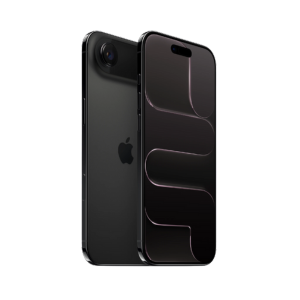
iPhone Air
The two also use the N1, an Apple-designed wireless networking chip that handles Wi-Fi 7, Bluetooth 6, and Thread. The chip is said to improve the reliability of features such as Personal Hotspot and AirDrop.
There is still NFC across both models, including Ultra Wideband Gen 2, and both Emergency SOS via Satellite and Roadside Assistance via Satellite.
Physical connectivity does differ here, despite both using USB-C ports. The iPhone 17 Pro can operate at USB 3 speeds, but the iPhone Air's version supports USB 2.
The reality is that it will be much slower to download videos or transfer files over a cable using the iPhone Air than the iPhone 17 Pro. Again, this is more a problem that affects people who tend to do large transfers, meaning videographers.
iPhone Air vs iPhone 17 Pro - Power and Battery
The physically different bodies mean that Apple has to handle the battery in each smartphone quite differently. There's a little bit more nuance than usual here.
They both use rechargeable lithium-ion batteries, complete with support for MagSafe, Qi2, and Qi wireless charging.
However, when it comes to capacity, the iPhone Air's slim frame limits how far it can go. Apple claims it can handle up to 27 hours of video playback, or up to 22 hours if it's streamed.

iPhone Air vs iPhone 17 Pro: The MagSafe power pack is back, but only for the iPhone Air
For comparison, the iPhone 17 Pro can go up to 33 hours for video playback, and up to 30 hours streamed.
The nuance here is that Apple has also introduced a new iPhone Air MagSafe Battery. A revival of a concept that sticks an extra battery on the back of the iPhone Air, albeit in a design that prevents it from being used by other models.
With that battery, the iPhone Air can get to 40 hours for video playback and 35 hours of streaming.
Of course, this is not much different from attaching other MagSafe or USB-C battery packs and power banks on the market to the iPhone. But it is unusual since this is something designed with the iPhone Air in mind.
Fast-charging is available over USB-C or MagSafe, with Apple saying the iPhone Air can get to 50% charge in 30 minutes. That is, if you're using a 20W adapter on USB-C or a 30W adapter with a MagSafe charger.
For the iPhone 17 Pro, it too manages a 50% charge in 30 minutes using a 30W charger with MagSafe. However, it shrinks to a 50% charge in 20 minutes on USB-C.
This speed increase is in part due to Apple listing the feat as being with a 40W adapter. If the same 20W adapter were used for the iPhone 17 Pro over USB-C, it would take longer.
iPhone Air vs iPhone 17 Pro - Other Features
Both models are rated at IP68 for dust and water resistance, meaning they can survive underwater for up to half an hour at a depth of up to 6 meters (19.7 feet.)
Crash Detection is a function that both smartphones have, which automatically calls for assistance if you're involved in a serious incident.
Both models have an Action Button as well as Camera Control on the sides.
iPhone Air vs iPhone 17 Pro - Capacity, Color, and Pricing
The iPhone 17 Pro starts from $1,099 for the 256GB-capacity model, rising to $1,299 for 512GB and $1,499 for 1TB of storage. While the Pro Max model has a 2TB capacity, that isn't available in the smaller variant.
The iPhone 17 Air is $999 with a 256GB capacity, with the 512GB model priced at $1,199, and the 1TB at $1,399.
When it comes to color choices, the iPhone 17 Pro ships in the highlight Cosmic Orange as well as Deep Blue and Silver. The iPhone Air has four options: Sky Blue, Light Gold, Cloud White, and Space Black.
iPhone Air vs iPhone 17 Pro - Which to get?
The iPhone Air is a brand new option for consumers that moves away from the usual format for something different. It's a model where appearances matter, hence the ultra-thin construction.
Doing so has its trade-offs, because Apple is still bound by the laws of physics and can only put so much into a tight space. The iPhone Air is much tighter than usual.
That said, it is still trying to make this smartphone a premium departure from the norm.
The screen is still Pro-worthy despite being a non-Pro device. The A19 Pro may be kneecapped by lacking vapor-chamber cooling and one less GPU core, but it's still going to be more than enough for most users.
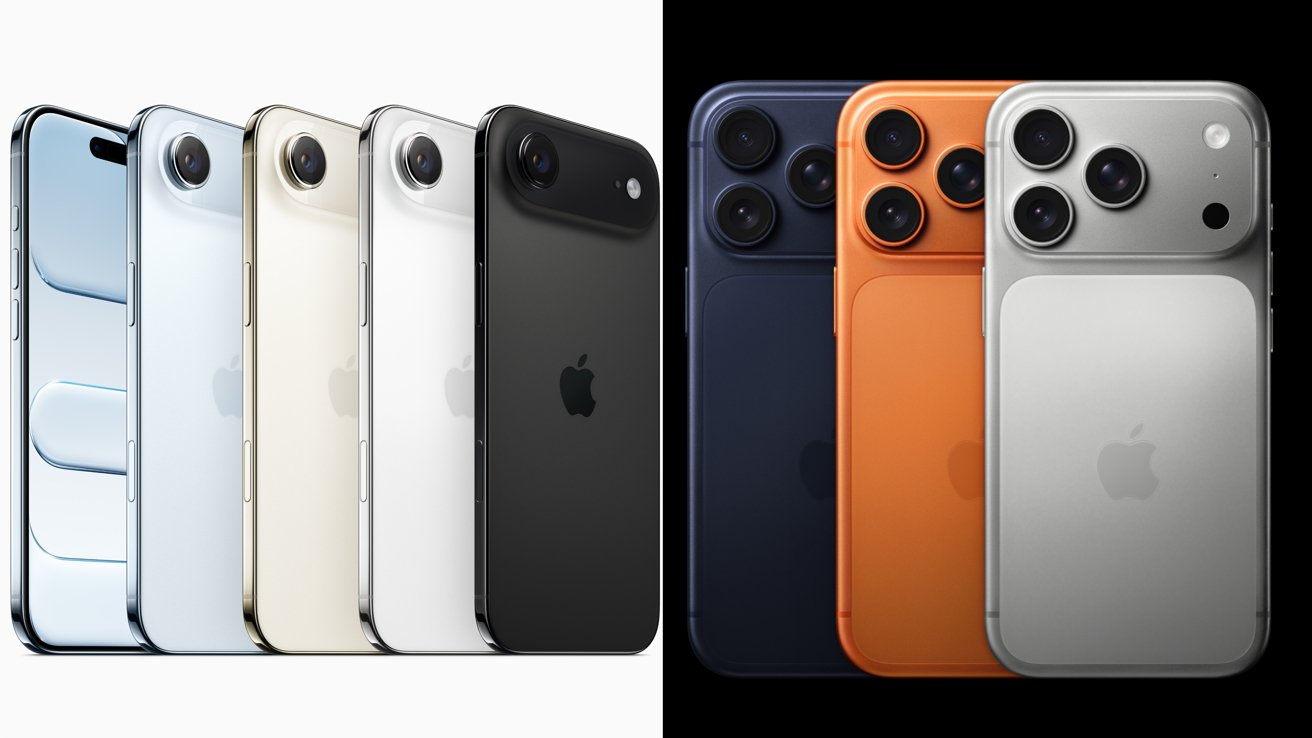
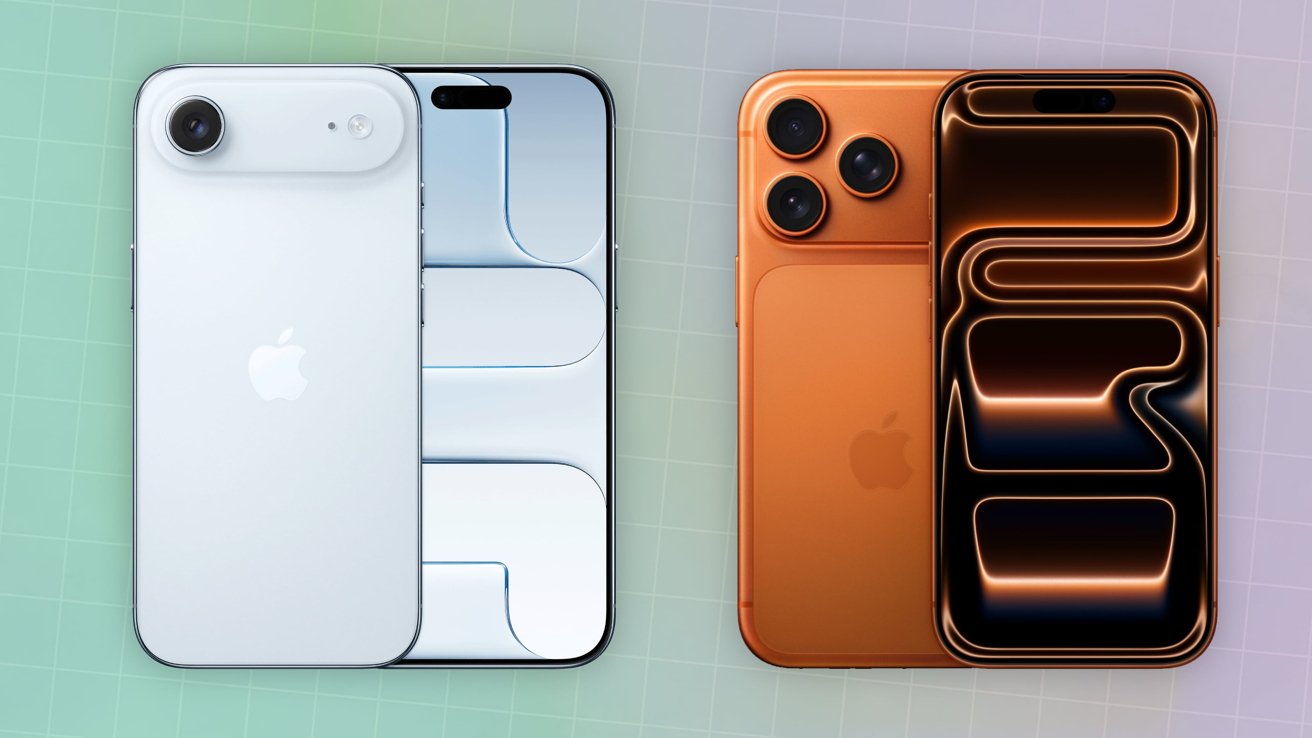
iPhone Air vs iPhone 17 Pro: All of the colorways for 2025
The single camera on the back is the biggest difference, and probably the biggest reason people could go for the iPhone 17 Pro instead of the iPhone Air. If photography or videography is a big part of your life, those cameras are non-negotiable.
Price-wise, there's only a $100 difference between the models, which is negligible at this level.
Ultimately, the decision comes down to whether you want the styling and bragging rights of the iPhone Air or the performance and utility of the iPhone 17 Pro.
For this writer, the Pro is probably the more sensible option of the two.
Where to buy Apple's iPhone Air vs iPhone 17 Pro
Both the iPhone Air and the iPhone 17 Pro are available to purchase at wireless carriers, with iPhone deals in effect that offer up to $1,100 in bill credits.