Never miss an update Follow AppleInsider
Friday, December 21, 2012, 08:39 am
AT&T rolls out 4G LTE network in 15 new US markets
AT&T this week announced that its high-speed 4G LTE network compatible with Apple's latest iPhone 5, iPad and iPad mini has launched in 15 new markets, and also expanded coverage in a handful of other locations.A total of 10 new locations with 4G LTE reception were announced by AT&T on Friday. They are:
- Boise, Idaho
- Boulder, Colo.
- Bowling Green, Ky.
- Harrisburg, Pa.
- Hartford, Conn.
- Lancaster, Pa.
- Lexington, Ken.
- New Haven, Conn.
- Ogden, Utah
- Providence, R.I.
Those 10 are joined by five other markets that AT&T announced have LTE connectivity on Tuesday of this week:
- Green Bay, Wis.
- Melbourne, Fla.
- Oxford, Miss.
- Springfield, Mass.
- Tucson, Ariz.
Finally, AT&T also announced this week that its existing 4G LTE network has expanded in a handful of markets. They are:
- Middlesex County, N.J.
- Phoenix, Ariz.
- Salt Lake City, Utah
- Los Angeles, Calif.

The latest expansions are the most significant update to AT&T's network since mid-November, when the company's 4G LTE coverage was extended to 24 new markets, including Denver, Colo., and Columbus, Ohio.
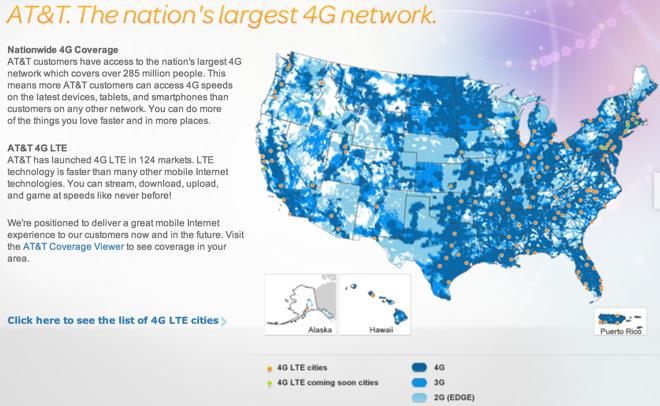
In all, AT&T's 4G LTE network has been launched in 124 markets. The company plans to reach 250 million people by the end of 2013, and 300 million by the end of 2014.

Today's' Headlines
-
No news headlines yet today
On Topic: iPhone
- High resolution images claim to show 'iPhone 5S' and iPhone 5 display assemblies side-by-side
- Briefly: Sprint LTE service expands to 22 more areas
- Inside iOS 7: Apple's Weather app gets animated
- Case intended for Apple's low-cost iPhone shows thicker, rounded design
- AT&T starts nationwide FaceTime over cellular rollout
Related Articles
Previous Comments View All
How about publishing an interactive map that can be used on desktop/laptop computer that is more than 3" across? or do they want it to be difficult to use? I can see how that might be designed to be viewed on a portable device - but guess what there are still screens in use that are bigger than 3.5, 4.0, 4.x, etc. Drives me nuts when I have 15 million pixels on my desk and can only use a few hundred thousand at a time to view content.

It still baffles me that AT&T's approach was, "Hey, we are not as far along as Verizon on LTE roll out. Verizon is calling that 4G. Let's make our customers out to be suckers and rebrand our HSPA as 4G. Then we instantly have "the largest 4G network!""
Doesn't baffle me: it was the right tactic for the situation.
It's just a few steps down the Staircase Of Deplorability from what Samsung did to Apple, but they're both heading to the same room.
It still baffles me that AT&T's approach was, "Hey, we are not as far along as Verizon on LTE roll out. Verizon is calling that 4G. Let's make our customers out to be suckers and rebrand our HSPA as 4G. Then we instantly have "the largest 4G network!""
That isn't what they did. T-Mobile USA started calling their HSPA+ '4G' a couple yeas ago. Initially AT&T said that wasn't fair but they couldn't do anything about it because there is no organization that decides where '3G' ends and '4G' starts for mobile network operators. It's just a cardinal number with a letter appended to it. The iPhone 4 is '4G' as in the 4th generation iPhone, it doesn't mean it has '4G' cellular components*.
So you have T-Mobile USA advertising as such so AT&T jumped on board. And it makes sense. Saying that you have to wait for LTE for '4G' is ridiculous. Using 3GPP and 3GPP2 standards the slowest theoretical maximum speed of a '3G' is CDMA2000 1X with a whopping speed of 153 Kbit/s. If we compare that to the old ITU definition of '3G' you find that HSPA+ has a current theoretical maximum speed of 168 Mbit/s (172,032 Kbit/s) and LTE has 299.6 Mbit/s (306,790 Kbit/s).
That's a performance increase of 112,439% for HSPA+ and 200,516% for LTE that we are told all belong in the same generational category as a marketing term presented to the average consumer. What makes this even worse is that HSPA+ had download speeds just as fast as LTE (and in some cases much faster) but we calling them '3G' while calling the slower tech '4G' simply because a part of the underlying tech that the customer won't ever understand has potential several years from now from exceeding the '3G's underlying tech. Does that really make sense to have such a huge divide between generations for a customer-facing designation?
Customers don't care about what underlying air interfaces and channel access methods these technologies use; they only care about what offers more or less performance. The variance to far too large to be useful. While things might get better as we move into more LTE connected devices and the disparity in performance differences between LTE networks and devices grow we're still going to be faced with the same issue of the device either saying LTE or 4G.
Bottom line, telling a customer that something with a potential for 337.5 Mbit/s '3G' whilst calling something that can barely get 2Mbit/s '4G' is stupid. My solution for marketing that the average customer could understand would be to start with a base-level theoretical maximum speed that uses the small common factor between the tower and handset. For example, let's refer to 10 Mbit/s as 1x. For 14.4 Mbit/s HSPA+ the handset would show 1.4x, for 21.1Mbit/s HSPA+ it would round to 2x, for 42Mit/s DC-HSDPA it would show 4x, and for 100Mbit/s LTE it would show 10x, etc. All you have to know is if a number is higher or lower than another.
* We're also on the 3rd gen LTE chips and 2nd gen Qualcomm Gobi LTE chips.
I've seen my iPhone 5 show LTE and depending on where I am, the speed still varies. The same with AT&T's changing to only showing 4G on an iPhone 5. You never know how fast the connection will be. I presume this is the same with Verizon. What I have noticed, however, is that using LTE in most cities I've seen it is way faster than any "free" WiFi connection. Their idea of high-speed wireless is not my idea. I bet they're only providing the slowest DSL connection (including at airports). Of course, my town will not have LTE for a long time, maybe never, but I at least get to enjoy it when I travel.
I can't complain. I regularly get 32 Mbps in Greenville, SC. I have seen reports of speeds as high as 54 Mbps.
What I have noticed, however, is that using LTE in most cities I've seen it is way faster than any "free" WiFi connection. Their idea of high-speed wireless is not my idea. I bet they're only providing the slowest DSL connection (including at airports).
Possibly, but I think it's more common if they are just connected through a main network interconnect on a separate VLAN with the maximum allowed bandwidth throttled and possibly given a lower QoS for data throughput. This makes it secure and doesn't impede internal operations past a known quantity.
WiFi also doesn't work so well with a lot of connected users. This is why you often see data bursts and why even at home with some many WiFi devices your consumer router might be feels the strain. Most are omni-directional antennas. When a WiFi router is sending you data it's not sending data to anyone else. This means that acts much like token ring where it can only service one device at a time. This means that two active devices on a network are splitting the half, 4 means you're down to 25%, 10 on public WiFi means you getting only 10%. Now the internet speeds should still be the bottleneck in a properly configured hotspot setup but I've seen plenty of public hotspots that use consumer grade routers that simply can't handle the load on the internal HW. I'm not saying that is what is going on, but it should be considered.

Doesn't baffle me: it was the right tactic for the situation.
It's just a few steps down the Staircase Of Deplorability from what Samsung did to Apple, but they're both heading to the same room.
I would expect an Administrator to have a better grasp of the facts and not resort to Fanboi-speak so quickly. SolipsismX is correct, AT&T's hand was forced by T-Mobile using the 4G moniker for their HSPA+ network. Hardly a deplorable move.

SolipsismX is correct, AT&T's hand was forced by T-Mobile using the 4G moniker for their HSPA+ network. Hardly a deplorable move.
Their hand was not forced. They could have easily not done it. Who cares what some other company does? And what you've said simply swaps out one name for another.
Sure, they ultimately had a choice, but why not do it? As previously explained it's not as if calling 42Mbps DC-HSPDA '3G' and calling 10.3Mbps LTE '4G' makes sense for the consumer. Why should T-Mobile USA and Verizon benefit from advertising '4G' when AT&T's speeds were just as fast as T-Mobile USA and faster than Verizon yet get hurt financially from people thinking their network speeds were slower. Over what? There is no moral or ethic issue here.
Latest Apple Headlines
-
High resolution images claim to show 'iPhone 5S' and iPhone 5 display assemblies side-by-side
~43 minutes ago -
Steve Jobs discusses his legacy in rare 1994 video interview
~4 hours ago -
Briefly: Sprint LTE service expands to 22 more areas
~6 hours ago -
Facebook for iOS adds privacy options and status icons in update
~6 hours ago -
Google's Nexus 7 tablets dying early, possibly due to cheap memory
~6 hours ago - more...
| Model | White | Black | |
|---|---|---|---|
| iPad mini (WiFi only) | |||
| 16GB WiFi | $329.00 | $329.00 | |
| 32GB WiFi | $429.00 | $429.00 | |
| 64GB WiFi | $529.00 | $529.00 | |
| iPad mini (WiFi + 4G) | |||
![]() |
|||
| 16GB 4G White | $459.00 | $459.00 | $459.00 |
| 32GB 4G White | $559.00 | $539.99 | $559.00 |
| 64GB 4G White | $659.00 | $659.00 | $629.99 |
| 16GB 4G Black | $459.00 | $459.00 | $459.00 |
| 32GB 4G Black | $559.00 | $539.99 | $539.99 |
| 64GB 4G Black | $659.00 | $659.00 | $629.99 |
Active Forum Topics
-
After crowning Samsung as Apple's heir, analysts now rethinking their math
133
-
Apple issues rare public comment on its 'commitment to customer privacy'
73
-
Editorial: What WWDC 2013 tells us about Apple
44
-
Apple defense to take over in final days of e-book antitrust case
32
-
Purported 'iPhone 5S' logic board has tweaked screw placement, lacks CPU
30
- more...
Lowest Prices Anywhere!
| Model | Price | You Save |
|---|---|---|
| 11"1.3GHz/4GB/128GB | $964.18* | $34.82 |
| 11" 1.3GHz/8GB/128GB | $1,061.18* | $37.82 |
| 11" 1.3GHz/8GB/256GB | $1,255.18* | $43.82 |
| 11"1.7GHz/8GB/128GB | $1,206.68* | $42.32 |
| 11"1.7GHz/8GB/256GB | $1,400.68* | $48.32 |
| 11" 1.7GHz/8GB/512GB | $1,691.68* | $57.32 |
| 13" 1.3GHz/4GB/128GB | $1,061.18* | $37.82 |
| 13" 1.3GHz/4GB/256GB | $1,255.18* | $43.82 |
| 13" 1.3GHz/8GB/256GB | $1,352.18* | $46.82 |
| 13" 1.3GHz/8GB/512GB | $1,643.18* | $46.82 |
| 13" 1.7GHz/8GB/256GB | $1,497.00* | $52.00 |
| 13" 1.7GHz/8GB/512GB | $1,788.68* | $60.32 |
* price with Promo Code:
APPLEINSIDER01
|
||
| Click for even more configurations | ||


Want to write for AppleInsider? Submit your application now!


It still baffles me that AT&T's approach was, "Hey, we are not as far along as Verizon on LTE roll out. Verizon is calling that 4G. Let's make our customers out to be suckers and rebrand our HSPA as 4G. Then we instantly have "the largest 4G network!""