
Apple has always used the tools it has at its disposal to influence EU politics, and it was not afraid to spend a record amount of its cash for lobbying officials in 2025 — but it is not the leader amongst big tech in that regard.
Apple faces a lot of criticism and regulations around the world. Like other companies, it wants to have rules to either work on its behalf or be at least tolerable.
Also like other major organizations, it lobbies lawmakers and officials, all in a bid to massage upcoming laws and regulations more to its liking.
Such lobbying efforts are frequently raised by critics as a way for big tech firms to push for deregulation. In the latest report from campaign groups Corporate Europe Observatory and LobbyControl, Apple's lobbying is part of a much more intensive pattern of influence control in the European Union.
Not just Apple, but Apple is a big part
In October's report, it is revealed that lobbying by the "digital industry" has grown from 131 million euros ($152.4 million) in 2023 to 151 million euros ($175.7 million) in 2025. An increase of 33.6 percent across two years.
Apple is among the top ten digital industry lobbyists in terms of spending in the EU. That group of ten makes up 49 million euros ($57 million) of the annual total.
Apple's contribution to the figure is more modest, but at 7 million euros ($8.1 million) per year, it's in joint second place in the standings alongside Microsoft and Amazon. First place is taken up by Meta with 10 million euros ($11.6 million) of spending, while Qualcomm and Google are in joint fifth with 4.5 million euro ($5.24 million) apiece.
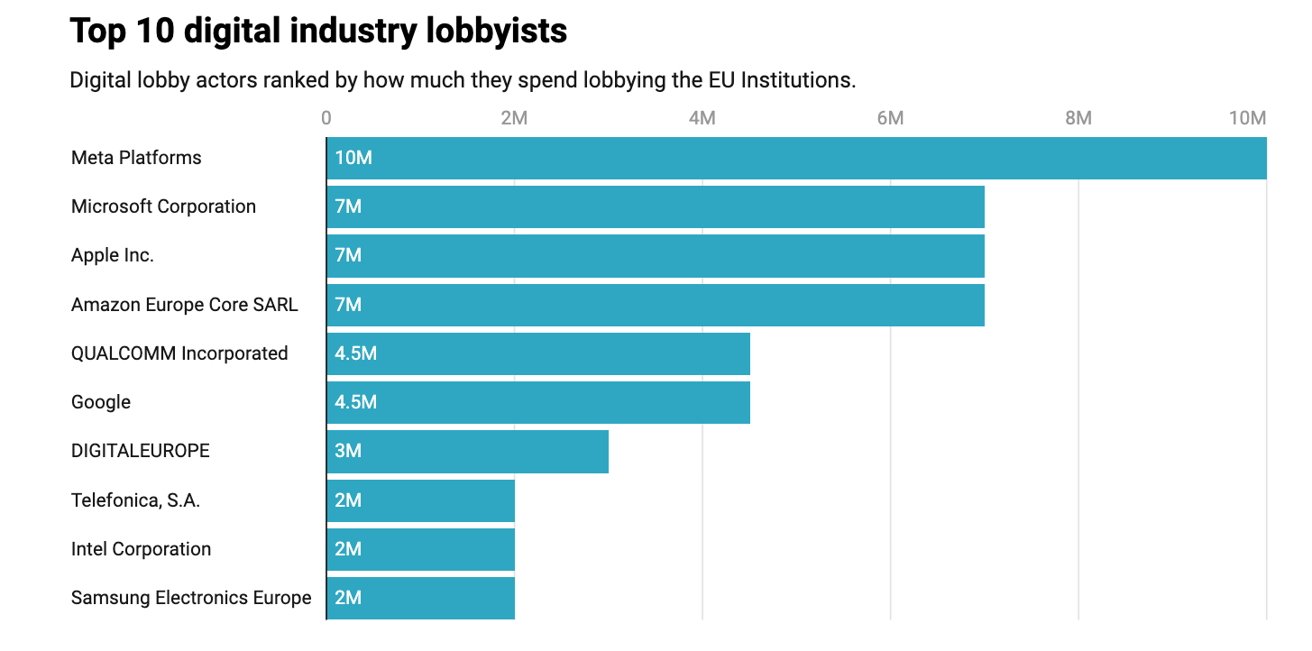
Digital lobbyist spending in the EU - Image Credit: Corporate Europe Observatory and LobbyControl
For reference, a 2021 report on the topic determined Apple's lobbying spend per year was between 3.5 million and 3.75 million euro.
Apple is a high spender, but has only slightly increased what it is spending per year, unlike rivals. Amazon increased its budget by 4.275 million euro ($4.97 million) per year, while Microsoft and Meta both grew their budgets by 2 million euros ($2.3 million) each.
Many meetings
The spending by Apple and other big tech organizations also means the companies can secure meetings with high-level European Commission staff. From a total of 146 meetings between January and June 2025, Apple lobbyists took part in 29 of them.
Amazon had the most at 43, with Microsoft and Google following at 36 and 35 respectively. Meta had 27 meetings.
The topic of conversation by the companies frequently concerned artificial intelligence, with it mentioned in 58 meetings. Data centers and cloud services were talked about in 23 meetings, with the Digital Services Act mentioned in 17 meetings, the Digital Markets Act in 16, and the upcoming Digital Fairness Act in 16.
For the first half of 2025, there were a total of 232 meetings with European Parliament ministers, with Apple included in 47 of them. By contrast, Meta had 63 meetings, Amazon had 49, Google had 47, and Microsoft had 34.
The lobbying has also meant an increase in consultancies to echo its messaging. That total is up to 9 million euros ($10.48 million) per year.
Of that total, Apple's consultancy spending was 2.3 million euros ($2.68 million), behind Amazon's 2.84 million euros ($3.31 million).
Pressure and threats
The lobbying is seen in the report as being a means to strengthen the position of the tech companies monopolies, and as a threat to digital rights. All of this is while the the EU faces criticism from the United States and major organizations over its digital affairs, and interference with US companies.
Some of these pressures are working. For example, President Donald Trump's tariff escapades and the White House's insistence it would not tolerate EU fines against Apple and other firms forced the EU to consider reducing fines against Apple.
The lobbying report claims that, thanks to bouts of deregulation in the EU, big tech firms may see this as an opportunity to cull more rules. Apple certainly has a vested interest for a loosening of the Digital Markets Act restrictions that appear to favor EU companies.
In conclusion, the report insists that the lobbyist spending is a "toxic brew which threatens years of progress" in regulating the influence of big tech firms. It urges the European Commission to continue fighting against the influence, and to strengthen its digital laws instead.