Apple relationship with Intel goes far beyond ads mocking the chipmaker, and a high-profile CPU shift in 2006. Here are all the ups and downs in Apple and Intel's relationship going back over 40 years.
Apple is currently in the middle of its Apple Silicon era, using its own-designed chips in its Mac lineup and other products. Before Apple Silicon, it relied on Intel to provide processors for its Macs.
There's a chance that it could happen again.
That was a relationship that spanned multiple decades, from Apple's 68000-series processor days, through PowerPC, all the way to the release of the first M1 chip under Apple Silicon.
It was one that was profitable for both sides, but also turbulent at times. Ultimately, directly or indirectly, Intel is one of the reasons why Apple's Mac lineup is the powerhouse that it is now in May 2026.
Early fumbles
The Apple-Intel story starts back in 1985. After co-founder Steve Jobs had left the company, there was a proposal to shift Apple away from the Motorola 68000 series, and onto Intel chips.
Apple leadership shot that down. Instead, it was an idea that stuck around in the background, waiting to resurface. The next effort didn't wait 40 years to 2026.
That next time turned out to be just a few years later, in 1992, with the wildly popular release of Microsoft Windows 3.1. The operating system was a serious threat to Apple and Novell, with the latter fearing potential issues with NetWare.
For Apple, Windows served as a different danger. Windows PCs were cheaper for corporate customers and consumers to buy versus Macs. And, a WYSIWYG graphical interface changed everything for users who were still shifting away from Linotype typesetting machines, and typewriters.
Novell's initial response was to modernize Digital Research's GEM, a GUI for the Atari ST, and to make it a rival operating system to Windows. That project was canned due to what they saw as a risk of being sued by Apple.
Darrell Miller, Novell's VP of marketing, then proposed to Apple CEO John Sculley that Mac OS could be ported to work on Intel's chip architecture. Sculley took the bait, since making Apple a software company had the potential to be profitable, especially when turning away from the relatively expensive hardware side.
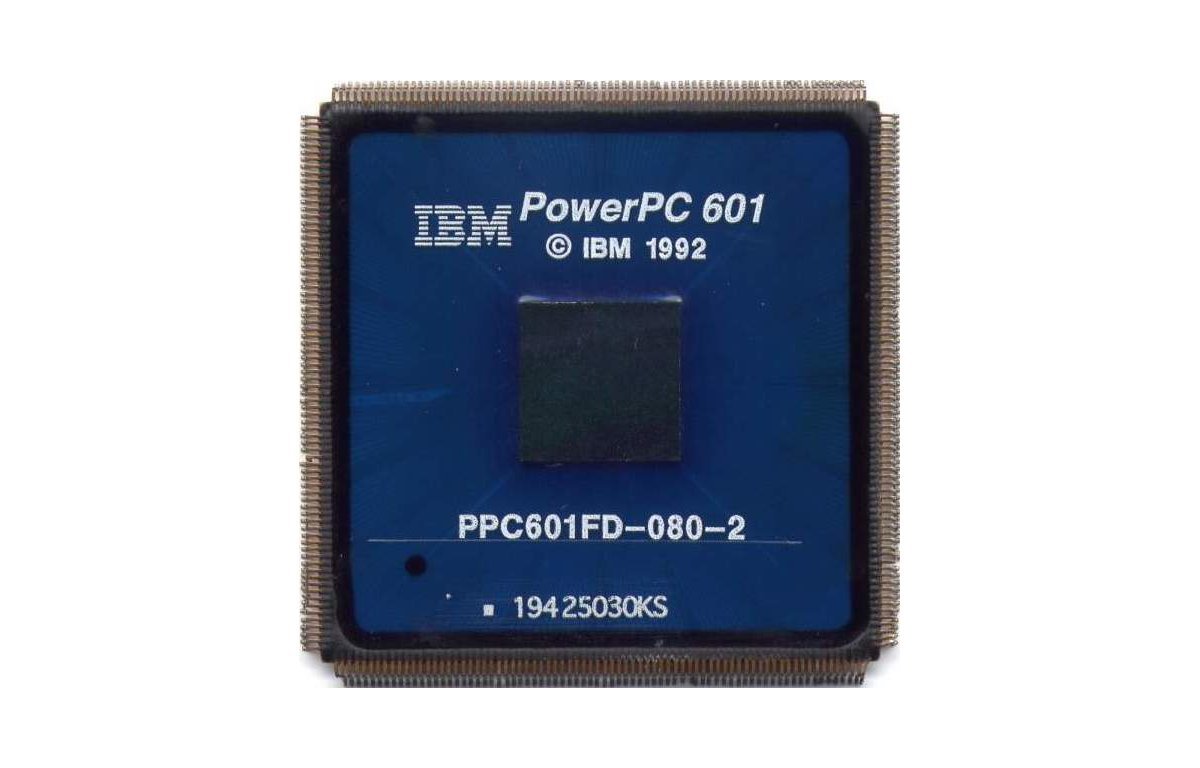
IBM's PowerPC 601 CPU - the first PowerPC CPU used in Macs.
The project started on Valentine's Day, 1992. It was codenamed "Star Trek," with the goal of porting Mac OS to Intel's 486 architecture. Even Intel CEO Andy Grove was interested, since it could cut Microsoft's dominant power in the PC market.
The engineers working on the project had a tough time, since a lot of Mac OS was written in 680x0 assembly code, and had to be rewritten to work on the 486. There was also the problem of Mac OS relying on ROMs for Macs, which were too cost-prohibitive to recreate on PC.
Eventually, this was done by recreating the ROMs in software. They got it to work then, and then dusted off again as part of the 1998 iMac.
For "Star Trek," there was an initial deadline of October 31, 1992, to get the project working as a prototype. They didn't quite make that deadline. By December 1, 1992, the team had completed a functional demo and even ported QuickDraw GX and QuickTime, too.
Despite the seeming success of the team, the project was put on hold. By then, Sculley was out and Michael Spindler was in as CEO, and decided to instead put Apple's resources into System 7.
"Star Trek" worked. Apple execs said no.
The second attempt
The transition picked up again following the acquisition of NeXT by Apple. The 1997 purchase heralded a number of changes at Apple, including the return of Steve Jobs, but also Apple's sudden ownership of the NeXT operating system, NeXTSTEP.
While Apple hadn't ported Mac OS to Intel at the time, it did have NeXTSTEP on hand, which it started to turn into the successor of Mac OS.
At the time, Jobs had pitched PC maker Dell on the concept of making a Dell Intel PC that would run Mac OS. While Dell was receptive to the idea of paying a license fee for every PC sold with the Mac OS, Jobs decided that it would be better to install both Windows and Mac OS everywhere, and for licenses to be bought for every single PC sold by Dell.
Dell declined. This, and killing off clones, prodded Apple into reworking the Mac lineup. This effort culminated in the brightly-colored Mac lineup that launched in 1998.
This didn't stop Apple from continuing to iterate the concept, including talking to Sony in 2001 about its Vaio line.
The work to embrace Intel intensified in 2002. Engineers started working on project "Marklar," to improve the internal Mac OS X builds compatible with X86 architecture.
Bunny People and snails
This was all against the backdrop of Intel intensifying its marketing campaigns against Apple. This included stunts like marketing to Apple users in MacWorld and other publications for years. However, Intel struck gold in 1997 with the Bunny People.
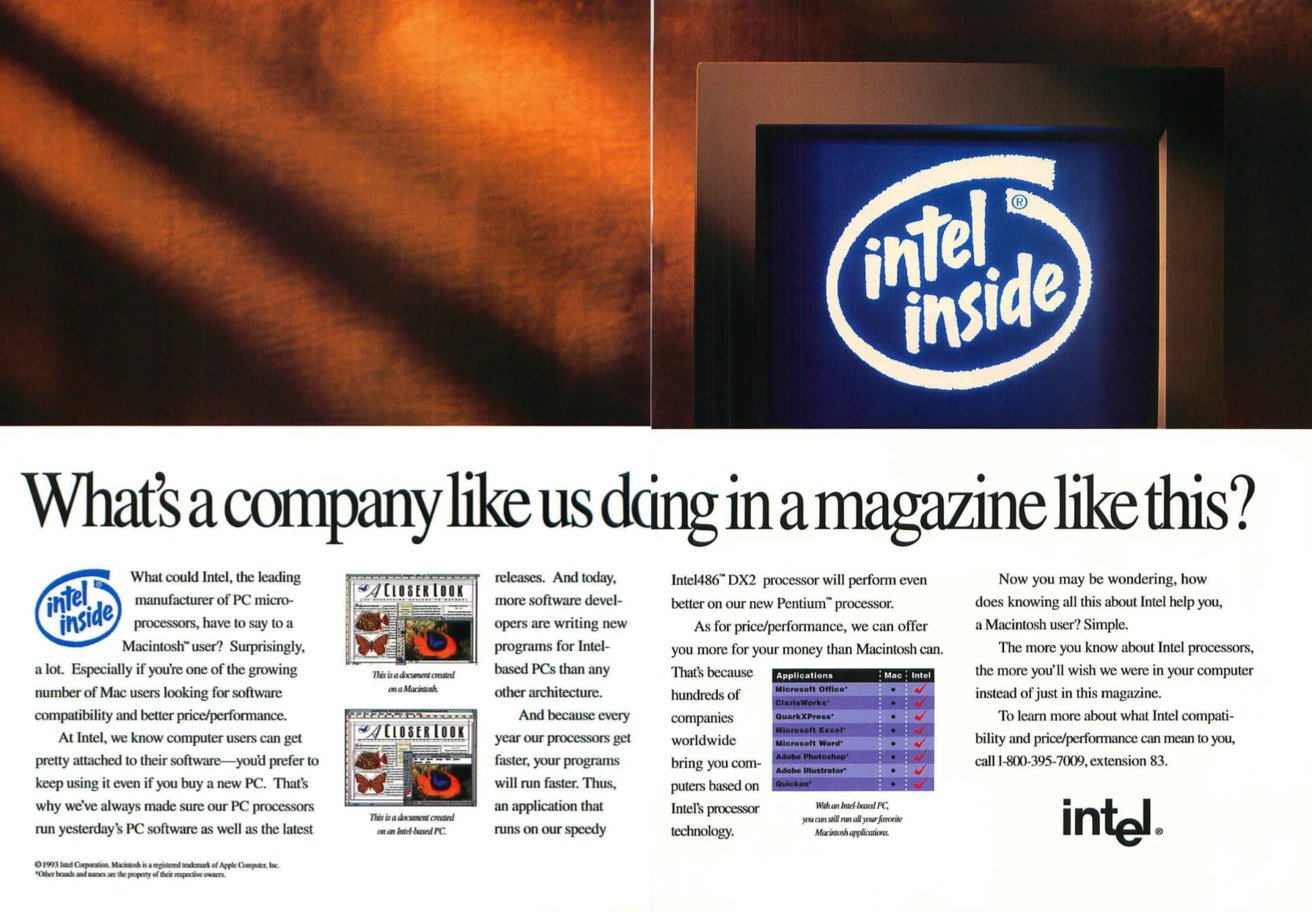
An Intel ad in MacWorld, December 1993
The colorful clean suit-wearers became a major marketing tool for the chip maker for years, thanks to its impactful Super Bowl ad. It led to mountains of ads, showing dancing wafer handlers promoting the Pentium chip range.
Apple took on this advertising juggernaut with its own parody. The "Toasted Bunny" ad from 1998 used a smoldering version of the Intel character, declaring its Power Mac G3 was twice the speed of Intel's Pentium II chip.

This ad aired during ABC's prime time and was made by TBWA Chiat/Day, the same people behind the famous 1984 commercial.
This wasn't the only attempt at attacking Intel's Pentium II launch with retaliatory advertising. A second "Intel Snail" spot also made by TBWA Chiat/Day had, predictably, a snail wearing the Pentium II as a visual representation of how slow the chip was versus the G3.

While Apple took aim with the Bunny People to attack Intel, it wasn't the last time either. Years later, an ad reused them to promote Intel chips in Macs, albeit in a much more serious and less colorful fashion.

Finally, a transition to Intel chips
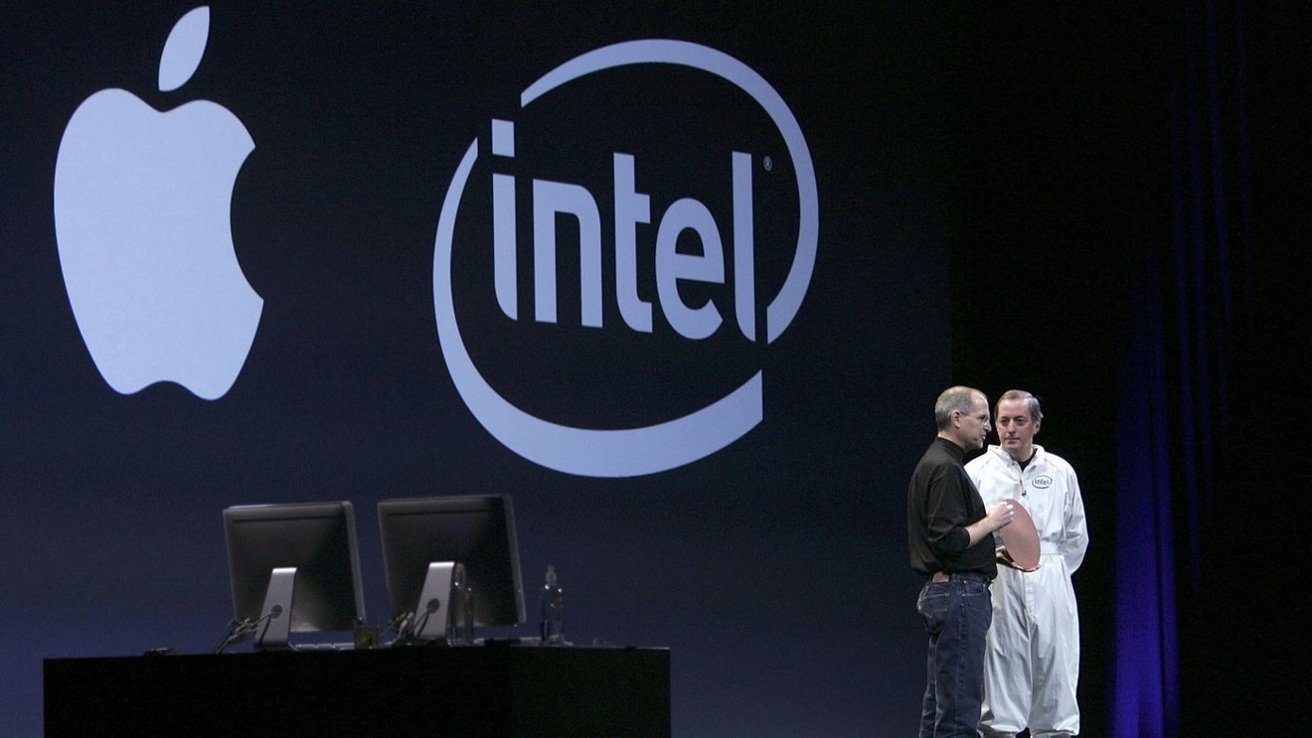
It was around this time that rumors floated about Apple making the transition over to Intel for its own hardware. Apple held off, but eventually made the announcement in June 2005 at WWDC.
In announcing the change, Jobs was clear about reservations he had about PowerPC's pipeline. Instead, he praised the product roadmap Intel had. It was very much a play to try and get the Apple faithful to accept the change, despite Intel's inherent closeness to Microsoft and Windows.
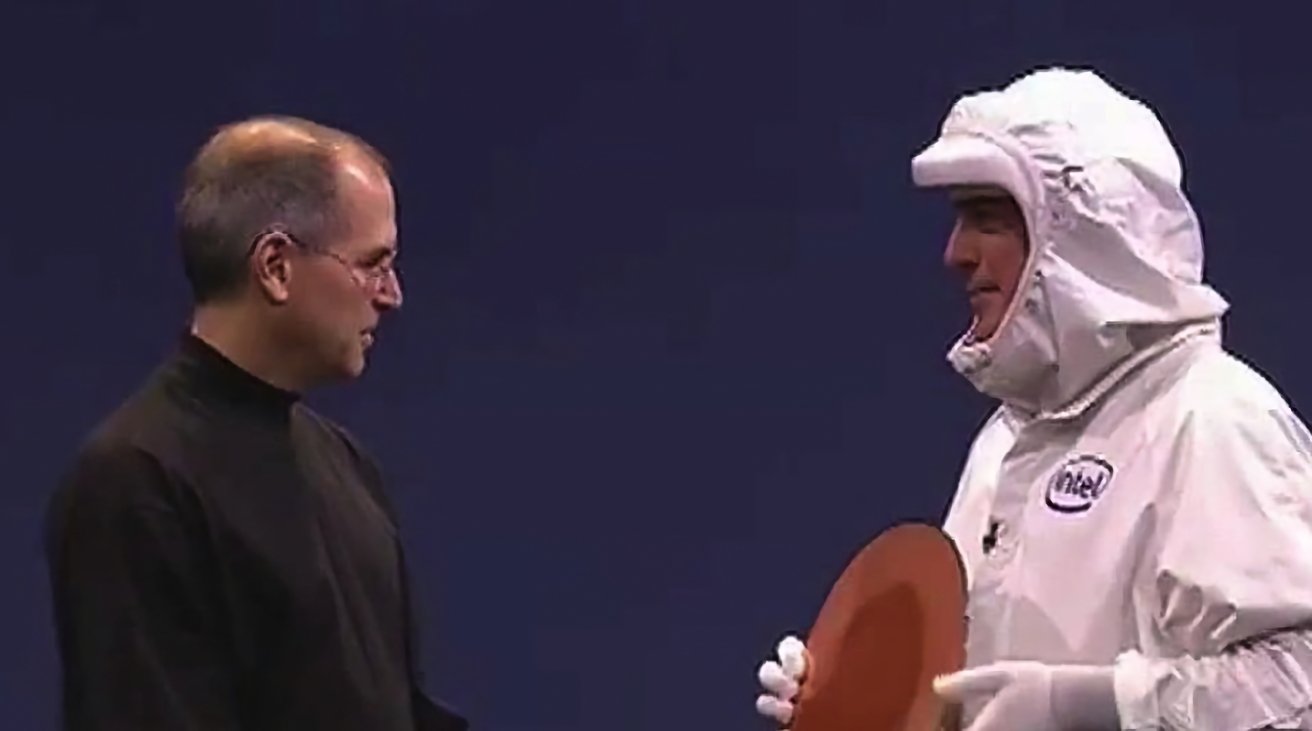
Steve Jobs announcing the Intel switch in 2005
The transition took place over two years, and started with Apple introducing a Developer Transition Kit. This included a prototype Mac with an Intel chip and initial versions of Mac OS X Tiger.
The kit was accompanied in 2005 by Rosetta, a translation tool that could run PowerPC apps on Intel Macs without recompilation. Initially, Rosetta didn't match PowerPC performance, but that only lasted about two years, until Core 2 Duo machines advanced.
There were some issues with the transition. Without delving too deeply into them, there were some Endian issues that caused some early incompatibility issues and some developer workload in porting PowerPC software to the Intel version of macOS. Also, the Core Duo processor was 32-bit, when the G5 was 64-bit until that Core 2 Duo shipped.
Over 2006, Apple rapidly brought out versions of its hardware using Intel chips, including an iMac, 15-inch MacBook Pro, Mac mini, and a 17-inch MacBook Pro.
There was also the April 2006 introduction of Boot Camp, software that allowed owners of Intel Macs to install Windows on their devices.
Despite the speed of the transition, Apple didn't give up on PowerPC for a while. Three years after the end of the transition in 2009, Apple released Mac OS X Snow Leopard, which required an Intel Mac to function.
By the release of Mac OS X Lion in July 2011, Apple removed Rosetta support, forcing current-gen Mac users to fully embrace the architecture.
Turbulence and rumors
In the following years, the Intel-Apple relationship went reasonably well, with Apple regularly including Intel's new chips in its Mac lineup. It was enough to help Intel recover from the dot-com crash and give the chip maker more strength in the market.
It even benefited enough to make a $1.4 billion acquisition of Infineon's wireless division. The deal made Intel a component supplier for the iPhone, though Apple later shifted its baseband supplies to Qualcomm not long after.
It was also around the time when Intel had issues with its Sandy Bridge chips, which also affected shipments to Apple for use in its Mac lineup.
In 2011, the relationship deepened with Apple deciding to adopt Thunderbolt, Intel's cable-based communications technology that boasted massive amounts of bandwidth. That was a connection that Apple has since continued to use in its products.
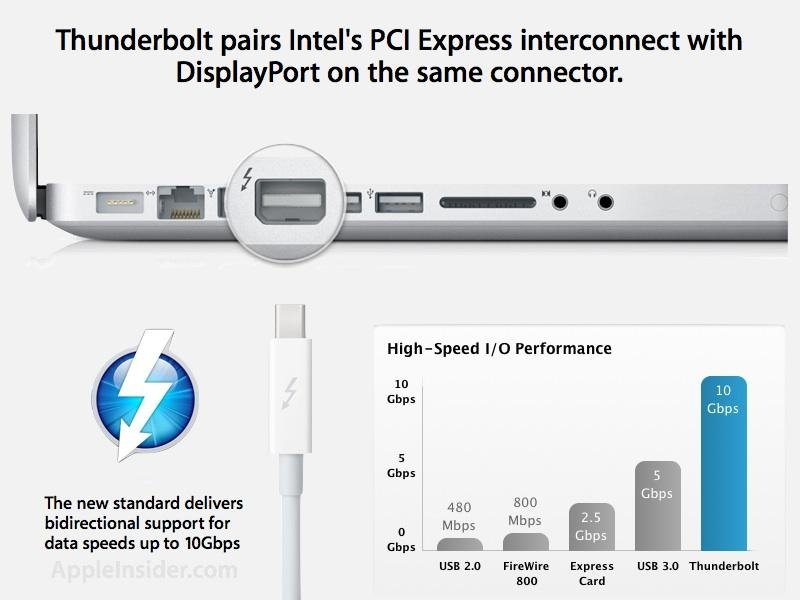
An early promotional image for Thunderbolt
That same year, there were the very first rumors that Apple was considering a move to ARM-based chips instead of using Intel processors. Its mobile A-series chips were impressive enough on iPhone, but it wasn't the time for Apple to switch chip tech again.
This happened around the same time as Apple found the power consumption of Intel's chips to be too much. Apple told Intel that power usage had to be cut, or else Apple would look elsewhere for its chips. And, then there was the massive heat issues, exacerbated by Apple's need for thinner and quieter hardware.
The following year saw Intel field more complaints, including claims from ARM that Intel's Atom chips were underwhelmingfor mobile use.
Early in that year, CEO Tim Cook hinted that Apple wasn't happy with its Intel partnership, and that moving to ARM CPUs on Mac was a possibility. The same chips as used in the iPad and iPhone at the time.
This prompted Intel into declaring it would make mobile chips that Apple simply "can't ignore." It wanted to compete against the A-series chips Apple was using in the iPad, which was rising in popularity at the time.
It wasn't enough to quell the rumors that Apple deliberated moving away from Intel, though. A change was viewed as "inevitable" by analysts, but was still far away from becoming a reality.
As the years rolled on, Intel insisted it was getting closer to Apple and the relationship was positive. It was also pushing to try and gain orders for baseband chips from Apple, but the Qualcomm connection was too great.
By 2015, Ming-Chi Kuo was forecasting Apple could ship A-series Macs within two years. That was a prediction that was a little bit optimistic, and both too early and four years later than the first rumors, but did eventually come true.
Intel CEO Brian Krzanich responded by reiterating the "strong" relationship and that Intel would retain Apple's custom by innovating. All to a backdrop of massive billion-dollar mobile losses on Intel's side, which it hid by changing how it reported its financials.
While the rumors of Apple jumping ship were well-grounded speculation, Intel couldn't cover up a series of problems towards the end of the relationship.
This included switching from its famous tick-tock development strategy to a tick-tock-tock version, optimizing the chip production process so generations could last for longer.
And frankly, tick-tock-tock was optimistic.
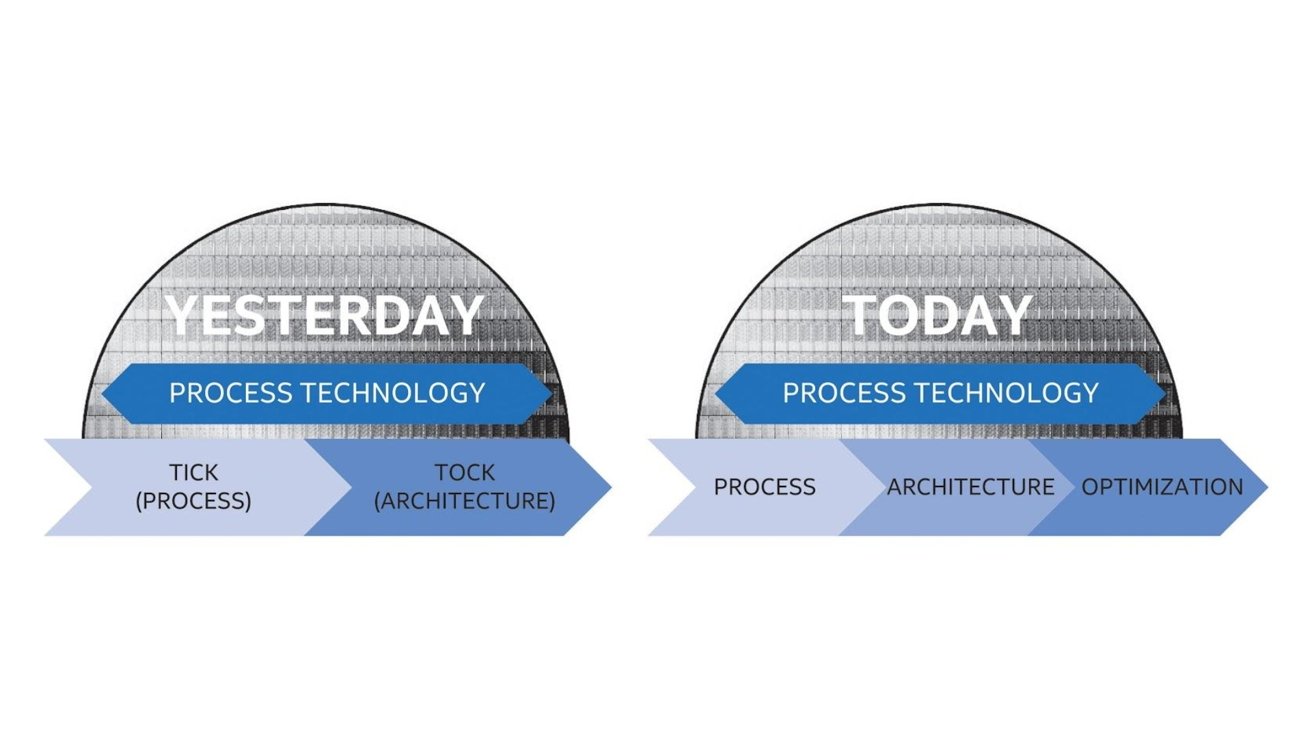
Tick-Tock disappeared in favor of Tick-Tock-Tock for Intel's architectures.
Later on, there was the infamous delays of Cannon Lake, Intel's 10nm generation. This was an issue for Apple, as it harmed its plans to sell a MacBook Pro with 32GB of memory, without needing a dedicated memory controller.
It did eventually ship in 2019.
That was followed by the 2018 chip kernel flaw, which required Apple and others to make an OS-level fix, affecting the performance of all Macs. More flaws were later found, making the situation even worse for Intel.
However, by early 2019, even Intel had admitted that the writing was on the wall. Officials believed that ARM Macs were destined to arrive as soon as 2020, and there was little Intel could do about it.
That year also saw yet another chip vulnerability that Apple had to mitigate, forming another nail in the coffin.
It was also around this time that Apple made a considerable acquisition from Intel. After repeatedly trying to convince Apple to buy its modems for the iPhone, Intel effectively gave up and sold its modem arm to Apple for $1 billion.
The purchase was a massive change for Apple, which has slowly been bringing the design of its important components in-house. The fruits of Apple's labor would take years to emerge.
Apple Silicon and a rumored return
The introduction of Apple Silicon and the two-year transition in WWDC 2020 was not quite the death knell for Intel's work with Apple. While Apple was moving over to Apple Silicon, Intel insisted it would still be friendly to Apple throughout the period.
The actual process of rolling out Apple Silicon closely echoed the introduction of Intel Macs. This included Apple rapidly bringing out models that used its new chips, gradually replacing Intel counterparts on the roster.
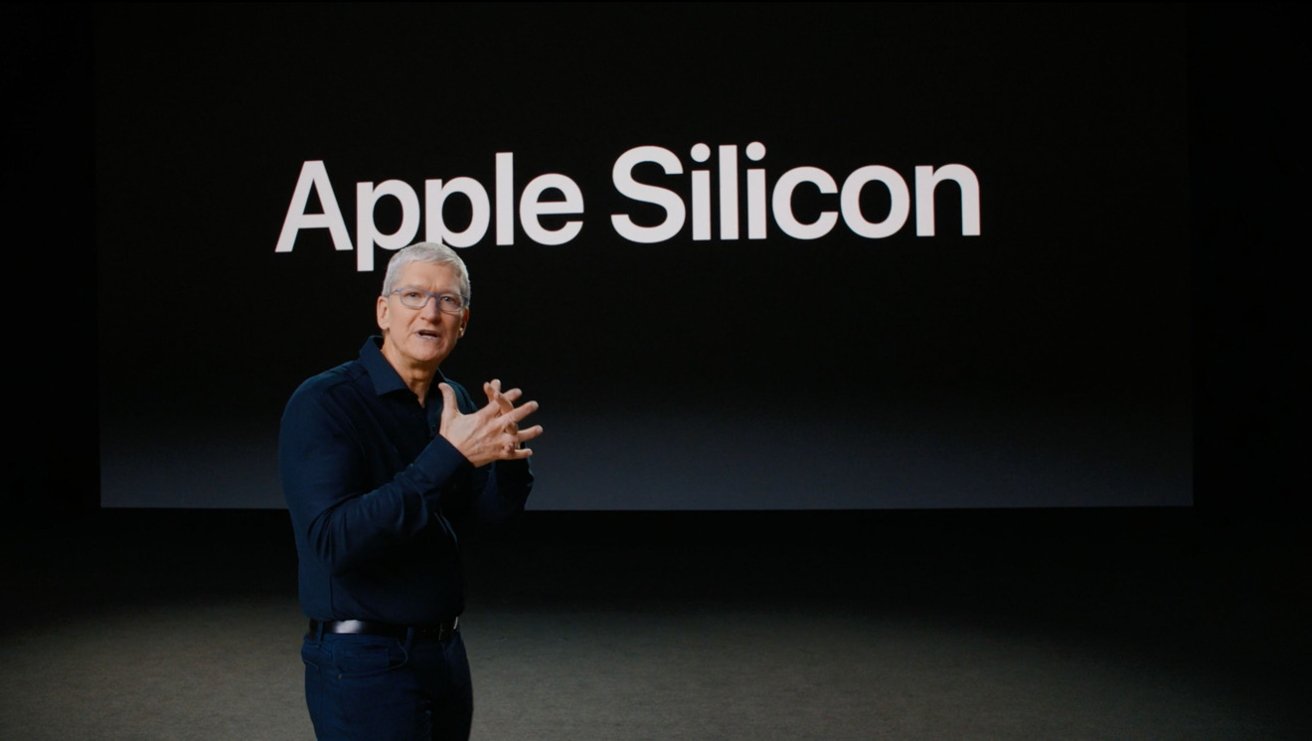
Apple CEO Tim Cook introducing Apple Silicon in WWDC 2020
There was also the Developer Transition Kit that included an A12Z chip inside a Mac mini. There was also Rosetta 2, which was used to allow apps made for Intel Macs to run on Apple Silicon, which will be going away in 2027.
The Mac Pro was the last Intel Mac on the roster, and eventually that left in favor of a short-lived Apple Silicon counterpart.
Losing Apple and changes in the market in general, including Microsoft making noises about making its own chips, forced Intel to consider alternative pathways beyond selling its own chips.
Of course, this introspection wasn't just internal. It also involved public attempts to win back Apple by saying it can do better.
In January 2021, just after the first public Apple Silicon releases, Intel CEO Pat Gelsinger declared to employees that the company had to do better with its own chips than "a lifestyle company in Cupertino."
What followed were attempts to smear the well-received Apple Silicon, including releasing presentation slides with carefully-chosen benchmarks showing that Intel was better in very specific ways.
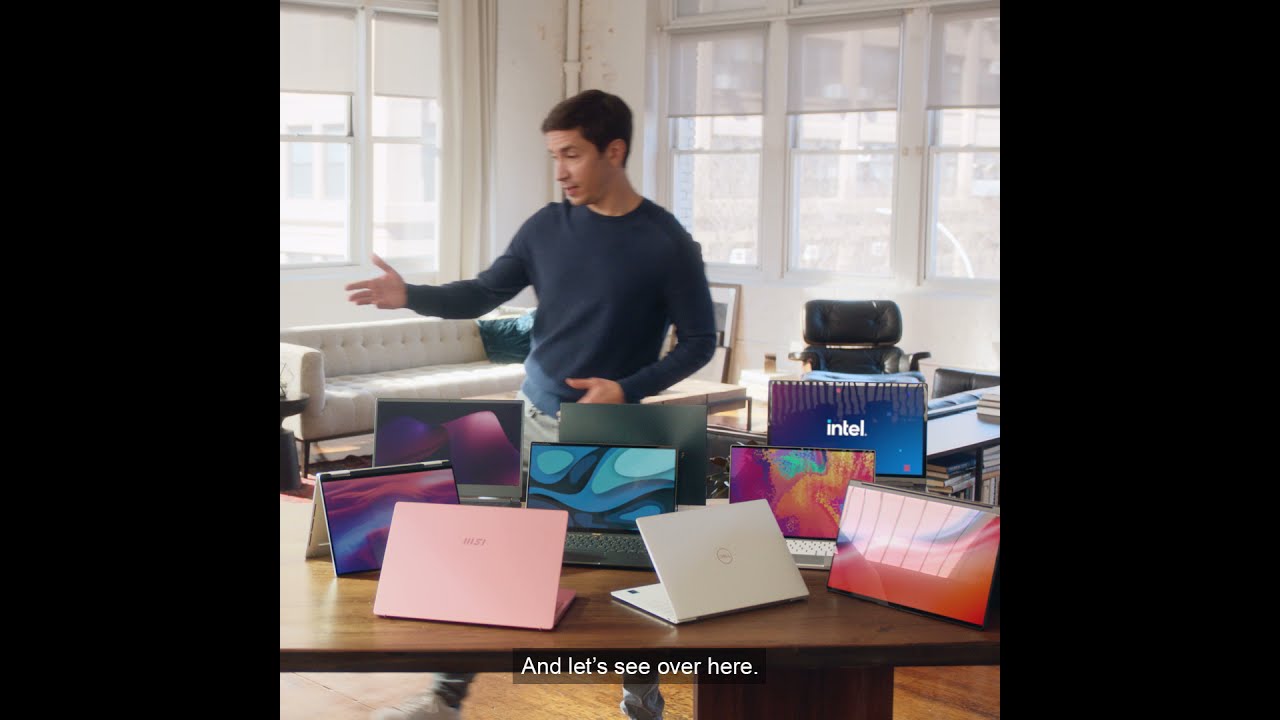
There was also the odd "You're not on a Mac" advertising campaign, which also roped in Justin Long.
Despite the public tantrum, Intel was still working on a way to compete with chip foundry rivals like TSMC, which was Apple's chief partner. Intel created a Foundry Services arm in 2021 to produce chips designed by others, under a $20 billion investment.
This was obviously a play to secure business from Apple. If it can't sell chips of its own design, Intel would instead make what Apple creates.
Intel first got business from Qualcomm and Amazon, which was a healthy start.
Of course, while it was trying to court Apple, Intel couldn't help but to deliver potshots with a weird "social experiment." All while CEO Gelsinger insisted it could win Apple back with a "better chip."
Along with a plan to build a $20 billion chip factory in Ohio, Intel was still so keen to make things for Apple that leadership said it would "never stop trying to get Apple to be a customer again."
By 2025, rumors were circulating that it was actually happening, including murmurs of a joint venture between TSMC and Intel in the United States. Ming-Chi Kuo said Apple would use Intel to make the M7 chip in one late 2025 forecast.
There was even talk of Intel's foundry producing A-series chips for the iPhone, as Apple considered spreading the risk instead of sticking to just TSMC.
This became more of a reality at the start of 2026. The demand for chips by the AI industry meant that foundries like TSMC were fully booked up, limiting the capacity for Apple's chip production runs.
It forced Apple into looking elsewhere, and to seriously consider using Intel's services once again. This time on its own chip designs.
With a greater push for U.S.-based manufacturing, as well as the U.S. government buying a 10% stake in Intel for $9 billion, the terms are more attractive for Apple to take up Intel's offer.
Sure, there's the very real prospect of having Intel-fabricated chips in Macs once again. But for the first time, it certainly won't be using Intel's chip design.