
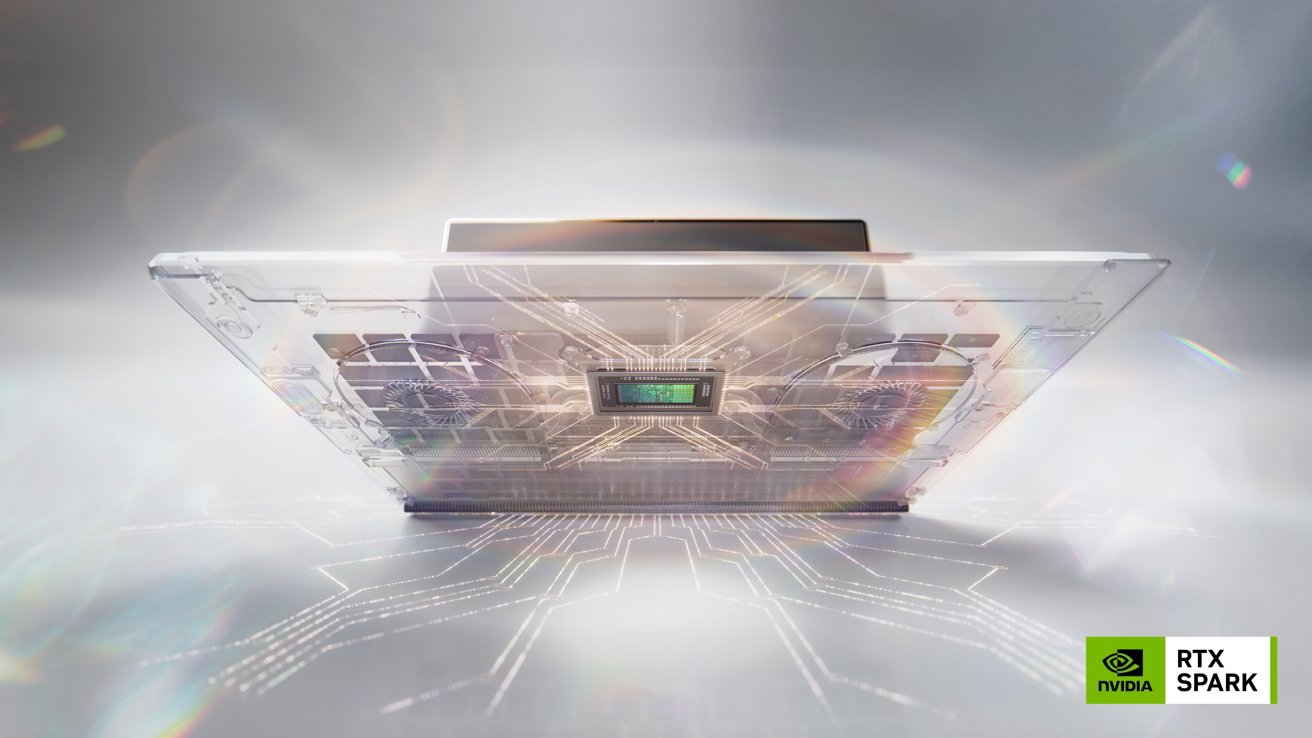
Nvidia has stepped into the processor market with its RTX Spark, but at first glance, it's clearly behind Apple Silicon by a considerable margin.
Computex 2026 is underway, and Nvidia has formally stepped into the processor ring with its own chip. Nvidia calls the RTX Spark a "superchip" for Windows PCs that have massive AI performance.
This chip consists of an ARM-based Nvidia Grace CPU with 20 cores, as well as an Nvidia Blackwell RTX GPU with 6,144 CUDA cores. There's also fifth-generation Tensor cores, up to 128GB of unified memory, and a 600GB/s Nvidia NVLink-C2C interconnect providing high-bandwidth communications between the elements.
According to Nvidia, it is "designed for AI, creating, and gaming," with the intention of it being used to help create slim Windows notebooks with all-day battery life, but massive performance capabilities. This includes rendering massive 90GB 3D scenes for games, generating 4K AI video, and 12K video editing.
More handily for AI researchers, it will also be capable of running a 120 billion-parameter large language model with up to a million tokens of context, using local agents.
"The PC is being reinvented," said Nvidia CEO Jensen Huang, referring to users predominantly launching apps and manually doing work. Instead, RTX Spark is made to enable "local agents, frontier models, creative workflows, RTX games" on a notebook.
"This is the new PC," he declared in a press release. "The personal AI computer."
Apple Silicon-esque
Undoubtedly, this is a big move for Nvidia, and a major chip introduction that can dramatically affect the Windows notebook market in general. However, Nvidia is still working to catch up to Apple.
Nvidia's chip shares many of the same core concepts as Apple Silicon, in that it combines a CPU, GPU, neural processing elements, and high-speed unified memory on a single chip. Viewed from a high level, the architectures follow the same approach.
Evidently, when Apple Silicon stunned the world at its launch, it made an impression on the PC industry.
However, despite Nvidia's bluster about its chip being extremely fast and powerful, it does need to be more directly compared against Apple Silicon to see whether it truly stands up. There's no real official benchmark result from Nvidia to compare against at this time, but there was a pre-release benchmark that's noteworthy.
Posted to Geekbench in June 2025 and subsequently removed, but archived by Wccftech, the listing for the Nvidia N1x is believed to be an early version of the GPU maker's chip.
The version listed includes an ARMv8 chip with 20 cores, a base clock speed of 2.81GHz, and 128GB of unified memory.
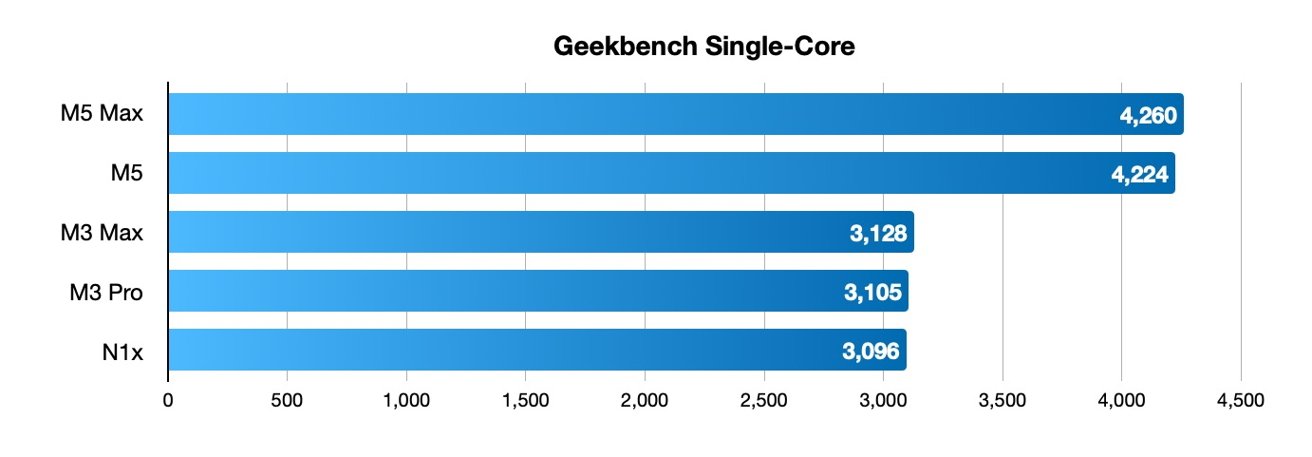
Geekbench single-core score comparison between the unreleased N1x and a selection of Apple Silicon scores
When it comes to performance, the single-core score is listed at 3,096 points, with the multi-core score reaching 18,837.
The immediate comparison made by the publication was to the M3 Max chip in a 16-inch MacBook Pro. On checking Geekbench's listings, the 16-inch MacBook Pro with M3 has a single-core score of 3,128 and a multi-core of 20,969.
For reference, the highest M3 Pro result in a MacBook Pro is 3,105 for the single-core score and 15,255 for the multi-core.
Under the current M5 generation, the 14-inch MacBook Pro with M5 gets a massive 4,224 for the single-core score and 17,465 for the multi-core.
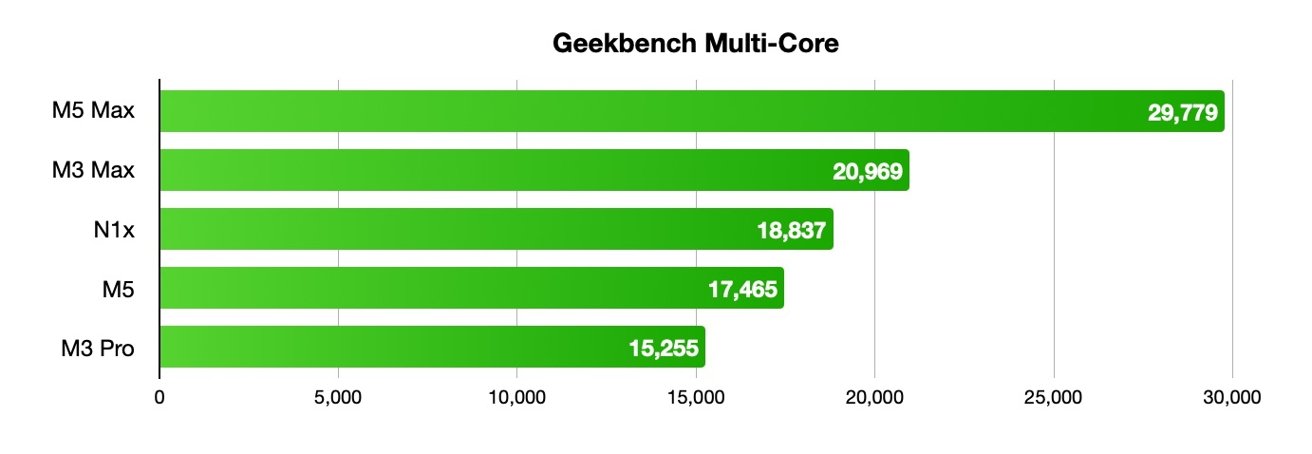
Geekbench multi-core scores compared between N1x results and various Apple Silicon versions.
This doesn't seem massively impressive, until you check the core counts of Apple's chips. The M3 Max in question has 16 cores, the M3 Pro has 12 cores, and even the M5 result involved just 10 cores.
The current Apple Silicon leader, the 18-core M5 Max, is seen setting scores at around 4,200 again for the single-core, but the multi-core is hovering within touching distance of 30,000.
Admittedly the N1x result is a pre-release listing and a year old. It's entirely possible that Nvidia has updated the design, increased the clock speed, and made other changes since that time.
However, with modern manufacturing lead times being extremely long, there probably hasn't been much change since then.
An impressive first try
The main takeaway here is that Nvidia has seen Apple Silicon as a threat, and believes it can do something better for the Windows market.
It probably could. Eventually.
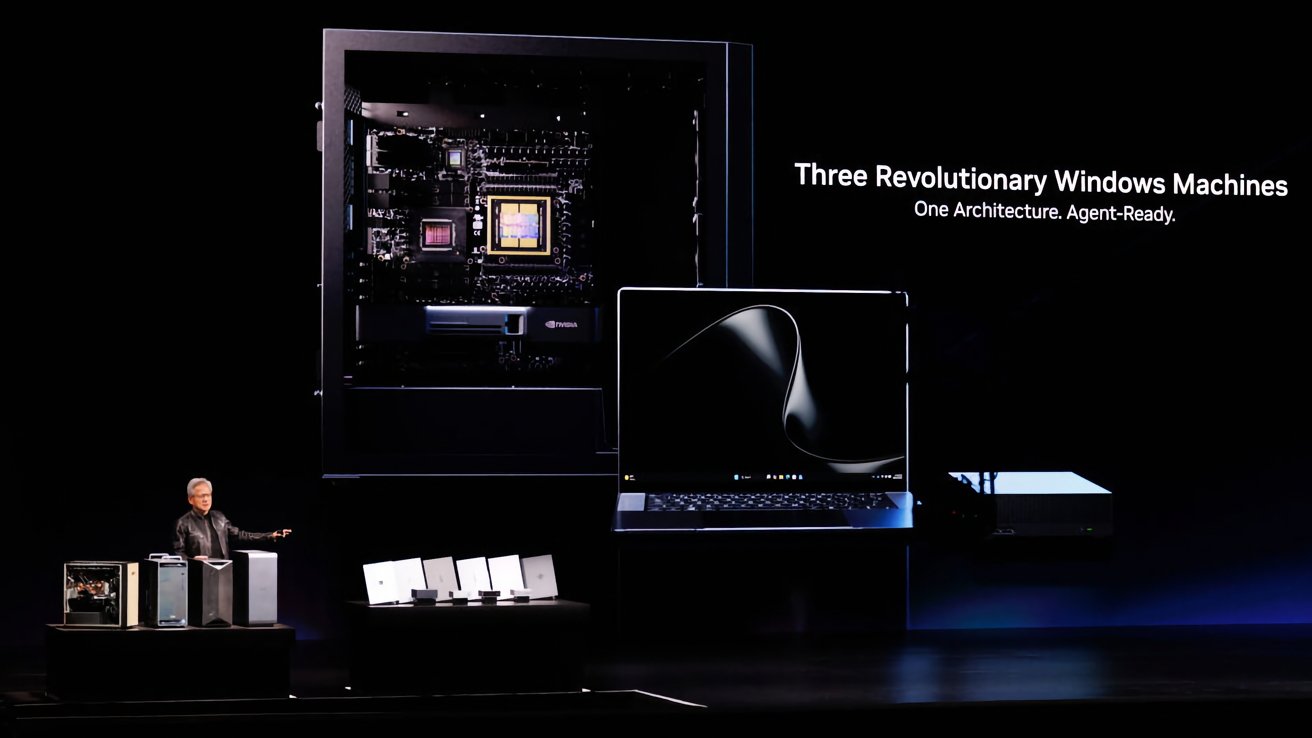
The Computex launch of Nvidia's RTX Spark
If the N1x result actually reflects the capabilities of the first chip, it's a good start for the company's initial release. But that said, it's up against some considerable competition.
As much as Nvidia boasts about the AI capabilities of RTX Spark, Apple's already got a counter for it. Aside from the Neural Engine, the M5 generation has neural accelerators in each GPU core, making it massively more capable of AI tasks.
As it stands, on the CPU front, it is trailing behind a chip from Apple that's more than two years old. Nvidia has some considerable catching up to do.