Apple has been researching how to adjust the Apple Pencil's tip angle, haptic feedback, weight distribution and even stiffness of the Apple Pencil to contextually turn it into the right tool for painting or calligraphy.
It's been over a decade since the Apple Pencil was announced to criticism that it was just an expensive stylus with an over-engineered name — and also praise that it was great. Since then, though, Apple has maybe spent more time developing this stylus than it has the Mac Pro.
So many patents have been filed before, such as having the Apple Pencil detect colors and textures. Or it might gain a see-through Touch Bar, or even be usable as a TV antenna, for some reason.
Now a newly-granted patent shows that Apple has been looking not only at the function of the Apple Pencil, but its feel. The patent, called just "Stylus with adjustable features," is about how the physical design can change — or appear to change.
"The size and/or shape of portions of the stylus (e.g., the tip) can be altered during use thereof to accommodate a user," says the patent. " For example, the size and/or shape of a tip of the stylus can be altered to mimic characteristics of a writing or drawing tool (e.g., pen, pencil, chalk, marker, or paintbrush)."
It is specifically about giving the Apple Pencil a different feel, depending on what it is being used for. So the Apple Pencil could adapt itself to the current task by changing its own characteristics.
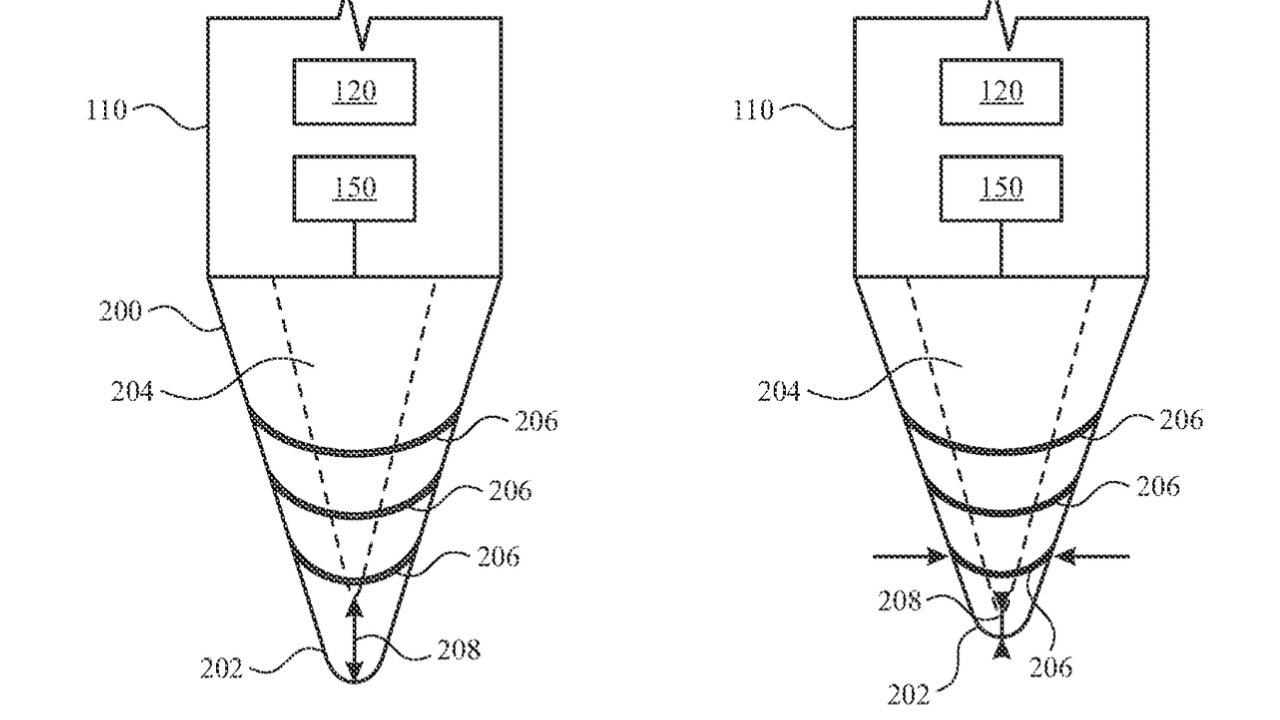
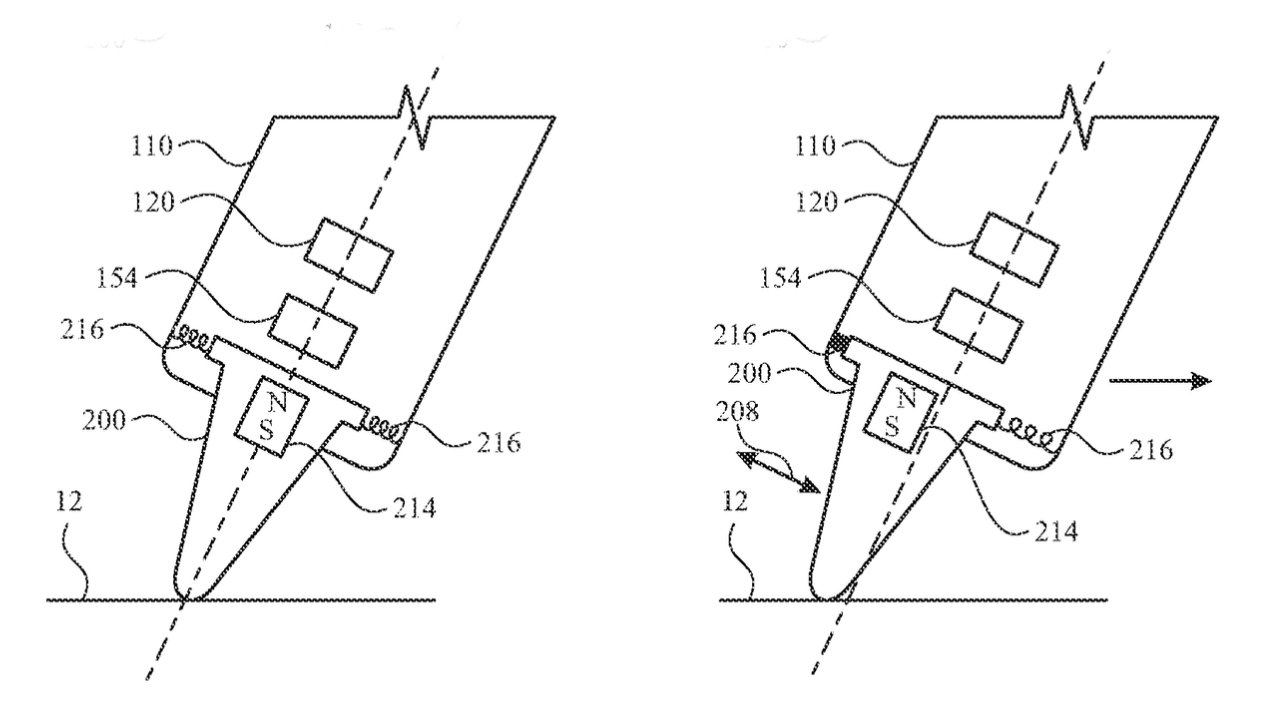
Haptic feedback and electromagnetics could alter the feel of the Apple Pencil on demand — image credit: Apple
"Such characteristics can include shape, stiffness, flexibility, friction, and the like," continues Apple. "Other characteristics, such as multiple bristles, center of gravity, and rotational moment of inertia, can also be modified as desired."
Apple's proposal talks briefly about the Apple Pencil perhaps having a touch-sensitive surface. That would presumably extend the current tap controls to let the user switch between characteristics as they want.
The patent concentrates, though, on the physical changes possible within the Apple Pencil. Some of the drawings show a region similar to the ball in a ball-point pen, but moved to one side to simulate weight.
Apple suggests that the tip of the stylus could further feature "a magnetorheological fluid between the rigid core and the outer body, wherein the magnetorheological fluid is configured to alter its viscosity in response to a magnetic field from [an] electromagnet."
So the physical feel of the Apple Pencil could be changed during use to fit whatever the user needs.
But then the exterior of the Apple Pencil could be made to change, too. The tip of the Apple Pencil "need not take a conical or frustoconical shape in all embodiments," says Apple, and instead could "exhibit a constant or adjustable size and/or shape.
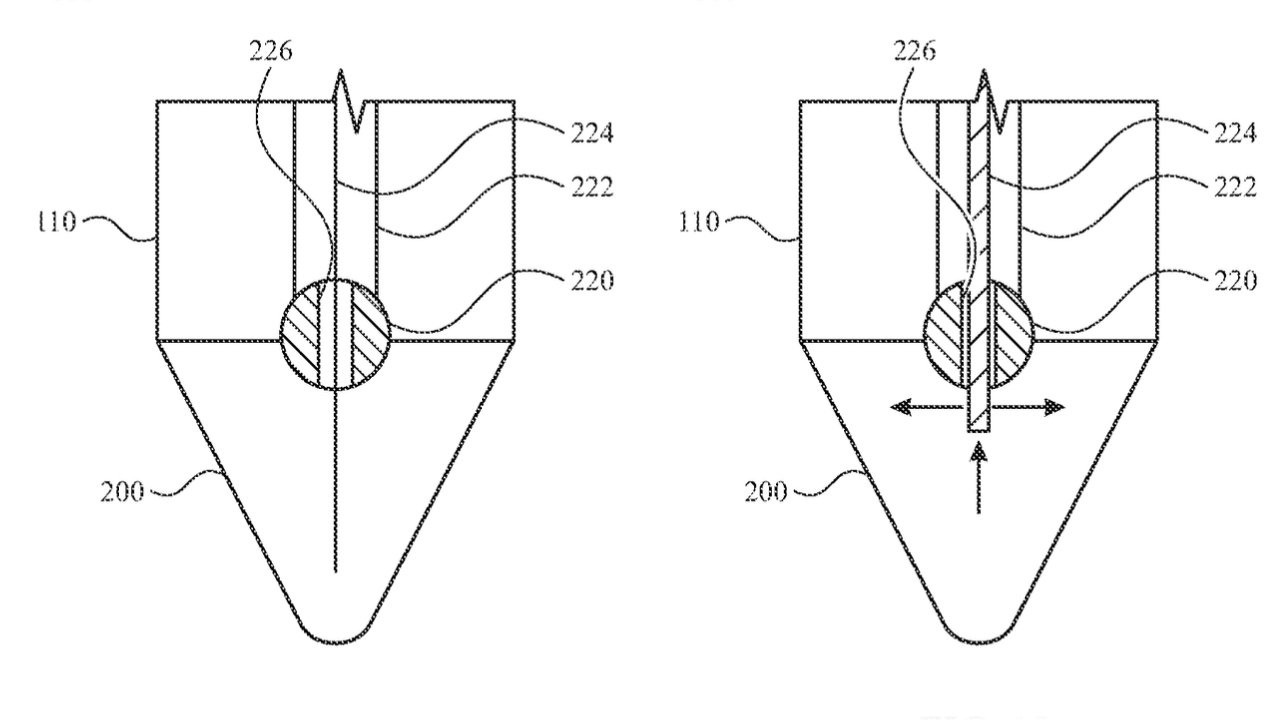
Elements of the Apple Pencil tip could move to alter its center of gravity — image credit: Apple
In all, Apple devotes 31 diagrams and over 16,000 words to the idea. It does cover the body of the Apple Pencil, but most of it concerns the tip — and whether that can even be extended.
Some drawings show a movable tip that spreads out from a single point to two. Others — possibly just illustrative of the feel instead of physical changes — show a brush-hair like attachment to the Apple Pencil.
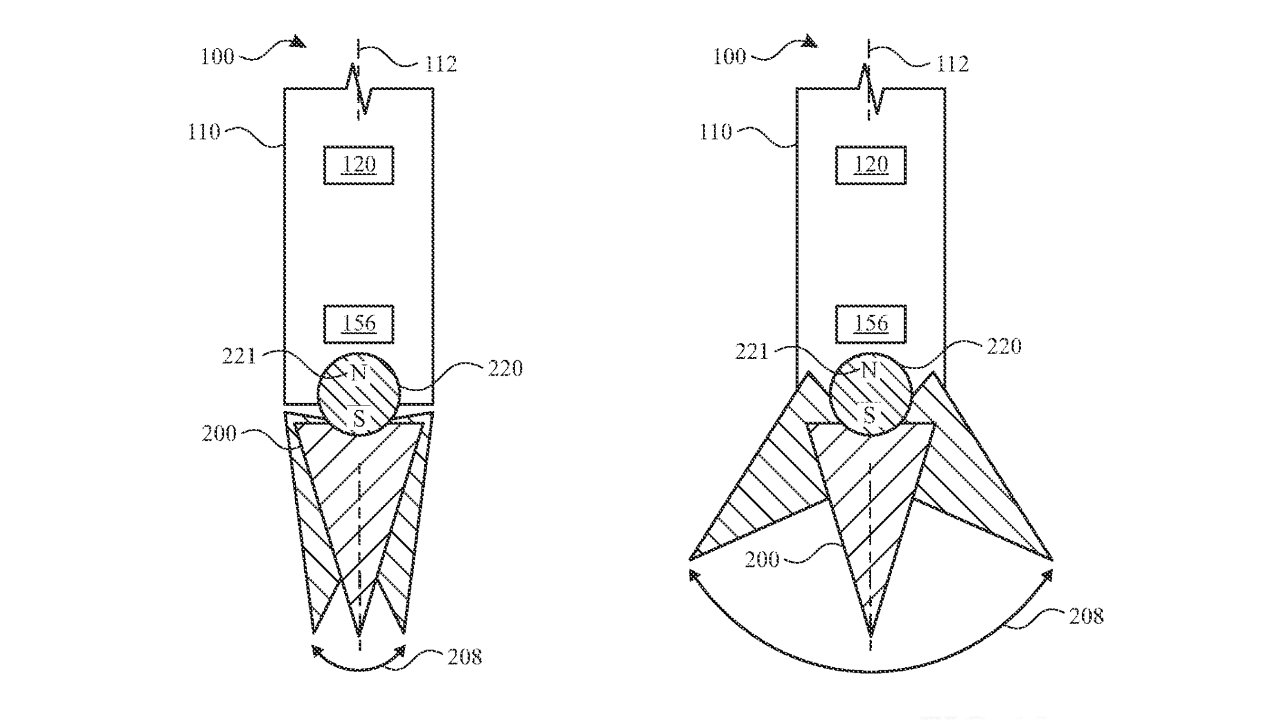
The familiar nib could even split open to better mimic a paintbrush — image credit: Apple
This future Apple Pencil would continue to be as tightly integrated with the iPad it's being used on — or possibly even the iPhone. There are continual references to control surfaces and what the device can be used to write or draw on.
But this appears to be the most extensive research Apple has done into the Apple Pencil as a stylus. If it does implement this idea, it's going to be a radical development of a device that has become such an important part of using the iPad.