
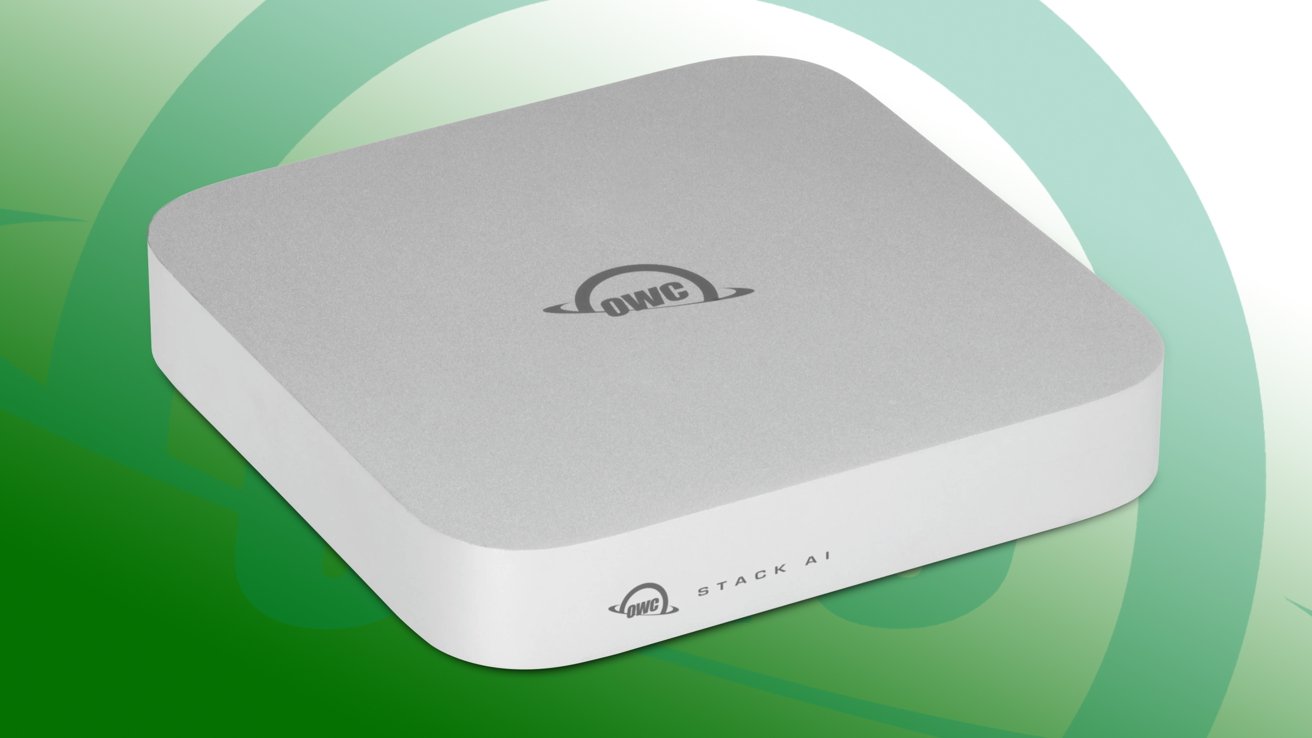
The OWC Stack AI promises to make local processing of large LLMs easier by somehow inflating your Mac's GPU memory across Thunderbolt. We have questions.
The majority of the AI industry consists of the big AI players, including OpenAI, Perplexity, and Anthropic, among others. However, using them can become expensive, especially for people with massive workloads and enterprise clients.
One way to trim the bills is to bring it locally, with AI models being used on a computer instead of a server. The problem there is the expense of the hardware needed for it. And, there are privacy concerns for cloud-based models too.
You can buy a Mac mini and load a model onto it, but you will be hit by a memory limitation. Since the entire model has to be held in memory, the amount installed limits the size of model you can use.
There are workarounds to this limitation, such as projects involving multiple Macs connected over Thunderbolt 5 to share memory and compute performance.
However, OWC thinks it can do something better.
OWC Stack AI's memory boost
The OWC Stack AI, or the Thunderbolt 5 AI Accelerator and Storage Hub, looks pretty much like an old-style Mac mini. It's a nondescript aluminum block that you can stack a Mac Studio on top of, similar to some other docks and hubs.
Connecting to the Mac using Thunderbolt 5, it does provide some storage capacity, but the real benefit is its ability to extend the working GPU memory. In effect, it uses onboard high-speed flash to expand the onboard VRAM of a PC's graphics card, and eventually Apple Silicon too.
With more memory available to use, OWC says that the host computer can handle Large Language Models (LLMs) of a far greater size than the graphics card's VRAM alone.
This is not the same as using an eGPU enclosure with a Mac. From OWC's description, the AI Stack works as an external memory enhancement, not an external processor.
OWC's announcement explains that the Stack AI will support Windows and Linux at first, with Mac support expected at some point in the future.
The company says that Thunderbolt 5 connectivity and its small size means it's a portable and transferrable item. It can be moved between desks with a notebook, or even shared between team members.
When it comes to the AI ecosystem, OWC assures that it will support numerous AI agents and applications, including OpenClaw, at launch.
AppleInsider has asked OWC for more information, including how the Stack AI works, the delay for Mac support, specs, price, and exspecifications and price. This piece will be updated with further information if we get a response.
What OWC has confirmed is that it will be at the Computex Taipei trade show starting on June 2. At that point, more concrete details about the hardware will emerge beyond an early Q4 launch target. Maybe.
Local processing boon
OWC has been light on details about the Stack AI and its price. We see the potential as an extremely useful item for AI research. Certainly, it would be a good tool for businesses, and depending on price, maybe everybody else too in this day-and-age.
The key problem surrounding local AI processing is having enough RAM that can accommodate the models the users want to use. The other is processing the queries, once you have that memory available.
The current cluster-based projects work well, connecting to each other over Thunderbolt to share cores and memory. That is a problem for more cash-strapped users who can't afford the tens of thousands of dollars for high memory Macs.
It is arguable that, with the introduction of the M5 chip, Apple has gone a long way to solve the processing side of things. The Neural Accelerators in each GPU core of an M5 GPU means there's a lot more machine learning processing power available.
This makes it possible for local processing tasks to do a lot more with less. But it only improves the processing itself, not the memory limitations.
You can get an M5 Max 14-inch MacBook Pro with 128GB of memory, but that is a $5,099 purchase with only the necessary upgrades applied. That's a hefty price to get that much memory.
When Apple comes out with the M5 equivalents of Mac mini and Mac Studio, there will be similar high memory capacity options on the table. But again, they will be extremely highly priced given how the industry is headed.
In May 2026, Apple's memory prices are reasonable. It's not clear how long that will last, given the ongoing memory crisis affecting the industry as a whole.
With a product like the Stack AI, there is the potential to buy an M5 Mac with the processing and GPU you want, but not necessarily the memory you need. The Stack AI would handle that bit for you.
This does, however, require OWC to price it at a level that makes sense for consumers to take that road to begin with. OWC is just as price-sensitive to memory as any other company, and that sensitivity will ultimately impact the price the Stack AI sells for.
Update May 28. 10:05 AM ET OWC's founder and CEO Larry O'Connor responded to us overnight. For clarity, we're going to quote Mr. O'Connor directly.
AppleInsider: "Reading the release, it seems like it's a Thunderbolt 5-based way to expand VRAM using flash. Is that right?"
OWC:
"Not exactly. We're not pretending Thunderbolt 5 suddenly turns flash into native GPU RAM because physics still matters and nothing replaces memory sitting directly on the GPU. What OWC Stack AI does is solve the much bigger real-world problem, which is that most existing systems simply hit a wall and cannot run larger AI models locally at all once they exhaust onboard memory resources. Stack AI extends the effective working memory available to the system through ultra-fast Thunderbolt 5 connectivity and high-speed flash, which lets much larger models, longer sessions, and more demanding local AI workflows actually complete instead of crashing, stalling, or falling back to the cloud."
AppleInsider: "Also, I see that there's macOS support intended later. Any reason for that or a timeline?"
OWC:
"As for Mac support, that's absolutely part of the roadmap. Right now the priority is making sure the platform ships stable and delivers the experience we're promising because the AI ecosystem, drivers, frameworks, and model stacks are evolving unbelievably fast. We wanted to focus initial validation around select Windows and Linux systems first, then expand support as the platform matures. We have not announced a specific Mac timeline yet, but it is planned for a future release."