OpenAI is pushing AI beyond chat with the recent release of GPT-5.5, a model designed to complete multi-step work instead of stopping at answers.
The company introduced GPT-5.5 on April 23, a new flagship AI model designed to handle multi-step tasks across software, research, and everyday computer work. It moves toward agentic systems that plan, act, and complete jobs with minimal guidance.
OpenAI claims that GPT-5.5 can handle loosely defined requests by breaking them into steps. It can use tools, verify results, and continue working until the task is complete.
The company rolled GPT-5.5 out across ChatGPT and Codex for Plus, Pro, Business, and Enterprise users, with API access expected later. A higher-accuracy GPT-5.5 Pro tier targets more demanding workloads.
AI models are shifting from answers to completed work
OpenAI points to a range of benchmark results to show how GPT-5.5 improves on earlier models. In coding tests that reflect real development work, GPT-5.5 scores 82.7% compared to 75.1% for GPT-5.4, showing it can complete more tasks from start to finish.
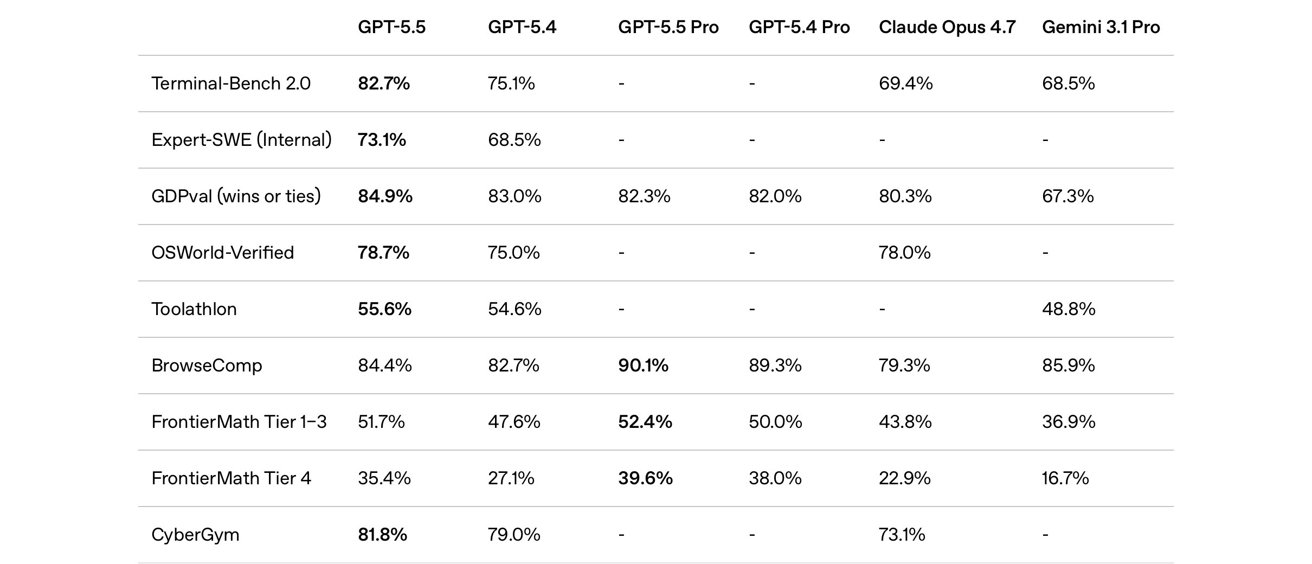
GPT-5.5 scores 82.7% compared to 75.1% for GPT-5.4. Image credit: OpenAI
GPT-5.5 performs better in broader tests, handling complex knowledge work and operating software tools, suggesting reliability across longer, multi-step tasks. The model completes more tasks end-to-end, unlike previous versions that stopped halfway.
OpenAI pairs those changes with improvements in efficiency. GPT-5.5 matches GPT-5.4's response speed while using fewer tokens to complete the same tasks.
Lower token usage reduces back-and-forth and shortens the path to a finished result, which matters for both cost and usability. A model that reaches an answer with fewer steps tends to produce more predictable outcomes.
OpenAI is pushing AI deeper into everyday computer use
OpenAI frames GPT-5.5 as a tool for knowledge work beyond coding. It generates documents, builds spreadsheets, analyzes data, and transitions between apps.
Example of an app coded with ChatGPT/Codex. Image credit: OpenAI
Examples include automating business reporting, processing financial documents, and managing operational requests.
GPT-5.5 can assist in multi-step problem-solving, from information gathering to idea testing and result refinement. While this capability is still in its early stages, it suggests AI could increasingly handle the iterative work of research.
ChatGPT's pricing ranges from a free tier with limited access to higher-end plans starting at $8 per month for Go and $20 per month for Plus. Pro plans start at $100 per month for expanded usage and access to GPT-5.5 Pro.
Business plans cost $20 per user per month. Enterprise pricing is customizable, with higher tiers offering more access, compute, and advanced features like expanded memory, deep research, and agent capabilities.