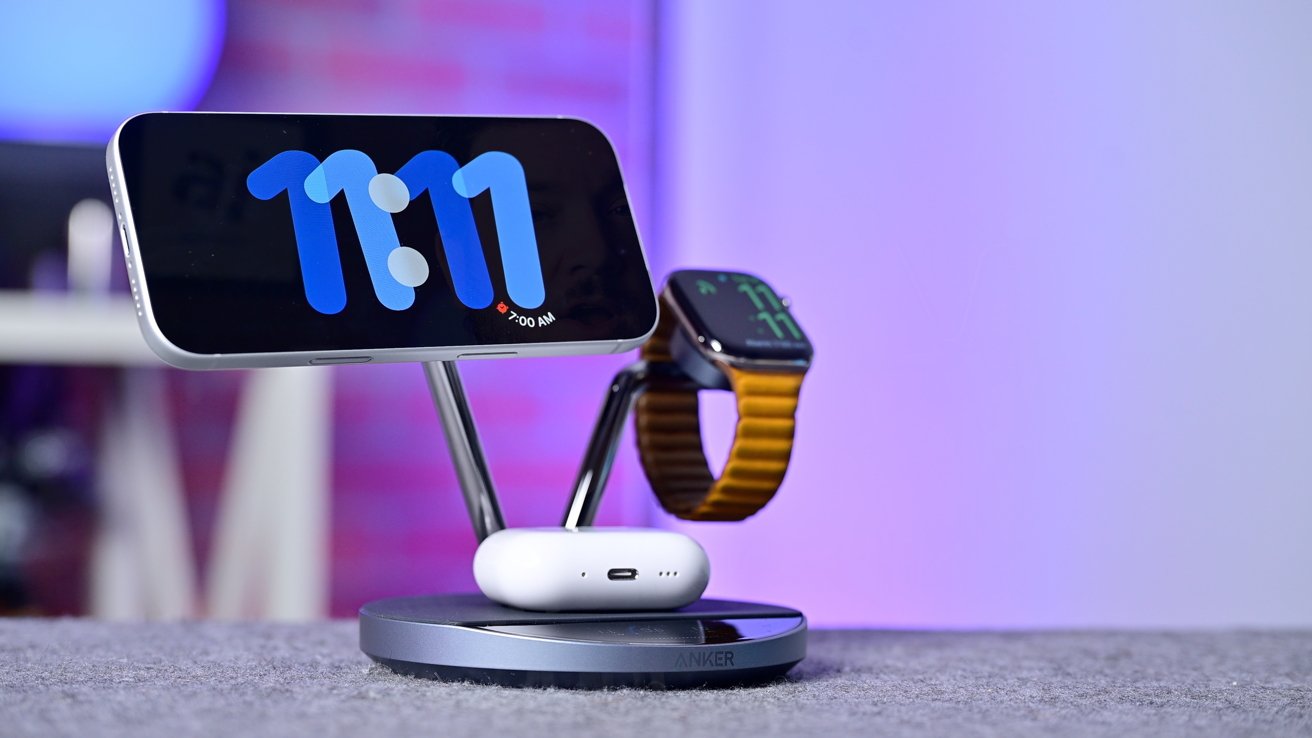
Anker's newest flagship multi-charger is full of both bells and whistles to charge your iPhone, Apple Watch, and AirPods as quickly and as safely as possible.
The Anker Prime Wireless Charging Station (on sale at Amazon) is part of the first round of Qi2.2 25W chargers. They were featured by the Wireless Power Consortium (WPC) among a few others that were quick to market.
At the moment, there are only maybe six notable Qi2.2 25W chargers available to purchase, making this especially notable to iPhone users. With an Apple-certified Apple Watch puck, it's also greatly tailored to Apple fans.

Anker Prime Wireless Charging Station review: Design
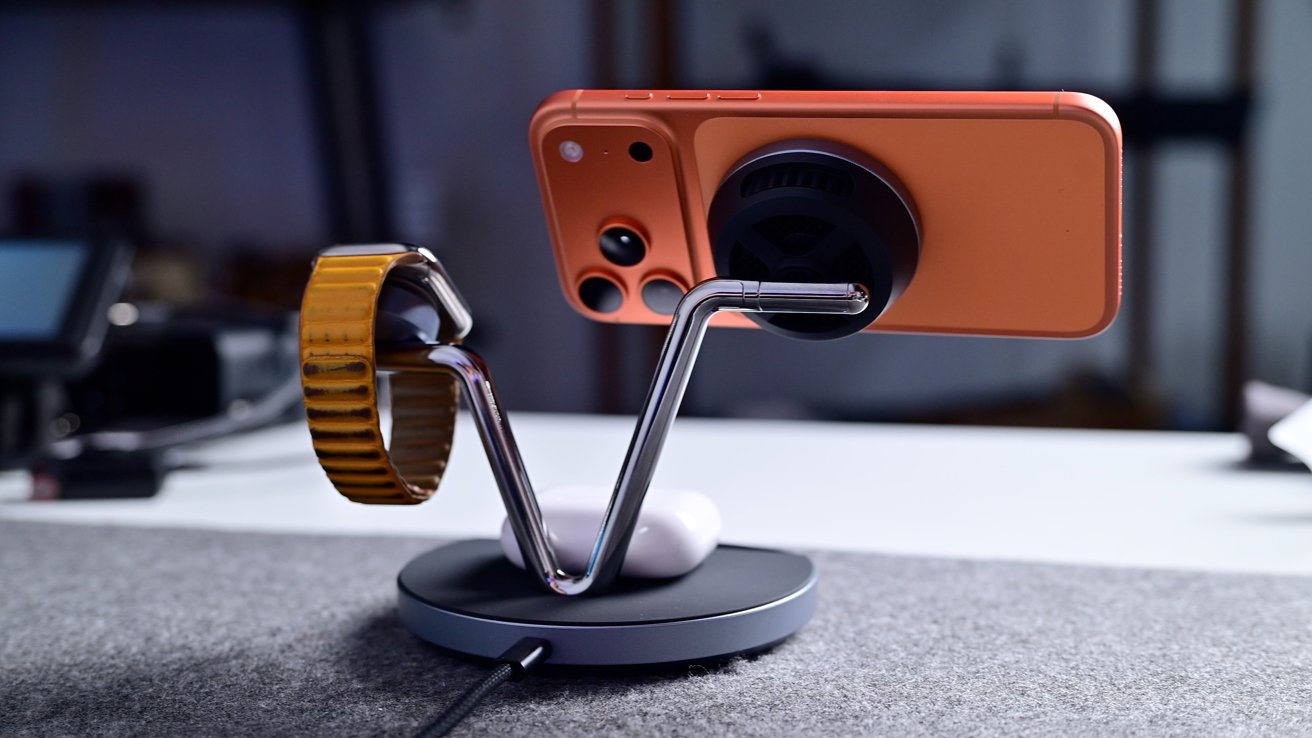
The new Anker charger has a fairly commonplace design with a premium spin. I've seen more "charging trees" than I can count, with the iPhone mount on the left, Apple Watch puck on the right, and a tertiary Qi charger on the bottom for earbuds.
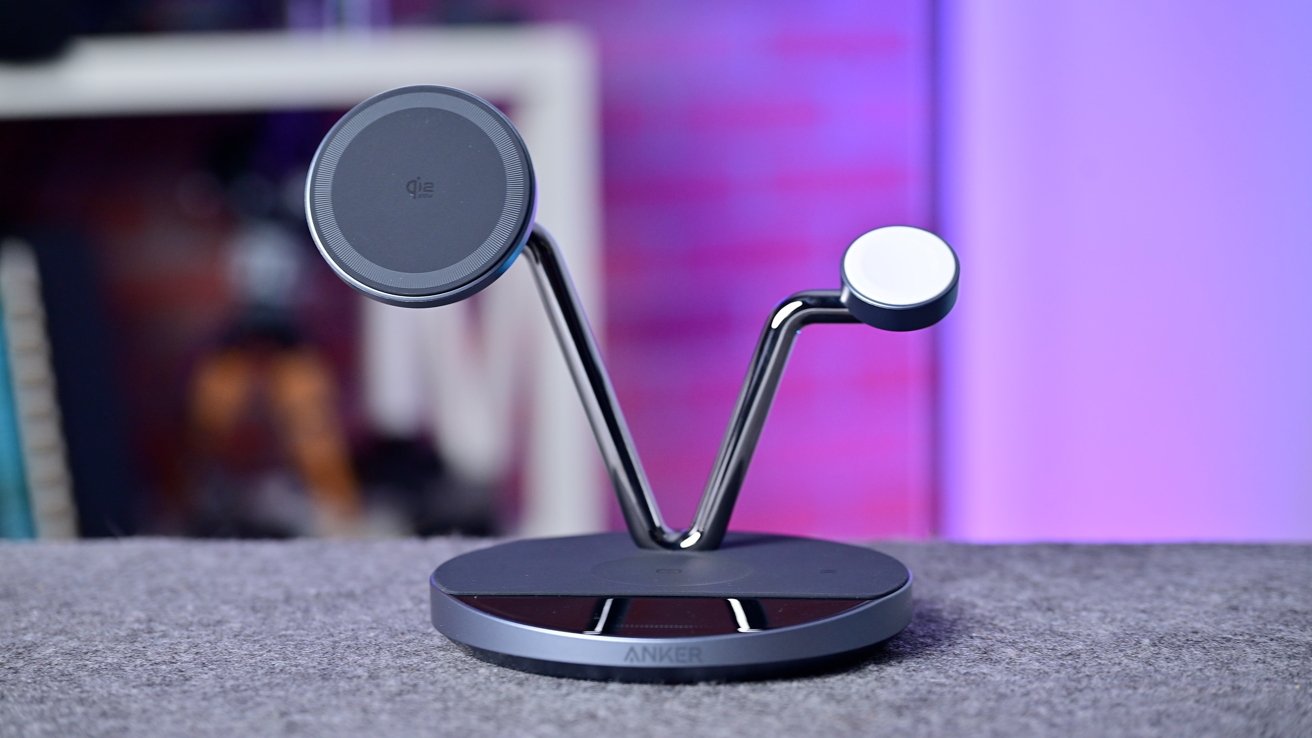
Anker Prime Wireless Charging Station review: It has a typical charging tree design
Anker does keep its quality, though, with polished metal arms that Y-out from the base and a soft-touch silicone on the bottom. The back has a USB-C input, which I vastly prefer over a non-removable cable or a proprietary barrel connector.
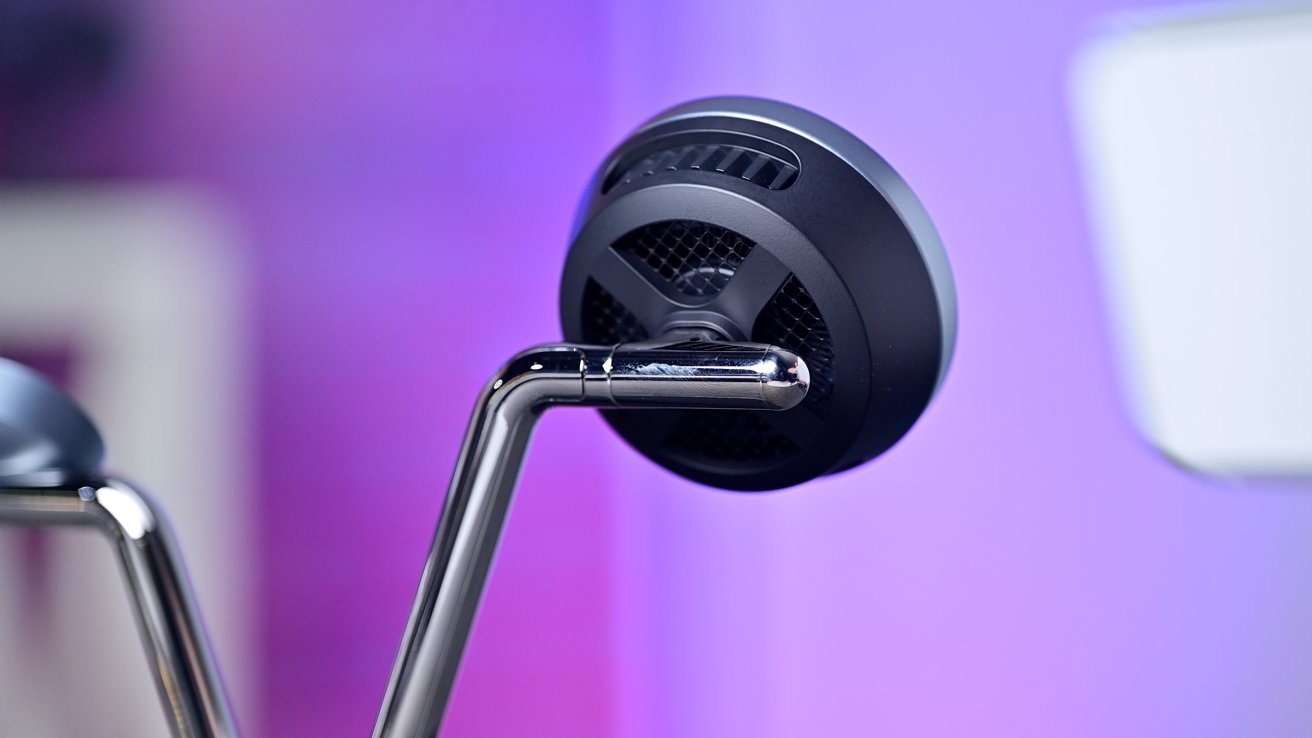
Anker Prime Wireless Charging Station review: The Qi2.2 puck rotates and has a fan to keep it cool
The magnetic Qi2.2 puck is on the thick side, though Anker tries to trick your perception by tapering it slightly to the back. It's a similar track Apple employed on the iMac to make it appear thinner than it was.
It's thick for a reason, though, as Anker has included a fan to reduce temperatures. More on that in a moment, once I get into the charging performance.
I will say that a lot of other multi-chargers ship with pretty low-quality accessories. While the cables and power supplies meet the specs, they're otherwise unremarkable.
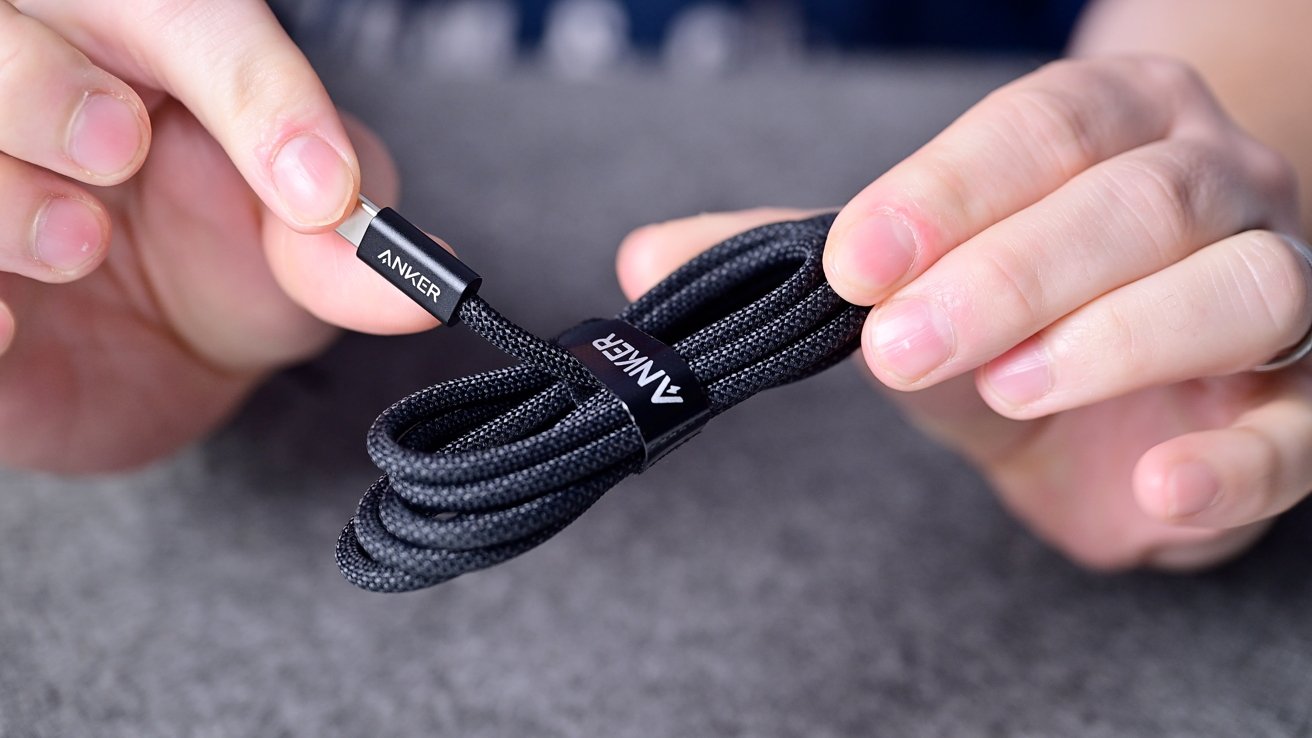
Anker Prime Wireless Charging Station review: Anker's cable is braided with metal ends
Here, Anker has gone above and beyond with both. The cable is reinforced with a braided nylon wrap and metal overmolds, and the power supply is a GaN brick.
The power brick can output 65W, more than most others that top out at 45W. The extra power ensures there's no slowdown when three devices charge simultaneously.
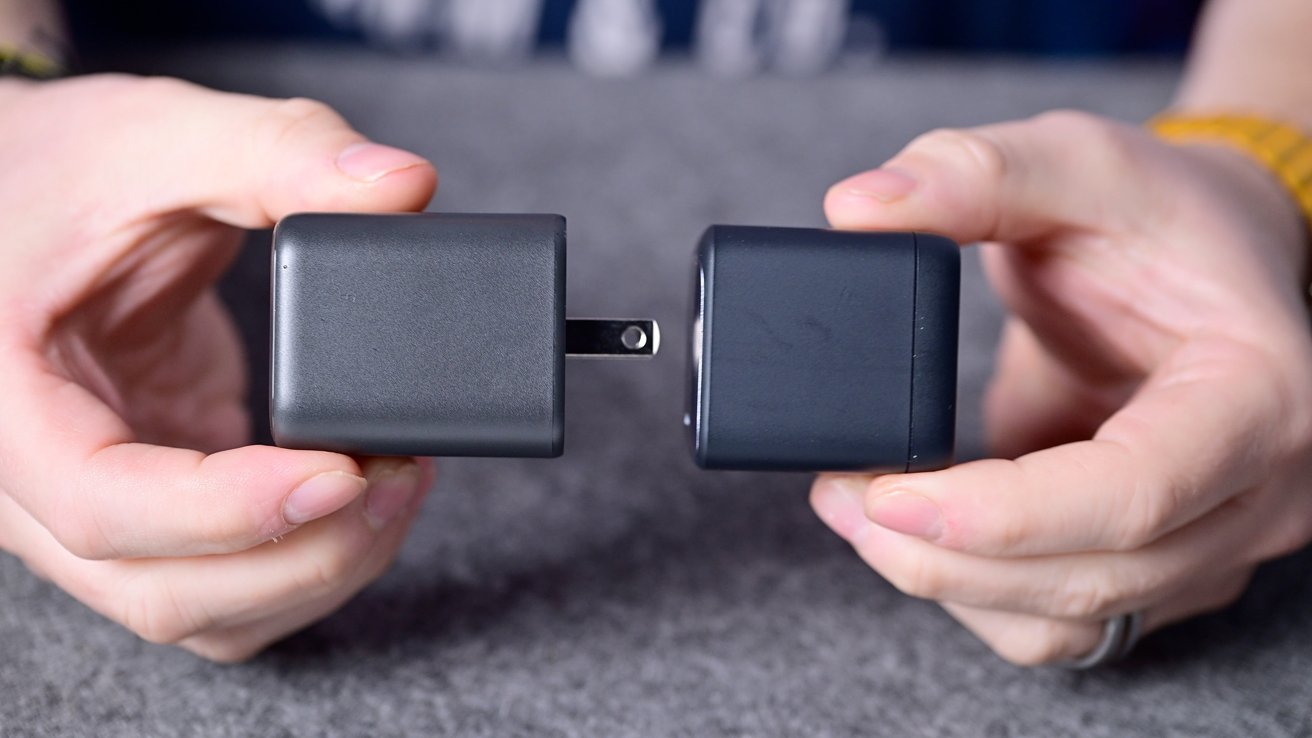
Anker Prime Wireless Charging Station review: Another brand's 45W USB-C charger (left) and Anker's 65W USB-C GaN charger with collapsing prongs
I recently tested another Qi2.2 charger with a 45W power supply that's bulkier than Anker's 65W brick and doesn't have collapsing prongs. Anker's USB-C brick is solidly made and could fetch at least $30 by itself.
Anker Prime Wireless Charging Station review: Charging performance
What counts most is the charging performance. To reiterate, this is a Qi2.2 charger that should deliver up to 25W of power to iPhone 16 series and iPhone 17 series, while iPhone Air is capped at a slightly lower 22W.
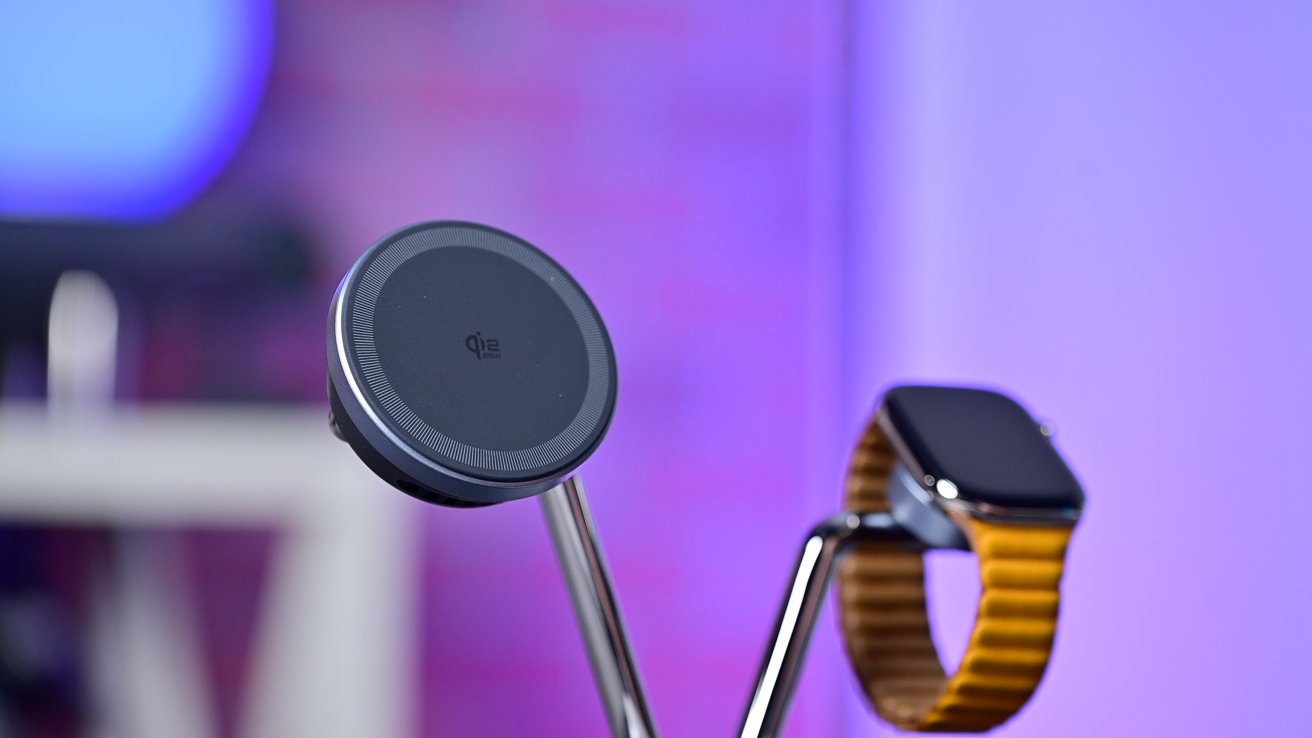
Anker Prime Wireless Charging Station review: Even the Apple Watch supports fast charging
As the speeds increase, so does the temperature. Anker, like so many, uses a fan to cool it down that they call AirCool.
Anker says that on an iPhone 16 Pro Max at peak speeds, the phone's surface temperature drops from 108 degrees Fahrenheit to just 89 degrees. That's a notable reduction.
Charging my iPhone 17 Pro, it took roughly 27 minutes to hit the 50% mark. An 80% charge was achieved in just under an hour in my test.
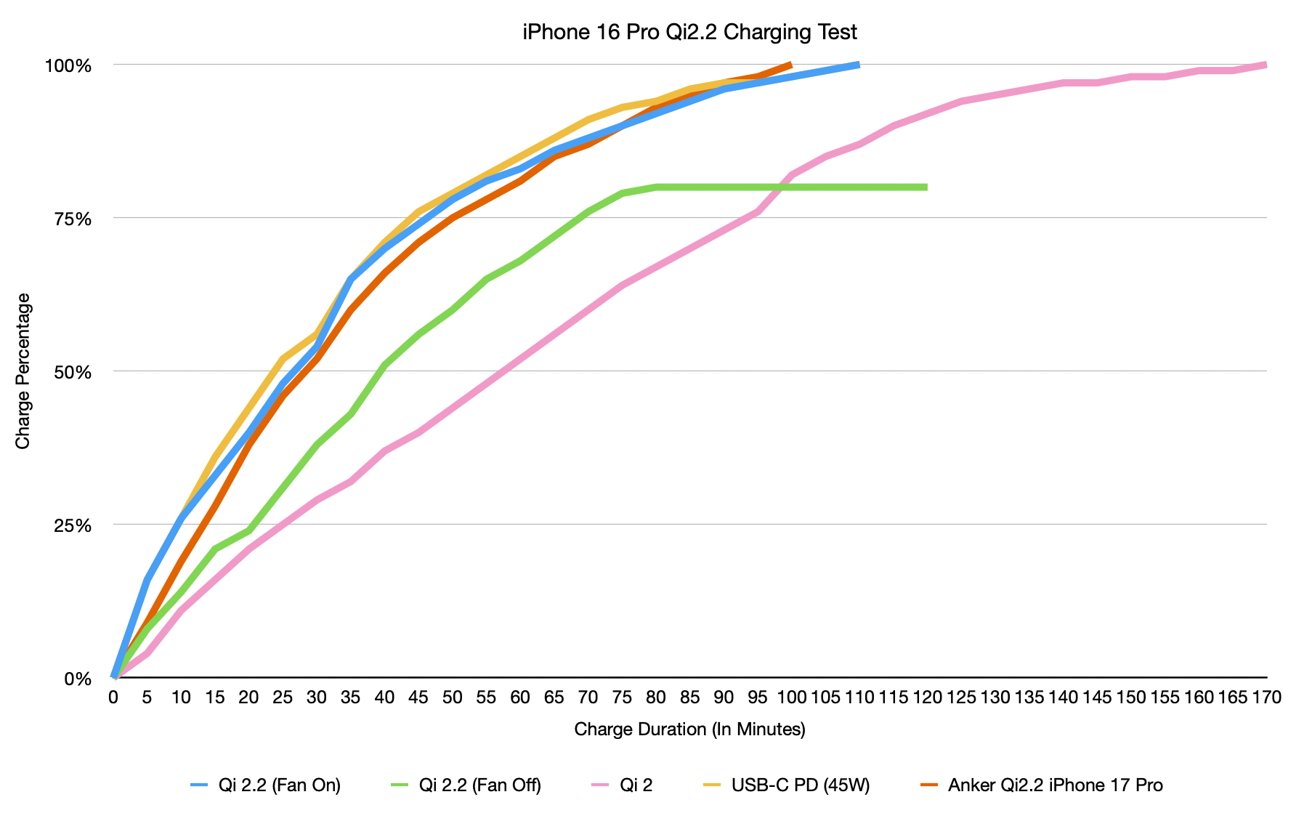
Anker Prime Wireless Charging Station review: Testing the charging speed on iPhone 16 Pro and iPhone 17 Pro on Qi2.2 chargers
For fun, I compared this to prior charging data I had collected using an iPhone 16 Pro on another actively cooled Qi2.2 charger. Out of the gate, the Anker one seemed to be a bit slower.
By the end, the Anker model hit 100% 10 minutes faster. That's even more impressive when you consider that the iPhone 17 Pro has an almost 20% larger battery.
There are a lot of variables in play here, from versions of iOS 26, to the chargers, to the phones themselves, but it was still an interesting comparison to make. The conclusion, regardless, was that this is an incredibly quick charger.
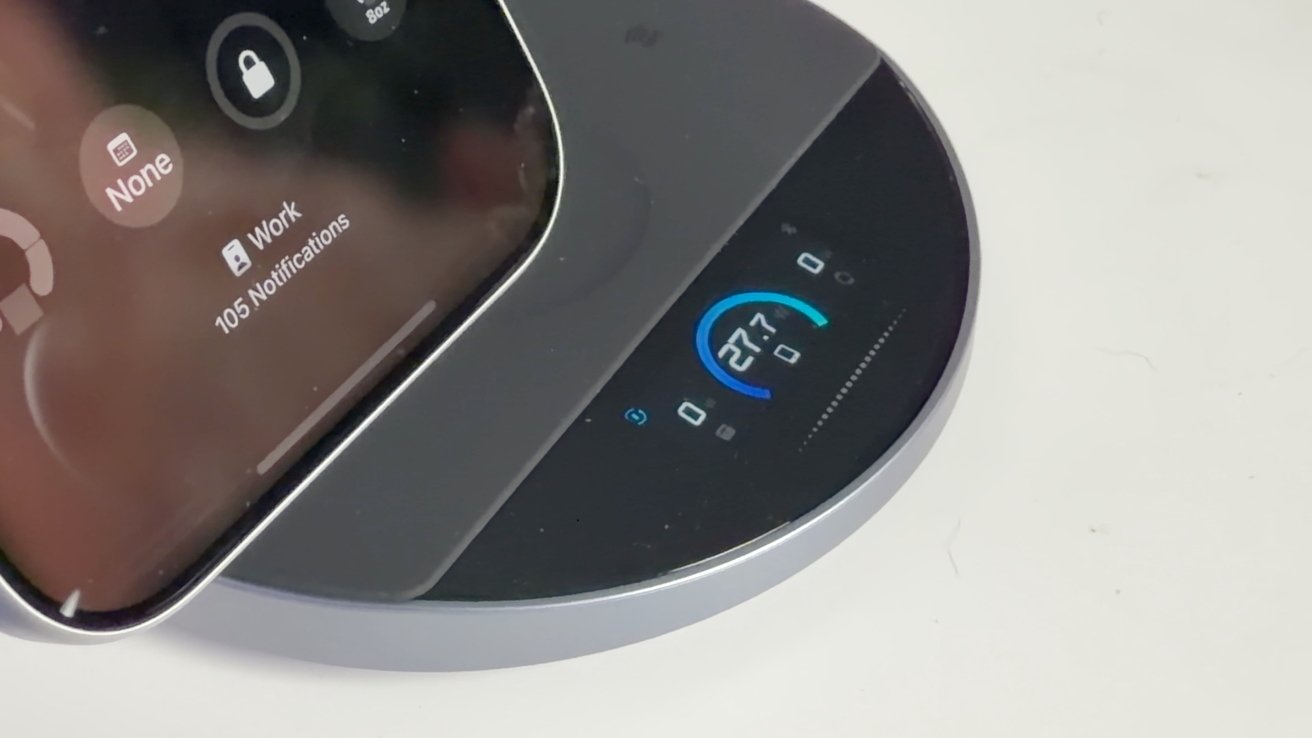
Anker Prime Wireless Charging Station review: I saw speeds hit above 27W and stay there for a few minutes
I was able to confirm this using the hidden built-in display. It shows how much power is being delivered, reaching nearly 28 watts.
My phone barely felt warm, even at the highest charging level. This test used standard mode, and a higher-performance mode is also available.
In the end, I'm getting an extremely fast charge with low temperatures. While it's fast, there is less wear on the battery thanks to the lack of heat.
It might even be better for overall battery health than a wired fast charger, thanks to how cool it stayed. A 45W power supply with a USB-C cable can make your phone very hot without any active cooling.
Anker Prime Wireless Charging Station review: Bonus features
That display I mentioned is amongst the coolest features of this charger. It sits right in front of the base, and yes — it can go completely off if you do not want it.
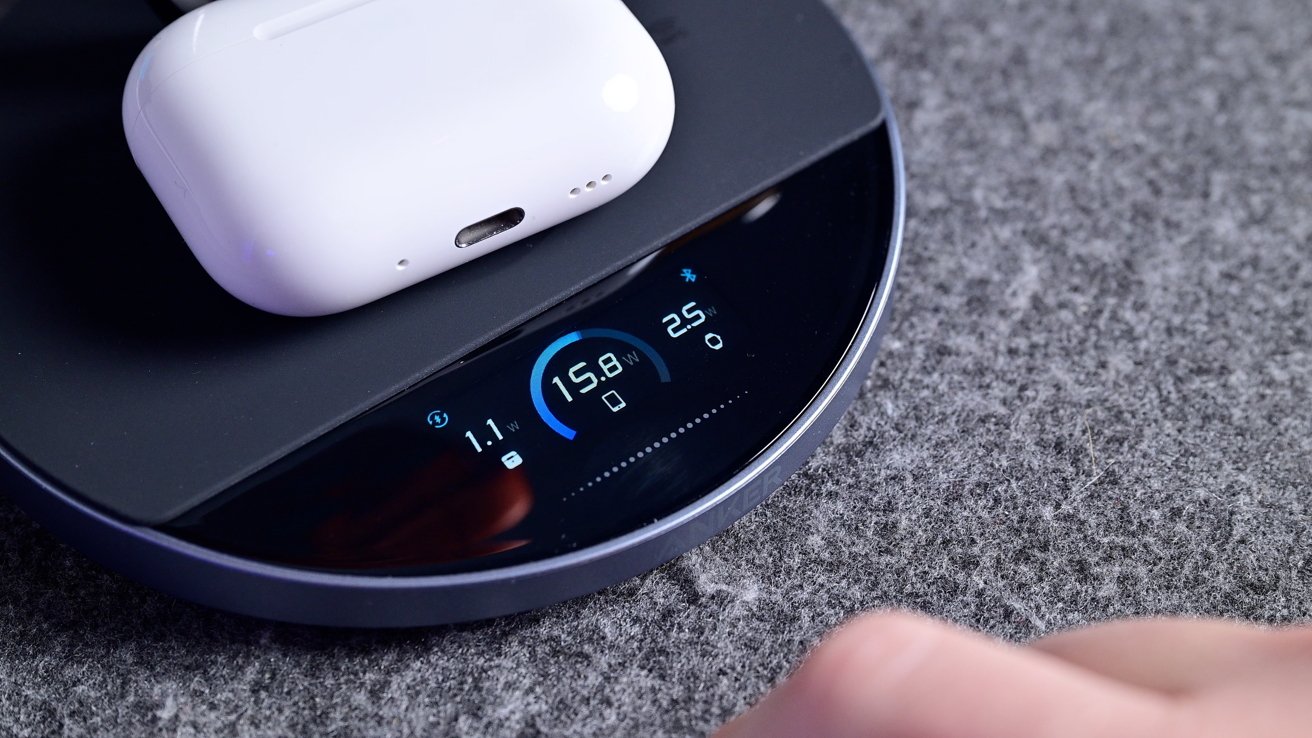
Anker Prime Wireless Charging Station review: The display can rotate and show different info
The display lights up whenever you place a device on the charger. It identifies the charger, shows a brief animation, and then returns to the status view showing all output wattages.
Personally, I find it fascinating. I often use a USB-C power meter to track charging speed, and it was great to see that it was built straight into the device itself.
Swiping just below the display lets you change views to see the current temperature or access settings. The display also provides useful alerts, like misaligned earbuds, low input, or unusually high temperatures.
Having explicit alerts is far more useful than a simple flashing amber LED. Some chargers don't give any warning at all and just trickle charge your device without you noticing.
To the right of the AirPods charging spot is also an NFC chip. By tapping your phone, a modal appears prompting you to open (or install) the Anker app.
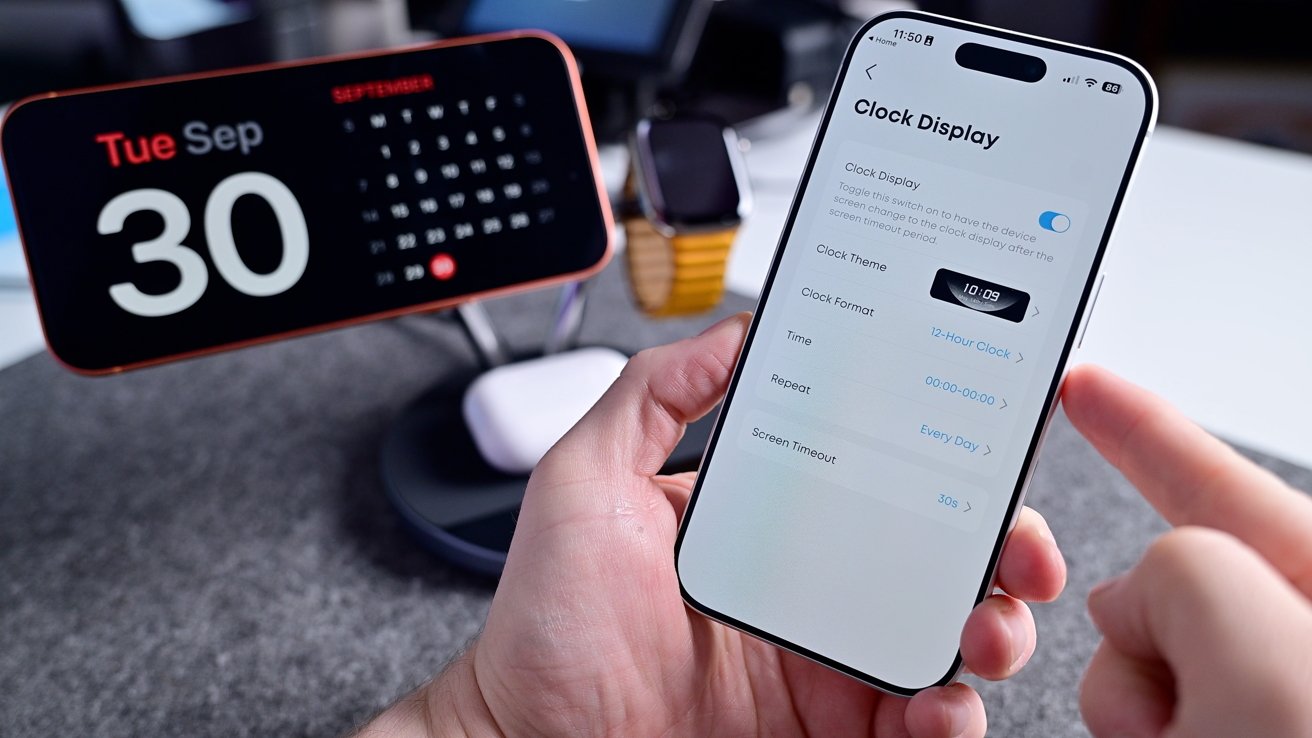
Anker Prime Wireless Charging Station review: You can change the look of the clock with the Anker app
This charger connects to your phone via Bluetooth for a host of different features. It was quick to connect, and I had no issues with that connectivity.
Historically, I hate it when products use Bluetooth for no reason. For example, a paper towel dispenser doesn't need it.
Here, though, I think Anker is specifically addressing the majority of the feedback I see in other charger reviews. I see common criticism about lights being too bright, performance issues on certain phones, or the fans being too loud at night.
This app can tackle all of this. The basic use, though, is to monitor charging.
Just as with the display, you can see all the devices that are charging and how fast they are being charged. There are helpful graphs that plot the power over time with different units of measurement.
It's easy to nerd out over. Plus, the graphics at the top are just cool to see as they adjust to what is actually on the charger.
There are plenty of settings to adjust. You can set the screen to show a clock when idle, pick from multiple designs, or change the brightness.
Anker even allows you to control the timeout length before it goes into standby mode. You can do firmware updates too, which should address any compatibility issues with flagship devices.
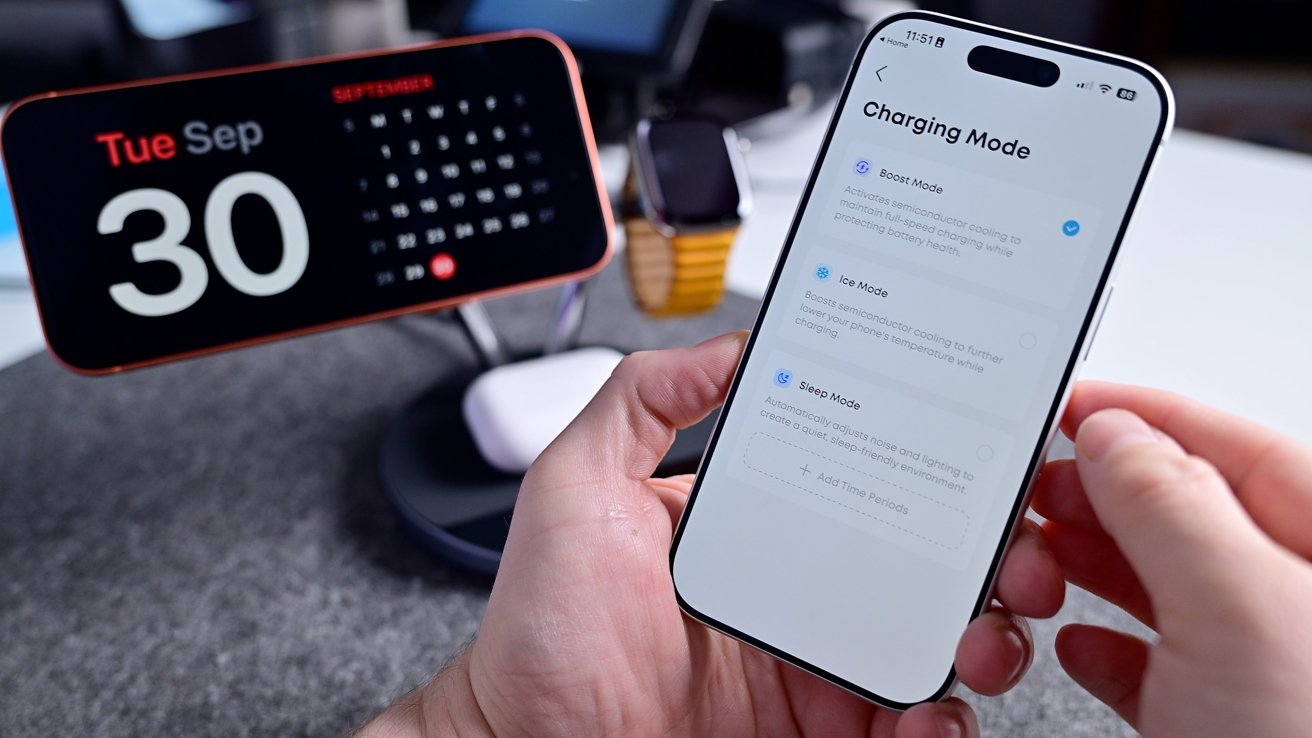
Anker Prime Wireless Charging Station review: Monitor charging speed and temperature through the app
The best part, though, is the charging mode. Anker offers boost mode, ice mode, and sleep mode.
Sleep mode will automatically drop the fan, noise, and lighting to be beneficial for sleeping. And ice mode "boosts semiconductor cooling to further lower the phone's temperature."
This should appease those who want no noise or those who want even faster charging. Like I said above, the test was done in the standard boost mode, and ice mode could have improved those results further.
You can set up the charger in the app once and never open it again. Using the app isn't required, but it offers customization options you don't usually get.
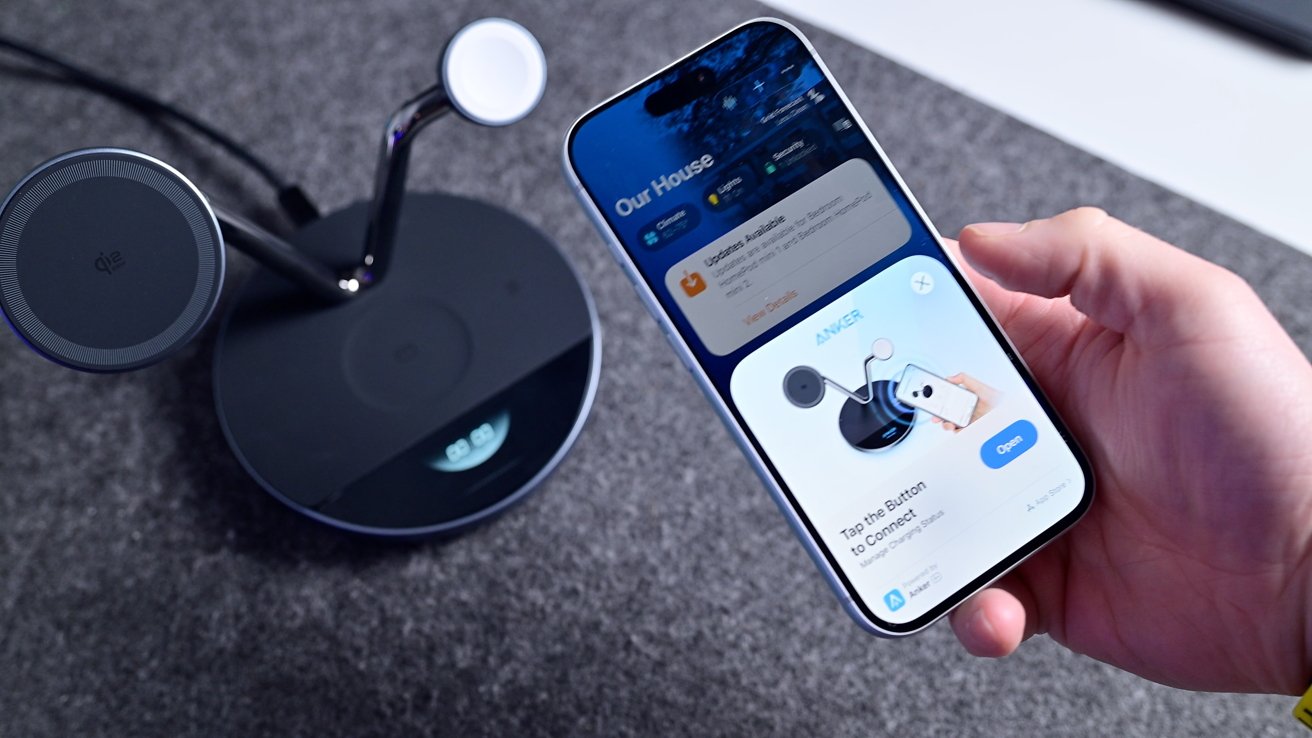
Anker Prime Wireless Charging Station review: Tap the NFC chip to open the Anker app or run an automation
One last thing to touch on is the NFC module. I've been a proponent of putting NFC chips on desks and in chargers for a while.
In my experience, I think it's helpful to be able to run various automations with the tap of your phone. Thanks to the Shortcuts app, there is no end to what you can do with an NFC chip.
If this charger is in your office, you could tap the NFC part to trigger an "end of day" automation to maybe turn off desk lights, send a message to your partner that you're leaving with an ETA based on traffic, and open up the Podcasts app.
I have one set up to run a filming automation in the studio. It closes the shades, turns off the fan, turns on the key light, and sets my background lighting.
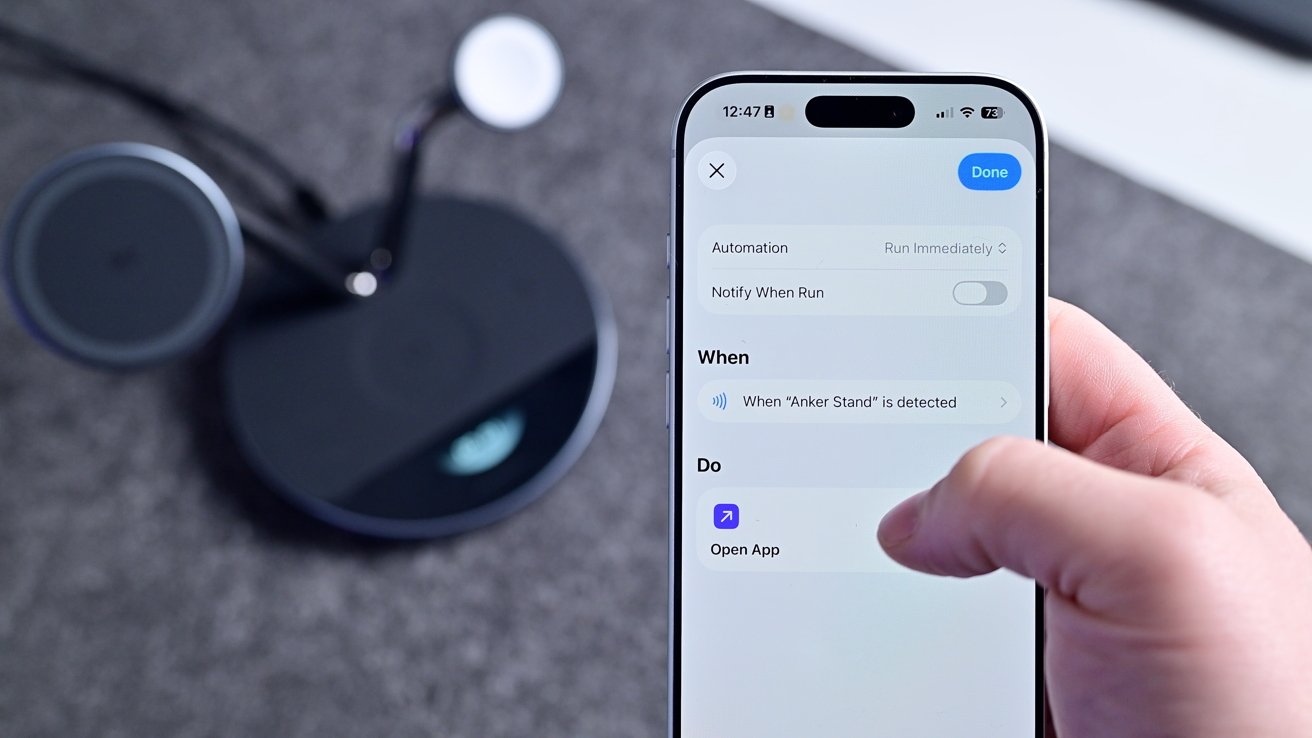
Anker Prime Wireless Charging Station review: Create a shortcut to run when you tap the NFC chip
The only problem is that the Anker modal still appears. So while those automations run, you do have to dismiss that pop-up each time, which I don't mind.
Of course, you can also just buy a pack of cheap NFC stickers and put them wherever you want. I just like that it is built in and doesn't add any extra clutter to my desk.
Anker Prime Wireless Charging Station review: That price tag...
Despite the stellar remarks thus far, I need to address the pricing situation. After reviewing plenty of chargers, it's apparent how much value each places on a charger.
Many users are perfectly happy with a budget $49 3-in-1 from a no-name Amazon brand. If that charger meets your needs, there's nothing wrong with it.
This charger falls squarely at the opposite end of the spectrum with an excessive number of features and a brand-new wireless standard. Unsurprisingly, it's got a price tag to match that.
Full MSRP is $229 with a launch discount bringing it closer to $180. Even at $180, it is just about one of the most expensive wireless chargers you can find on the market.
Looking at the market, Nomad has a 3-in-1 at $160, Belkin's Qi2.2 is $130, Courant has a leather-wrapped one for $200, and both Mophie and Twelve South have models for $150.
I think $230 is high in this space, but at the moment, nothing else matches its features and performance. The selection of 25W Qi2.2 chargers is extremely limited thus far as well.
Call it what you want — the early adopter's fee, price gouging, the premium premium — but I think the price matches what you get at the moment. That's not to say it won't change.
Anker Prime Wireless Charging Station review: The best charger out there, but it's expensive
I expect Anker will soon release a lower-cost version, and other accessory makers will likely join the competition. It wouldn't surprise me if Anker drops the price permanently after a few months on the market.
Here at launch, I think this is probably the best, most premium, and safest fast charger on the market. But if you want the best wireless charger, you're going to pay for it.
Anker Prime Wireless Charging Station review: Pros
- One of the first round of Qi2.2 chargers
- Fastest wireless charging for iPhone
- Fully customizable
- Integrated display
- Braided metal cable & tiny GaN power supply
- WPC & Apple MFi certified
- Premium build & construction
- Real-time monitoring
- NFC chip
Anker Prime Wireless Charging Station review: Cons
- High price tag
- Wide footprint won't fit small spaces
Anker Prime Wireless Charging Station rating: 4.5 out of 5
You can buy the Anker Prime Wireless Charging Station on Anker's website for $229 where there is currently a 20% discount available at launch. It's also on Amazon with a matching coupon.