New research shows that Apple is looking to improve gestures on AirPods by dropping the separate detection circuitry of AirPods, and instead using the RF antenna to sense the gesture.
In the surprisingly long history of AirPods — the first known patent for them was back in 2011 — there have been many plans for gesture control. Some have yet to appear, such as camera-based systems.
Now in a newly-revealed patent application called "Gesture Detection Based on Antenna Impedance Measurements," Apple has detailed another gesture approach entirely. Where the current AirPods have a touch surface, it's a separate system from the rest of the earbud and Apple doesn't think that's good enough.
"In practice, arrays of capacitive sensor electrodes and/or other input devices in input/output devices can occupy excessive space," says the patent application. "[This] can cause [the] device to be needlessly bulky or heavy and/or... prevent device [it] from including other components while exhibiting a compact form factor (e.g., for comfortable use within a user's ear)."
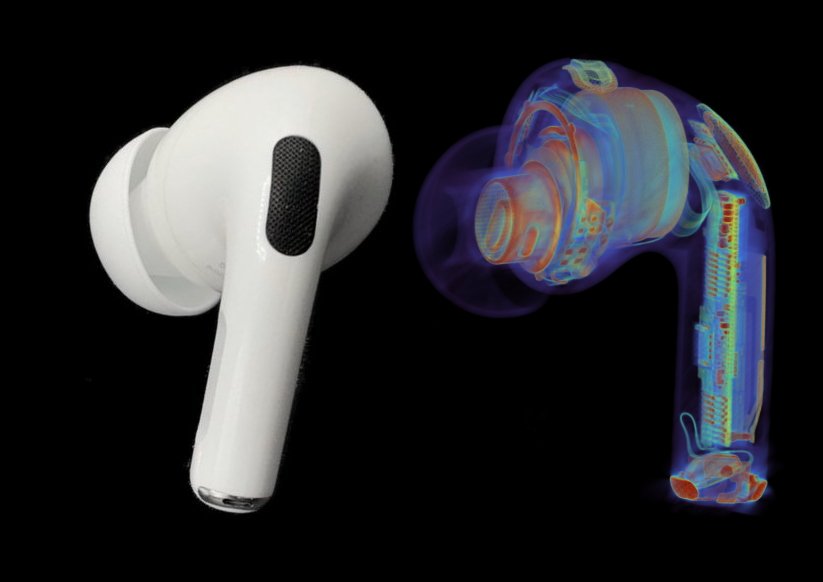
The new technology would save space in the already packed AirPods Pro — scan image credit: Lumafield
Plus if you've tapped on an AirPod to skip to the next track, you may have noticed that it's far from instantaneous. This is another concern for Apple's researchers, who refer to the "excessive amount of time to detect a user input gesture."
The proposed solution revolves around the radio antennas used in AirPods. These are what receive audio such as music, and which relay back audio, such as input from the AirPods' microphone.
Audio reception and transmission "are scheduled much more frequently than the refresh rate supported by capacitive sensor electrodes." It's more important that audio be handled promptly than gestures, so dedicated touch controls may have to wait.
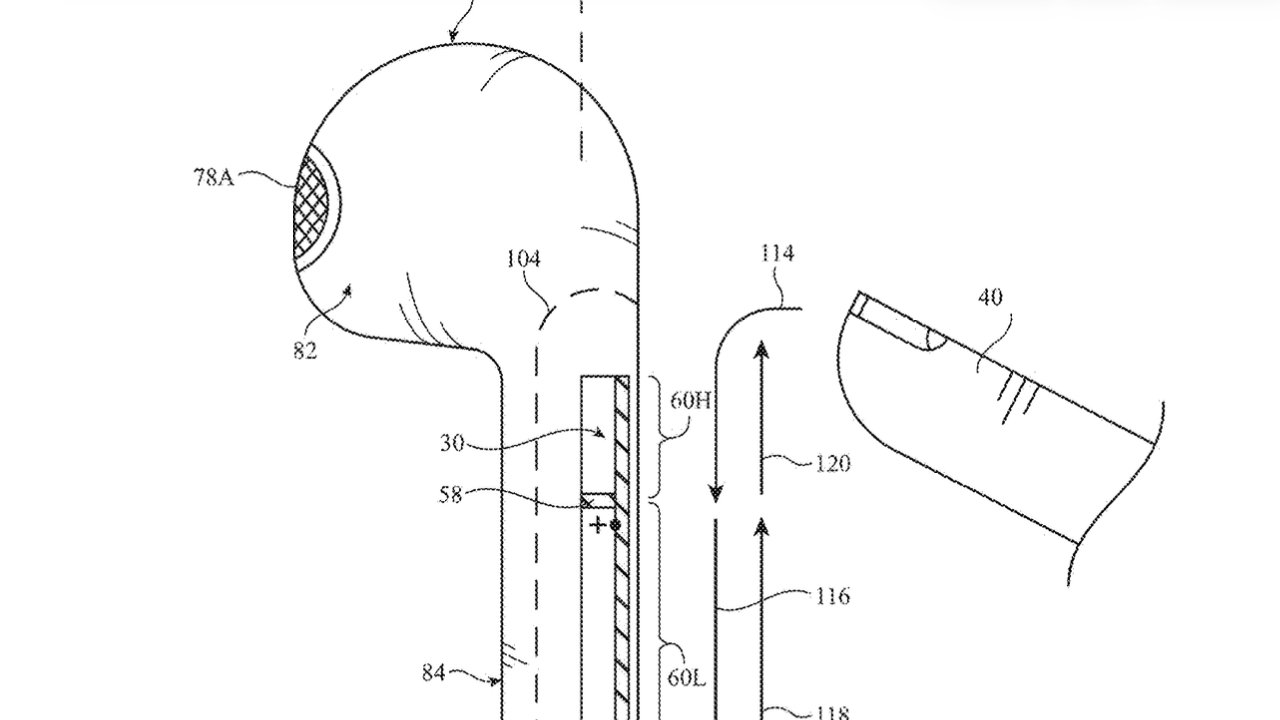
So the idea is that gesture detection should be included in the antennas used for passing audio back and forth. Detecting gestures based on the impedance of antenna 30 may thereby exhibit less latency than detecting gestures using other sensors such as capacitive sensors," says Apple.
These capacitive sensors can be thrown away, saving space and weight, because AirPods could measure impedance — and changes in impedance.
Those changes in impedance "may be indicative of the presence or absence of external object... [which] may be, for example, a user's finger." Particularly if there are two antennas, then it would be possible to measure the rate of change of impedance, and the sequence of any change.
So if a user swipes upwards on the AirPod's stalk containing the antennas, it should be possible to detect the start and end of the gesture. That would give direction, too, which could be used to interpret a volume up or down gesture.
Across its 13,000 words and even diagrams, the patent application concentrates on the specifics of impedance measurement using different materials. It does also try to claim that this idea is applicable to many devices, rather than just AirPods, but that's just attempting to make the patent as broad as possible.
Note that even if Apple is granted this patent, it is no guarantee that the company will ever use the technology. Apple applies for many hundreds of patents every year, and at most they can be seen to be indicative of areas the company is interested in.
It can well be the case, for instance, that Apple has researched an idea enough to want to patent it, but has also moved on to other ideas. There definitely do not seem to be a shortage of AirPod ideas, either, as Apple has even researched using lasers in them to read the wearer's lips.