AI is the world's most efficient plagiarism machine, and it is coming for music. But, the recording industry isn't trying to protect musicians from AI — it just wants to get its cut of the blood money, too.
AI is here. It's not going away, and it's stealing from everybody.
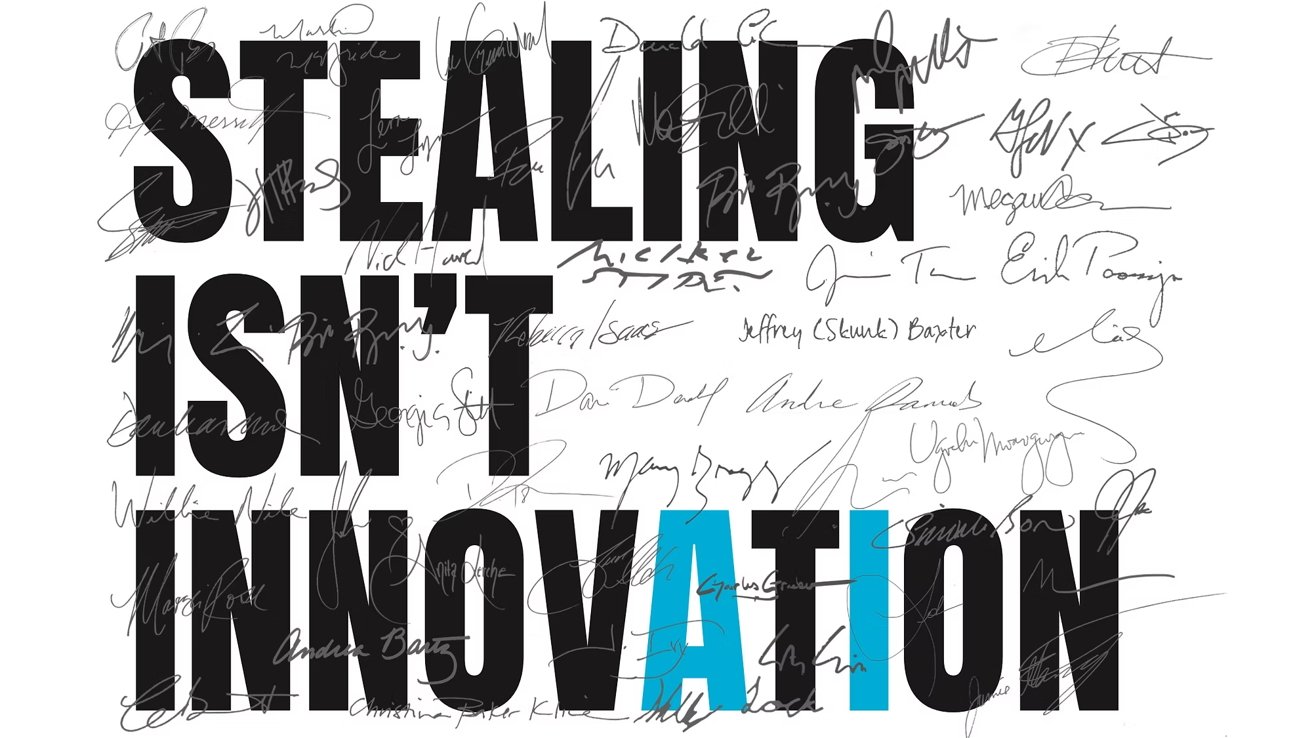
On Thursday, the Human Artistry Campaign, a collective of musicians and industry professionals, launched the "Stealing Isn't Innovation" campaign. The collective and the campaign aim to draw attention to the use of AI in music spaces.
The RIAA, the Recording Industry Association of America, has taken quite a bit of interest in the campaign and is looking to help it gain traction. It alleges that it's worried about large language models that are trained on unethically obtained music, allowing AI to generate music without an artist's consent.
Ultimately, the goal is to help place restrictions on how creative content — be it music, visual art, video, or the written word — is accessed by AI. Looking at the campaign page, it seems the biggest bugbear is the fact that many generative AI models are trained on copyrighted material, which makes this an issue that falls under copyright law.
The list of signees is huge, and the purported list of supporters is said to top 800 at the time of publication. We expect many more artists to sign on in the coming days.
"Artists, writers, and creators of all kinds are banding together with a simple message: Stealing our work is not innovation. It's not progress. It's theft - plain and simple," the website reads.
"A better way exists - through licensing deals and partnerships, some AI companies have taken the responsible, ethical route to obtaining the content and materials they wish to use. It is possible to have it all. We can have advanced, rapidly developing AI and ensure creators' rights are respected."
We here at AppleInsider agree on the surface, given that Google, ChatGPT and so many more scrape us constantly, and steal from us with what they've taken. It's just bad that big tech thinks that it's too hard to license content that it has stolen, and will steal — and the courts tend to agree.
The RIAA has an interesting argument, but I'm not entirely sure if licensing is actually the solution, either.
It's hard to explain why this is without delving into the whole issue with machine-generated content in the first place.
Piping hot slop, served fresh every day
You can't really talk about the rise of AI-generated content without talking about social media. Because, for all the squawking the AI companies do, a very large portion of AI content feeds directly back into five major social platforms: Facebook, Instagram, YouTube, X, and Reddit.
Not all that long ago, if you wanted to get precious — yet pretty much worthless — views on your content, you mostly just had to be consistent. For most publications, quality didn't matter. You just needed to show up.
I ran a blog in the mid-2000s that did very well for itself — enough so that I made a decent side-income from advertisements and occasional sponsorships. At one point, I had a Twitter account with nearly 100,000 followers.
I wasn't particularly funny or providing any useful service to anyone. I was just in that generation of millennials who had access to a computer with halfway decent upload speeds.
And yet, I still managed to garner an audience for some reason.
Later, quality did begin to matter. In the early 2010s, the internet began to whittle itself down into the five websites — just substitute Reddit today for Digg then — that comprise most of the internet activity.
Because everything was condensed, consistency wouldn't cut it. Everyone was posting, and they were posting all the time.
It was around that point where the internet became a "thing." It wasn't just a haven for little weirdos whose family owned a shared family den computer — it lived in your pocket.
You had perpetual access, just like everyone else. You weren't going to get new followers just for posting a picture of your lunch — you may need to resort to posting a picture of your dog or cat.
People were incentivized to make at least half-decent content if they wanted views, and good content could be monetized.
This is widely regarded as the golden era of social media. It's the one millennials and Gen Xers talk about fondly, even if it was still largely the same cesspool it is now.
Alas, Vine, we hardly knew ye.
But hey, we had Vine. We'd lose it pretty soon after, but for one, brief, shining moment, we learned that, oh my god, they were, in fact, roommates.
But soon, the pendulum would swing back to the other direction. Vine was no longer the only short-form video platform in town.
Musical.ly — which was soon renamed to TikTok — would gain traction. In an effort to keep up, Instagram, Snapchat, and Facebook would all release their own versions.
And each version had an algorithm that could be exploited. The game was no longer quality — it was, once again, quantity.
In an economy where everyone is fighting to rack up those watch time minutes, AI content provides an easy, sleazy way to overwhelm the system. You see this on every platform, but it's especially bad on YouTube, where there's a whole economy built around worming your way into the autoplay algorithm.
In fact, according to Kapwing, somewhere between 21%-33% of YouTube videos are low-quality, AI-generated "slop." And, while this is pretty anecdotal, I'm willing to bet the numbers on Instagram and TikTok aren't far behind.
The Sunofication of music
Thanks to Google search summaries plagiarizing content, 99% of you reading this have already read AI-generated text. I'm willing to bet 99% of you have also seen your fair share of AI-generated images and videos.
But I'm also positive that the majority of you have heard AI-generated music, even if that can be a bit harder to clock at first.
I learned about Suno much earlier than most of the people I know. My brother-in-law found it via Reddit a short time after it had launched and mentioned it to my partner.
If you don't know what Suno is, it's a piece of web software you can use to generate songs with a few clicks of a mouse. You can pick your genre, write your lyrics, and give notes on how you'd like it to sound.
You can even have Suno generate lyrics, which, by the way, are always awful.
Image Credit: Suno
And, according to Suno, as long as you have a premium subscription, you're free and clear to use the music however you want. Put it in a YouTube video, use it in a movie or television show, or even upload it to Spotify and Apple Music.
That's right, folks — the slop had now entered the music streaming platforms. And, like AI-generated images and video, it's rapidly spreading across the platforms, leaking into publicly shared playlists and rolling across people's proc gen stations.
It's already proliferating on TikTok and Instagram, where the respective platforms routinely suggest AI-generated music to score videos you record. And, as many already know, there's a huge market in making your music go viral on TikTok, as you directly get paid when your music is streamed.
A piss-poor simulacra, at best
The main pitch many AI companies give is thus: rip the human out of the equation entirely and use a much cheaper generative artificial intelligence instead. AI is faster, cheaper, and "easier" to work with.
Plus, it was already trained on human content — so it should, theoretically, create more content that people would like.
However, the products that AI produce nearly always feel soulless. A wax statue, a ventriloquist puppet — a piss-poor simulacra of human creativity.
So not only is it unethically created, without compensation to the creators that fed the model, it also just sucks. It didn't need to be this way.
So, how have we fallen this far? The problem is, as it nearly always is, systemic.
Intellectual property law — especially in the United States — isn't designed to protect individual creators that are not powered by Fortune 500 companies. It never really has been.
If you've got any friends who work in design or animation, there's a great chance that you already know this lesson second-hand. If they make something cool and someone — or something steals it, the odds of an independent artist or small-scale creative outlet winning any legal battles are nearly zero.
Most people simply don't have the money or time to pursue court cases. And even if they did, the profit they earn is likely to be eaten up in both court and lawyer fees.
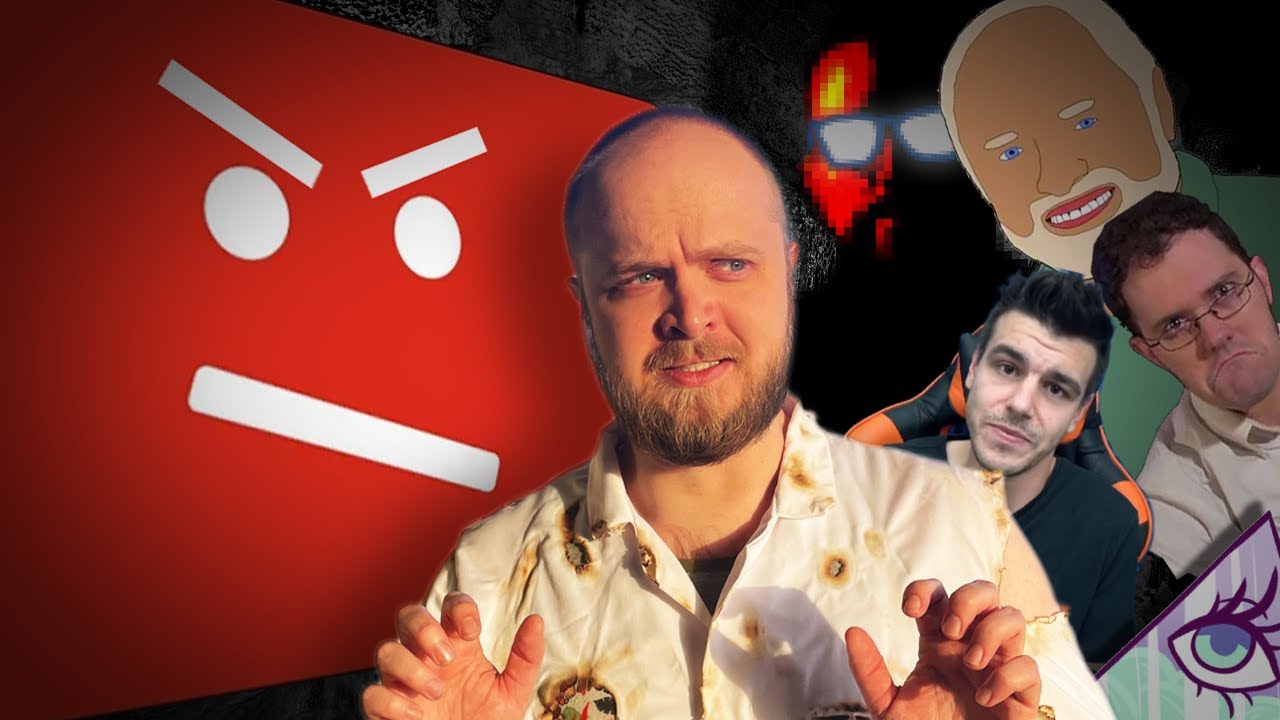
I should direct you to HBomberGuy's video, "Plagiarism and You(Tube)," which covers the subject far more eloquently than I ever could. It's a long watch, but it's worth it if you're interested in this kind of thing.
You might be wondering, then, "If IP law doesn't protect creators, who does it protect?" And that's a good question to ask.
IP law protects big business, full stop. It doesn't protect anybody else with any effectiveness. This is especially true in the music industry, where producers and record labels tend to hold both licensing and distribution rights.
This means that large corporations can lob cease-and-desists at pretty much whoever they want. They have entire legal teams dedicated to doing so.
If you ignore the C&D, you can have your content forcibly removed. Or they could sue you — that's always an option, too.
And, thanks to auto-flagging, they don't even need to look for it. It's why your favorite YouTube creators now cut the audio if they film in a location where there may be music playing in any capacity — they don't want to risk getting a flag on their account.
I suppose that's why the RIAA's "we'll just license the content" leaves a bad taste in my mouth. It's not doing it for artists, the little guy. It's just trying to protect its own ass.
Record labels do not care about human integrity the way they suggest they do. What they care about is where the money is going.
They want to be paid when the content they own is accessed in one way or another, and they'd like that to be via licensing fees. However, companies that create LLMs and generative AI don't want to pay those licensing fees, as it would cut into their bottom line in a market that is famously hemorrhaging money.
The problem becomes a feedback loop of two companies fighting over what constitutes fair use. And the artist, no matter how popular they are, isn't really central to the debate.
At best, they're a convenient face to slap on the movement.
"Look, everyone. Your favorite artist wants their art protected — don't you agree," the movement asks. Unfortunately, the movement is pretty light on the details of how it actually plans on protecting said art in the first place.
What does licensing solve, anyway?
I suppose the ultimate point of this whole back-half of the article is this — licensing solves matters at the corporate level, but not at the content producer one.
If a record label sells bulk batches of music to an AI company to train models on, do the artists get a say in whether and how their music is used? Are they even informed in the first place?
And it doesn't tell you whether this solution that the RIAA is backing is a one-and-done deal, or an ongoing subscription, or if there's a limit to how many songs they can generate or sell using the data.
Some may say that this is actually a race to the bottom.
If you're an author and you sign a book deal with a publisher, what protections could you really expect that the publisher won't turn around and sell it as bulk data to AI developers? Would this become a predatory line in contracts that artists are expected to sign? You can either agree to let the publisher sell your work to feed into the machine, or you can look for someone else to work with.
As always, I don't have a solution, and I'm open about my bias against AI generated content.
Like a lot of other people, I'm worn down by the onslaught of AI content. I have friends in the creative industry who are finding they're being pushed into using AI creative tools against their will.
I watch artificial intelligence move across my own career field, leaving hollowed-out publications in its wake. Long-time Apple news site TUAW is now one of them.
And then there's coding. The consensus is slowly shifting to believe that we are entering an era where coding by hand will become a "dead skill."
In August of 2025, Reuters ran a six-day poll that showed 71% of respondents were worried that AI would wind up "putting too many people out of work permanently."
A lot of the arguments for AI are that it's just cutting down on menial tasks and that it will always need human reviewers. A forum-goer here suggested that this shift is akin to the calculator being replaced by the computer, which is not at all relevant to what's actually happening.
Some of the early AI-generated content was reasonable, but it's progressively gotten worse as models have fed off of AI-generated content. At some point, companies will be resigned to making sure AI doesn't screw up too much — at least until they figure out how to automate that, too. More likely, like how Google Adsense review used to be done by people, the corporations will find out that enough people don't care about AI slop so human review doesn't matter.
There's a Latin phrase, "Quis custodiet ipsos custodes," that roughly translates to "who will watch the watchmen?" While initially the phrase referenced the inherent problem of holding powerful institutions — like governments and militaries — responsible for their actions, it applies to the rise of AI just as much.
The goal is to make most of us unnecessary — and not just the folks on the bottom of the ladder — they're coming for our doctors and lawyers, too. The issue arises that, if we remove the human from the equation entirely, could we ever trust artificial intelligence to govern itself?