
Smartphone manufacturers are overloading their devices with AI features in an effort to control how you interface with both the device and information at large. That's not good.
On Friday, Wes had asked me if I wanted to write a piece on what I thought AI was good for, versus what it is decidedly not good for. Yes, he knows exactly what he was doing with that "harmless pitch."
He is, after all, someone who routinely tags me in Slack with some sort of very, very stupid AI innovation just to get my reaction. And who can blame him: I take the bait every time.
I know I'm AppleInsider's resident luddite; I don't hide it. In fact, I wear it as a badge of honor at this point.
And, judging by the comments and emails I get, quite a few of you, dear readers, are on the same page as I am. Again, this is not surprising; I tend to think of myself as Jane Everyman when it comes to, well, most things.
But it might surprise you to know that I don't actually think AI is always bad. I just think it's almost always bad.
You've been here, you know what time it is. Let's pull out the soapbox, folks, and ask ourselves a very important question:
Is this AI feature helping or hurting?
Before I get too into the weeds with this piece, I'm going to outline my methodology here.
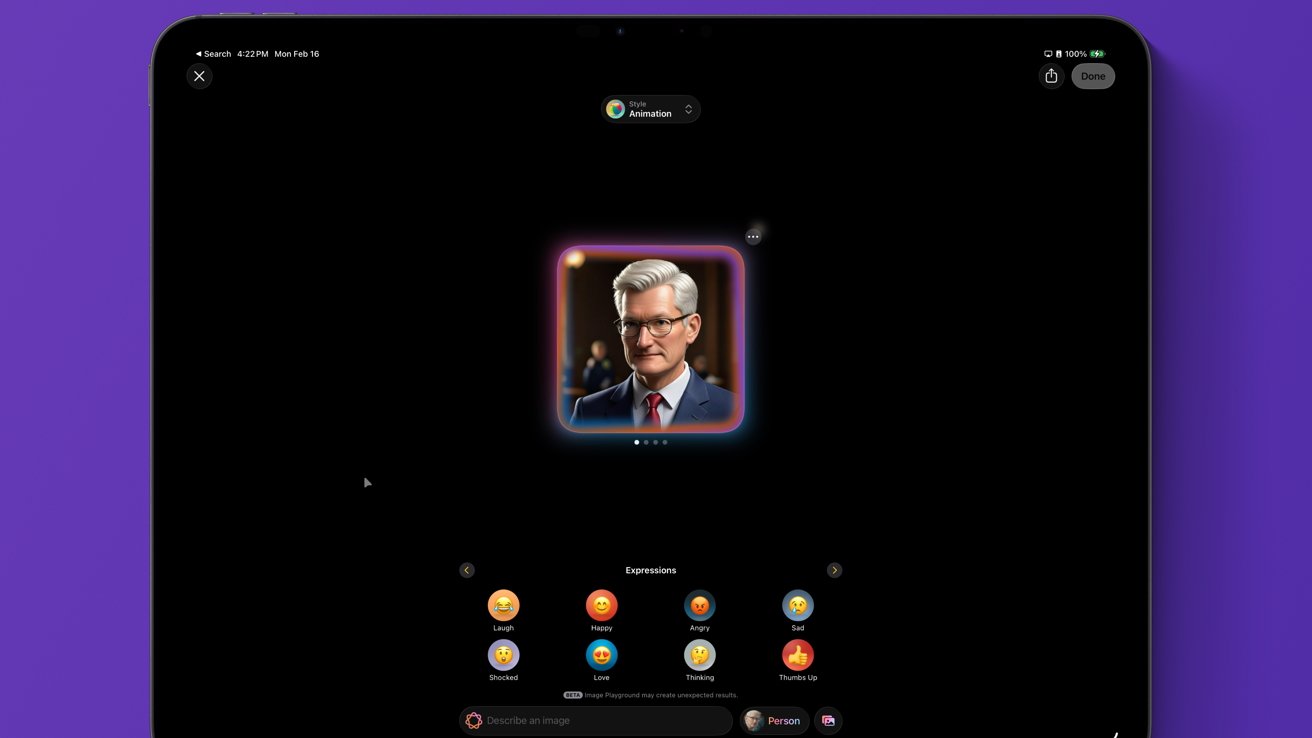
Image Playground has never helped anyone accomplish anything
I think most AI features can be broadly grouped into "good," "bad," or "ugly."
And it's worth noting that "bad" doesn't necessarily mean that the feature is detrimental, though I will say it often is. By "bad," I'd argue it's just not a good feature at all.
An ugly AI feature does not need to exist. Even if it did its job well, chances are, it could have been either done better by a person, or did something so niche that it leaves you asking, "why is this a feature in the first place?"
You're probably wondering if there are truly neutral AI features that don't move the needle in one way or another. My gut response is to say "well, considering the amount of unethical data harvesting and electricity that goes into creating the feature in the first place, no."
And, you know what? I think I'll stick with my gut response.
But, for the sake of brevity (and avoiding giving myself a migraine), I am going to limit this article to offerings made directly by smartphone manufacturers. This means that third-party offerings are mostly off the hook, for now, at least.
Yes, I am aware that Apple Intelligence and Google Gemini features also exist on desktop operating systems or in-browser. Yes, a lot of my arguments can be applied there.
I'm trying to avoid making this a 15,000-word article, dear reader. I am trying to be kind to all of us.
Basic concepts you need to understand: memory and data
Before we delve into AI features and what does and does not make them useful, we need to do a quick vocabulary lesson. Today, we're going to learn the difference between memory and data in regard to AI.
If your job isn't to stare at the internet for eight to ten hours a day, I think it would be pretty reasonable for you to think these terms were interchangeable. After all, AI often works with both of these.
But they are very, very, very different. You could sail, at the very least, a Royal-class cruise ship between the two.
Data, in this context, is presently available information that resides, typically, in a file, list, or database.
You can think of them as books on a shelf. You can add books to a shelf, you can take books away, but you really can't change what is inside of them.

Image Credit: Lubos Houska at Pixabay
Your listening history on Apple Music, for example, is data. Every time you listen to music, you're adding data, but it's non-negotiable.
Memory, on the other hand, is the ability of a system to offer an output. Memory can be influenced by the system's past experiences or recent interactions.
Memory is like a librarian. The librarian has read a lot of books; they know how the system is, or at the very least, should be organized.
The librarian also has a fair amount of freedom when it comes to helping a patron look for information. Especially if it's interacted with the patron before.
When you talk to, say, ChatGPT, it remembers things you've talked about in the past. Additionally, it has a little profile it's built up about you, and it will use its memory to influence how it produces data.
The more you talk, the more ChatGPT will adapt. It will change its memory based on your responses.
There are a lot of obvious benefits to an AI with a limited memory. There are also a lot of drawbacks.
The important thing is that you know the difference between the two, especially when it comes to truly useful features that should exist on every smartphone ever.
Okay, now we can get into the good, the bad, and the ugly.
The good, aka "a frictionless, accessible experience"
Often, these features are powered by the "dumber" form of artificial intelligence. Researchers usually call this "Reactive Machine AI," and it is the kind of AI that I find particularly useful.
Reactive Machine AI is great. It has zero memory and does not care at all what you did five years ago, five days ago, or five seconds ago. It just looks at presently available data and goes "okay, so the next logical step is x."
This is pure data with none of the pesky problems that come with memory-based AI.
If you've used Netflix or Apple Music, you've interfaced with it. It knows that you like a specific type of music, and it can check an existing dataset — either yours or other listeners' — to make recommendations on things it thinks you'd like.
That's pretty nifty and useful if you're trying to find something to watch or listen to. I think this is a great example of a feature that is genuinely beneficial.
The iPhone has a bunch of this kind of reactive memory AI built in on-device, too.
Smart HDR and scene detection on smartphone cameras, for example, are reactive. They recognize certain colors or shapes that they've seen in datasets and respond accordingly.
The camera, in this case, doesn't remember settings you've liked before; it knows that if it sees something that looks like a sunset, it should automatically adjust to make the picture look its best.
Spam call filtering is also reactive. When you receive a call from a number that matches a spam database, your iPhone detects it as spam, and you don't get it.
Accessibility features are also often reactive AI.
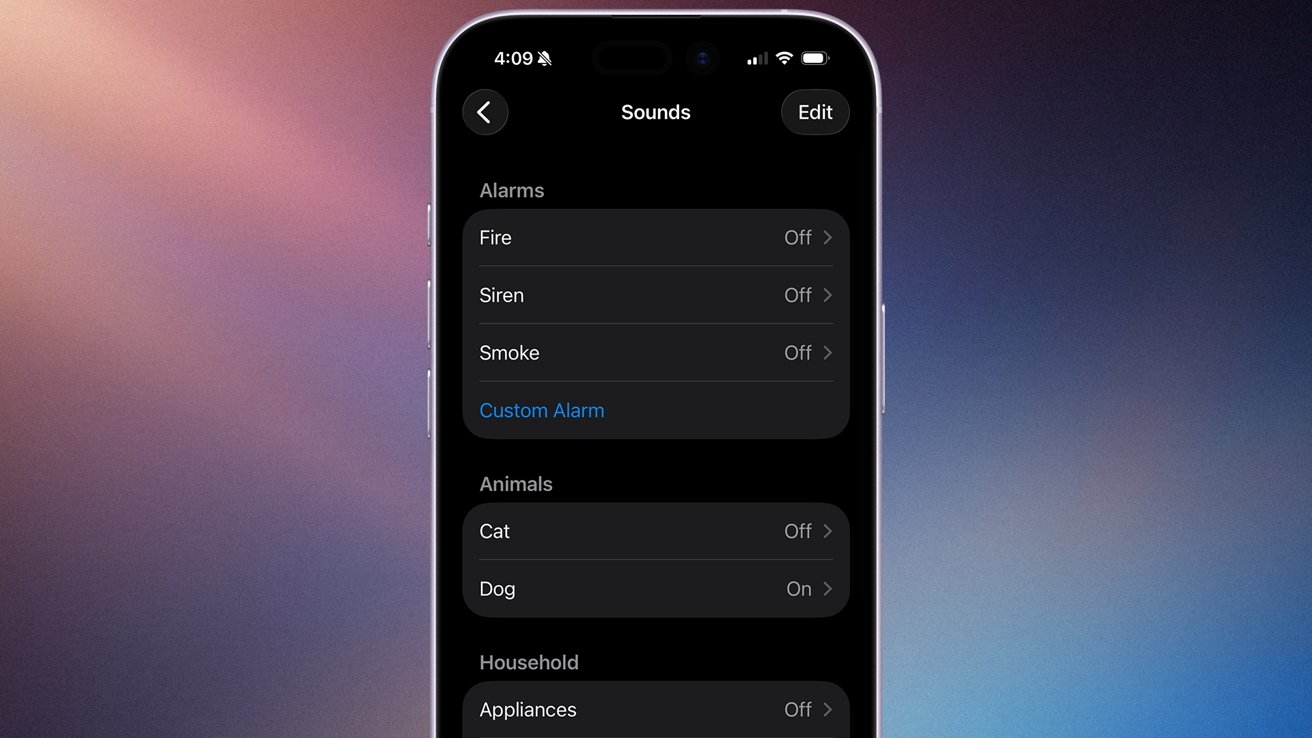
Sound recognition is a reactive machine AI powered feature
Your iPhone has a feature geared towards alerting hard-of-hearing individuals to sounds like doorbells, sirens, smoke alarms, and appliance beeps. It doesn't learn those noises over time, it simply cross-matches them with datasets.
I love reactive machine AI.
Are there memory-based features that are useful? Yes.
Face ID is the biggest one for me here. Face ID actually remembers your face and routinely updates the mathematical data with successive successful locks.
If you grow out your hair, grow a beard, or gain or lose weight, your phone accounts for it. And it does so by updating the math behind it, not by adding to an ever-growing, on-device database that would eventually slow your phone down.
Adaptive, optimized battery charging is also another limited-memory AI feature that is extremely useful. If your device knows you throw it on the charger at 11:00 p.m. and don't pick it back up until 7:00 a.m., it will adapt accordingly.
Chances are, it'll charge your device to 80% within the first hour or so of being on the charger. Then, it'll wait until closer to 7:00 a.m. to charge it to 100%.
If that suddenly starts changing because you changed shifts at your job or you decided to start going to bed earlier or waking up later, it will adapt.
In doing so, it actually protects your battery's health and extends its lifespan. This is a fantastic use of limited memory-based AI.
But unfortunately, limited memory AI is rarely so altruistic.
The bad, AKA "you're too stupid to do this on your own," features
I have no idea how all these allegedly smart people have decided that they enjoy "talking" to AI.
In 2023, I had a pesky wisdom tooth removed without an anesthetic. I would rate that experience higher than many of the interactions I've had with ChatGPT, specifically.
And I can hear some of you rolling your eyes.
That's fine. You are welcome to use the sycophancy simulator.
But similarly, I'm willing to bet a lot of you have been extremely frustrated at the sheer quantity of incorrect information you get from LLMs. And for a lot of you, I'm willing to bet you didn't even go out to find the information: it was forced upon you.
Gemini used to be the worst about it, and the little Google AI overviews at the top of every Google search were a coin flip between "this is very funny" or "this is demonstrably dangerous information to be giving out."
I feel like most of these features can be grouped into a "we didn't trust you to do it yourself, so we're doing it for you" category.
Apple, for the record, is not free of this sin. In fact, the entire advertising campaign behind Apple Intelligence felt malicious.

How to use an iPhone to slam the brakes on a genuine, heartfelt moment | Image Credit: Apple
One ad showed a woman actively trying to one-up her children on her husband's birthday by pressing a single button to "make" a heartfelt movie.
Many of the ads featured Bella Ramsey utilizing features that would prevent her from getting into awkward situations.
You know, like asking someone she'd met one time before, Heaven forbid, what his name was. Or reading a script for a movie or show she'd be expected to act in, which seems like something an actor might want to actually look into before agreeing to it.
Or there was another that showed the office dullard using the iPhone to shirk his responsibilities. And some of you might be saying, "Amber, it's a joke."

How to use an iPhone to pawn your work off on someone else | Image credit: Apple
To which I respond, "Why would you pitch your most transformational features that you're spending millions — if not billions — in research and development, as a joke?"
Hasn't Apple repeatedly shown that it's attempting to adapt or die vis-a-vis artificial intelligence? If it's all in, why does it make these features look so bad?
The ads have all since been deleted. I'd like to think it was because Apple somehow realized that it made it look like its potential user base was all a bunch of stupid, self-serving assholes.
But realistically, it probably just deleted it because it continually keeps stepping on the same rake as to when these features will actually be out.
I hate features that attempt to do my job for me. You already know how much I despise Grammarly's AI features, and I'm hardly alone in that regard.
Apple's own Writing Tools is somehow even worse. I don't need my iPhone to write something for me; I just need it to make sure I didn't put any double spaces in after a period and that I didn't accidentally type "mate" instead of "made."
Instead of being helpful, many of these features are pitched as "we'll just do it for you, so you can go back to doing something else." But if my job is clocking in for 40-50 hours a week and writing, what on Earth am I supposed to do? And if I'm not the one writing, do I deserve the paycheck?
I don't think so. I wouldn't pay someone to show up, put a prompt into a chatbot, sit around and do nothing for 8 hours, and then go home.
And I certainly don't want to ingest content that has been manufactured in this way. I don't want to look at AI art. I don't want to watch an AI movie. I don't want to read an AI book.
There are people out there. There are people out there who want to make stuff for me to look at. And I want to look at it!
If I am lucky, I will get 85 years on this stupid rock hurdling through space. The entire point that these tech executives seem to miss is that we get to be here with other people.
You get so little time to enjoy art and food and good movies and bad TV and people's company and their good ideas and their bad takes. You only have so much time to learn to paint or ride a bike or make the perfect souffle.
All I'm saying is you are not going to be on your deathbed saying, "man, I wish I would have generated more images using a chatbot."
The ugly, AKA "AI for the sake of AI" features
There's also just a weird amount of AI features that are being shoehorned into devices for no other reason than they can.
Actually, scratch that. I assume that a lot of the features have some sort of process that can be extracted and used to train similar paid features down the line.
For example, if you download an app that can take a still image of you and make it do a complex choreographed dance. I assume that process is used to figure out how to create realistic AI-generated influencers.
Or make deepfakes. Either/or.
But the point is that there are an increasing number of AI-powered features that are not particularly helpful, they're not particularly novel, and they're not particularly... good.
A great example is the sheer number of websites and apps that have added a chatbot to them when they don't merit one. My sister recently sent me a screenshot of a pizza website she was ordering from.
The pizza website had a built-in AI assistant. It suggested asking it to "help me create an order for my friends and family" or craft a meat-free pizza for vegetarians.
Now, I'm not a pizza scientist, but I think I could probably figure out how to make a meat-free pizza. And I should hope, after living with another person for, presumably, at least a little while, I should know what pizza toppings they like.
Most smartphones have limited this so far, but that isn't to say they don't exist.
Do you remember Notification Summaries? Do you still use them? I know I don't use them.
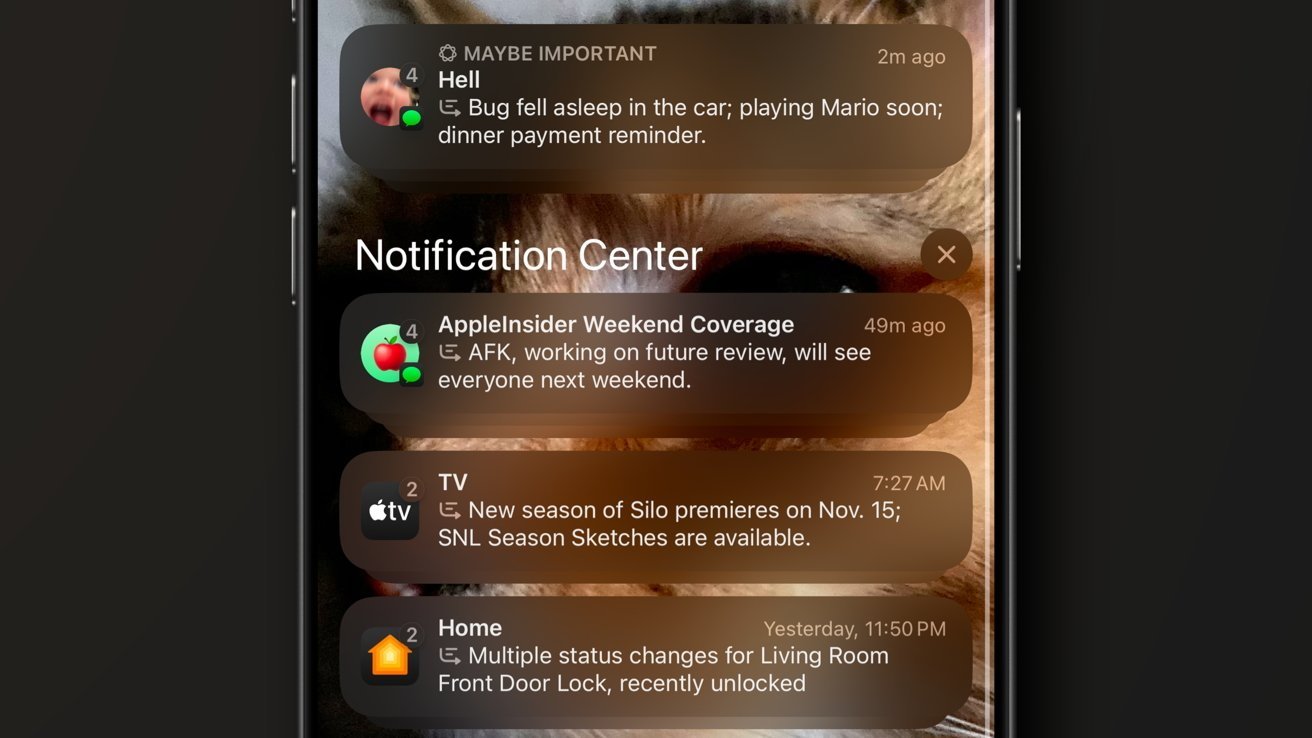
Examples of notification summaries in iOS 18.1
Isn't the point of notifications to alert you of something you should take a look at? I know that notification fatigue exists, and that theoretically notification summaries should help you decide whether or not to respond to a text immediately.
But does it, really? Shouldn't the first line of a text actually give you the general idea whether or not this is an emergency you need to respond to?
I don't actually need Apple Intelligence to decide how to summarize the already nearly unintelligible texts I get from my mom at 4:30 a.m. when she's awake and playing Wordle. Especially because without context, Apple Intelligence certainly won't make the situation any better.
And it's not just text-based things that are terrible, either. Sony has wedged a new AI camera assistant into the new Xperia 1 VIII, and let me tell you, the results are comically bad.

Image Credit: Sony
They're so bad, in fact, that people everywhere are asking if someone at Sony needs to be fired for taking these posts live as selling points. And, after looking at them, I have to agree.
"Amber, photo editing is probably one of the few things that can be improved with AI," I hear some of you saying.
I fail to be convinced. And besides, there's a difference between contextual photo editing and giving over complete control to an LLM to decide what edits should be made.
The point I am trying to make is that you don't actually need the robot to do everything for you. And I assume most of you know that.
I just wish that Apple knew that. I wish that Google and OpenAI knew that.
And truthfully, I think that they do know that.
The ultimate goal of AI is not to help you or make your life easier. These companies are not being altruistic. They are not being kind.
The ultimate goal is to create products and services that you become dependent on. I'm already seeing this in the writing world, where good writers started leaning on AI and are now struggling to write without it.
That's disgusting.
Actually, I'll go a step further:
It's disgusting and pathetic.
It's okay to be inconvenienced. It's good for your brain to struggle sometimes.
I don't do the crossword because it's easy. I do the crossword because it's hard. And when I finish the crossword, I feel accomplished.
It's the same way I felt every time I'd go to the gym and do the hip adductor. Sure, my lower body was sore for the better part of two summers, but when I finally managed to lift the maximum — 265 pounds — I felt amazing.
Self-improvement isn't meant to be easy. You learn more from struggling than from doing things correctly the first time.
I think we're losing our ability to appreciate the struggle to do things on our own. I think we're losing our willingness to put up with being inconvenienced.
Instead of cooking, you can just order a meal in. Instead of doing research, you can just ask ChatGPT.
I know it sounds wild, but I promise that there is a point to the struggling.
Try it out, you might even find out that you like it.