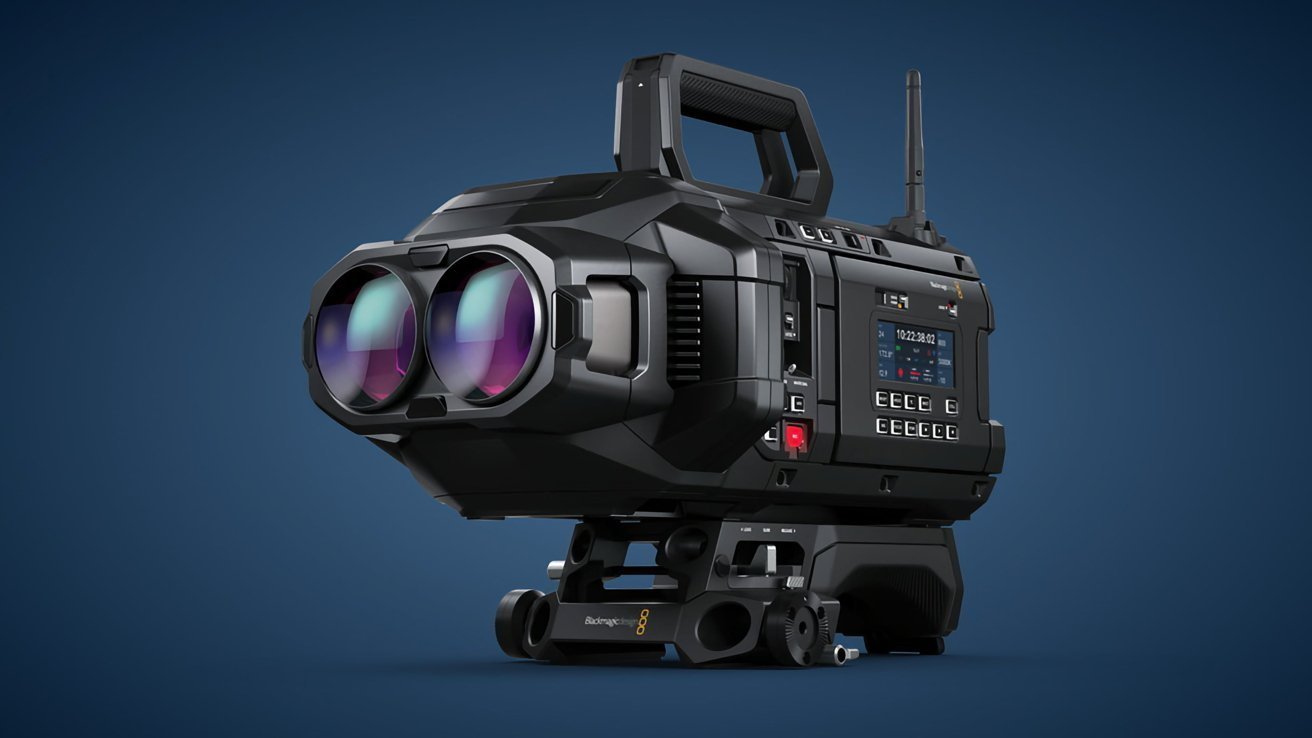
Blackmagic's URSA Cine Immersive camera for Apple Vision Pro content can now be ordered, if you have $30,000. Here's what it can do, and who it's for.
Announced back in June 2024, the high-end camera was presented as an end-to-end workflow for the Apple Immersive Video format used by the Apple Vision Pro. Apple Immersive Video delivers 8K 3D video with a 180-degree field of view, along with support for Spatial Audio.
With the Apple Vision Pro, Apple delivered immersive 3D video experiences, giving wearers the chance to re-live their favorite moments with the help of formats such as Spatial Video. Exclusive content, in a special format called Apple Immersive Video, is also offered on the headset.
Other companies have since added to the mix, with their immersive video cameras. Blackmagic, in particular, has brought impressive specs to the market, albeit at a relatively high price tag.
Blackmagic URSA Cine Immersive camera specifications
Blackmagic's URSA Cine Immersive camera will let users record Apple Immersive Video and edit it via DaVinci Resolve Studio.
The new camera can take stereoscopic 3D video, with dual 8K sensors capable of recording at 90 fps. Pixel-level synchronization and 16-stop dynamic range are available as well, while the resolution per eye is 8160 by 7200 pixels. ND and IR filters are available too.
To be more specific, the Blackmagic URSA Cine also includes high-performance optical low-pass filters. These reduce the interference patterns that can be caused when synthetic materials like fabrics or the LED matrix in video walls are recorded by high-resolution sensors.
The URSA Cine Immersive is equipped with a 5-inch fold-out HDR touchscreen on one side and an external color status LCD on the other. There's even a second 5-inch touchscreen, which minimizes the need for external displays. The camera can also be controlled wirelessly, via the Blackmagic Camera iOS app.
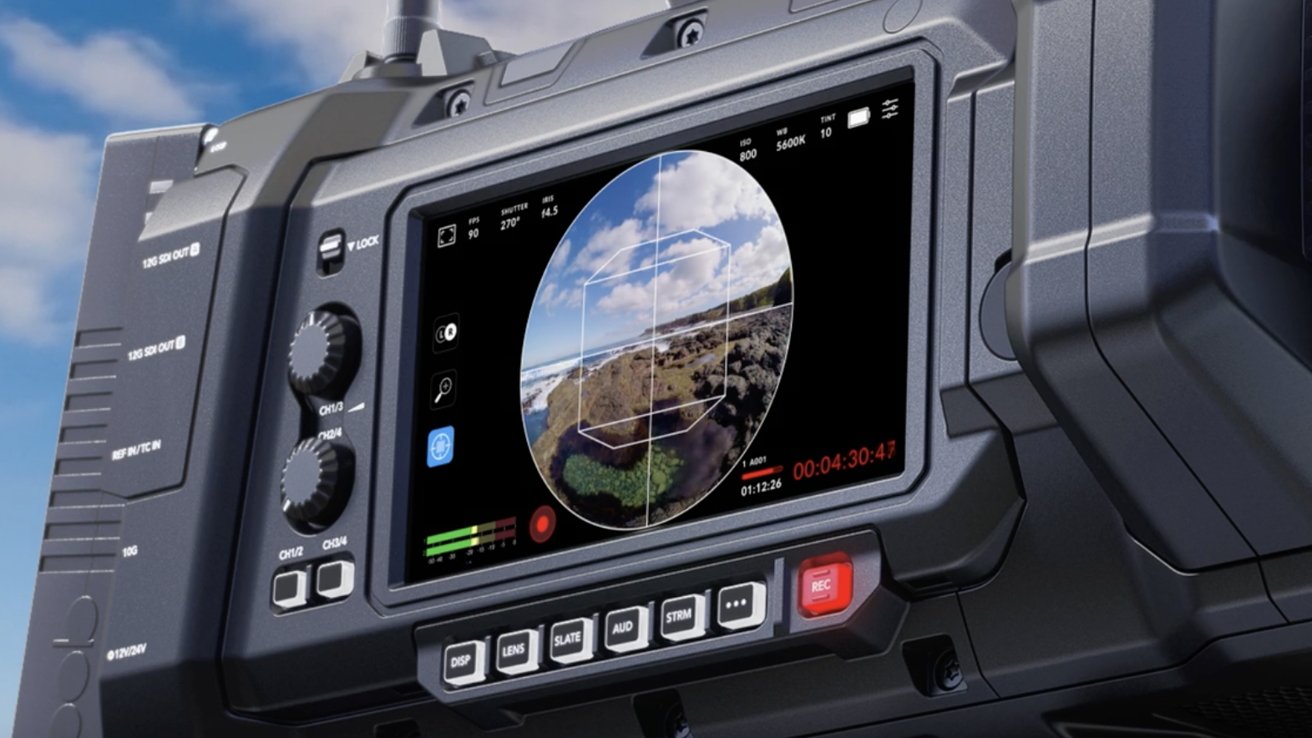
Blackmagic's URSA Cine Immersive features a touchscreen. Image Credit: Blackmagic.
For connectivity, the Blackmagic URSA Cine Immersive camera offers two independent 12G-SDI outputs, 10G Ethernet, USB-C, XLR audio, and more. On the front, a 3-pin Fischer connector supports 24V of power, which Blackmagic says is useful for onboard accessories.
On the back, the device has a 2-pin LEMO power connector and support for low-voltage accessories. There's also an 8-pin Lemo power connector, which enables support for 12V and 24V power supplies. The camera ships with a 250W power supply.
Blackmagic also announced the URSA Cine Immersive 100G, which is essentially the same camera, but with dual 8Kx8K RGBW sensors and faster 100G Ethernet. This allows for SMPTE-2110 live video output.
With either model, the body of the camera is made up of a magnesium alloy chassis, with a carbon fiber polycarbonate composite skin. This allows for added strength and even weight distribution. A removable sunshade is offered as well.
More professional Apple Vision Pro content is on its way
The $29,995 price tag of the Blackmagic URSA Cine Immersive is indicative of the camera's commercial nature. Grant Petty, the company's CEO, has even said that Blackmagic is "looking forward to working closely with filmmakers" on Apple Immersive Video.

The Apple Vision Pro offers exclusive immersive content, like World of Redbull.
"With this innovative system, filmmakers can record remarkable moments like action-packed scenes, unique perspectives, stunning landscapes, intimate performances, and more, all with incredible fidelity, offering viewers an unparalleled sense of realism and immersion," explained Petty.
While Apple Vision Pro users can already enjoy exclusive content, it has so far mainly come from Apple itself, with few third-party contributions. In theory, this could change once the Blackmagic URSA Cine Immersive reaches more filmmakers. However, there are reasons for doubt.
The uncompetitive price of the Blackmagic URSA Cine Immersive camera means it's actually unlikely to result in more third-party content for the Apple Vision Pro. Similar products, such as the V-RAPTOR 8K VV, a high-end RED camera, can be bought for approximately $24,000 to $30,000 new.
The arrival of the Blackmagic URSA Cine Immersive camera ultimately means that professional filmmakers have more options, though it is unlikely we will see a drastic increase in third-party content for the Apple Vision Pro as a result.