
Apple's Mac mini is in extremely short supply, under pressure because of demand for good AI hardware, and RAM shortages. M5 Mac minis are expected, but what about a MacBook Neo approach to a new Mac mini for people who want to get work done?
Beyond having the components, Apple has all of the elements to make a "Mac Neo" Mac mini adjunct. There is proof of market demand, and proof in the company's own historical trends.
Steve Jobs, for instance, famously introduced his quadrant of devices with pro and consumer laptops, and the pro and consumer desktops. Later he expanded it into a 2x3 array.
And that's where the Mac Neo fits.
With the MacBook Neo, we've now seen the latest version of that consumer notebook. And given the crush on supply, there is a gap to be filled with a lower-cost consumer desktop that will work and play well, but not do that well with AI tasking.
It would have to be markedly less expensive than even the Mac mini to justify its place in the lineup. As the original Mac mini proved, in a G4 and G5 world, it can be done.
Apple has demonstrated a willingness to shoot at the lower-end desktop Mac market. It can do this by carrying forward the use of an iPhone processor in the MacBook Neo. That MacBook Neo has a binned A18 Pro, the processor that powered the iPhone 16 Pro in 2024.
Flash forward to 2026 and Apple's current iPhone 17 Pro, iPhone 17 Pro Max, are all the A19 Pro the same as the iPhone 16 Pro used the A18 Pro. If the yield remains roughly the same as for the A18 Pro, Apple will have a lot of binned processors that could go into a Mac Neo.
We'd be fine with the binned A19 Pro in the iPhone Air, honestly.
Even if the yield is perfect, and it never is, Apple is making millions of the A19 Pro. Keeping the production line going a little longer is always more cost effective than having to spin up a new one, or relaunch an old line.
MacBook Neo started a trend
The underlying architecture is the same, but processors from iPhones are not as powerful as M-series ones from Macs, given the same process, and the same year. The MacBook Neo demonstrates that they are powerful enough for what most users do most often.
Those tend to be tasks that need only a single core, such as opening applications, or browsing the web. For that, the MacBook Neo's A18 Pro compares very well with the iPhone 17 Pro Max and the current Mac mini.
For simplicity's sake, we're using the full A19 Pro chip throughout here.
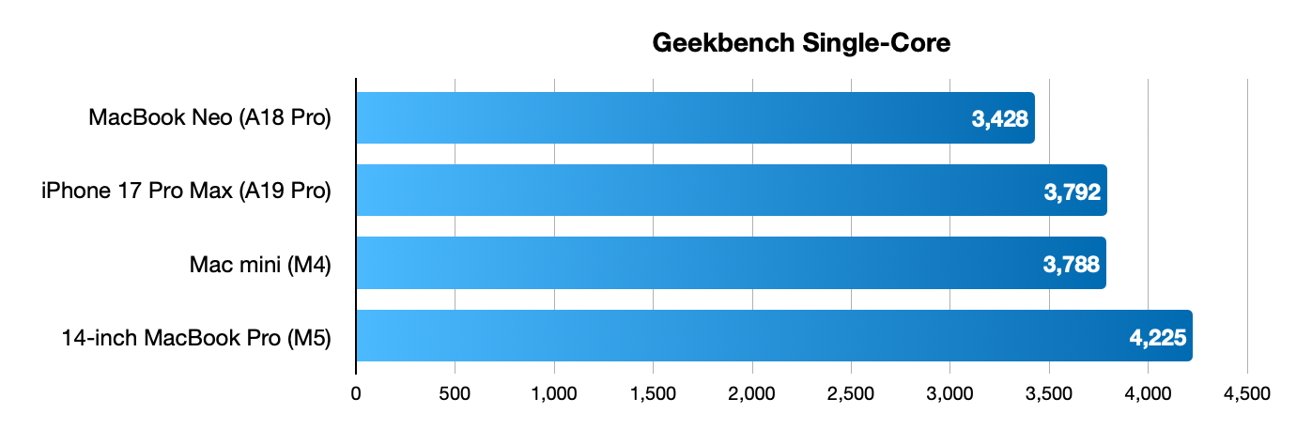
For most typical computer tasks, the MacBook Neo stands up well and an A19 Pro in a future Mac Neo would do to - image credit: Malcolm Owen
The Mac mini is likely to be upgraded to have an M5 processor shortly, which will increase the gap between it and the MacBook Neo. But at present, the single-core score in Geekbench testing shows the Mac mini and iPhone 17 Pro Max having roughly 10% greater performance than the MacBook Neo.
That is a significant difference because it's at the 10% mark that users can see an appreciable improvement. Then on the Geekbench multi-core tests, for science work, video editing, and other processor-intensive tasks, the MacBook Neo is a little bit left in the dust.
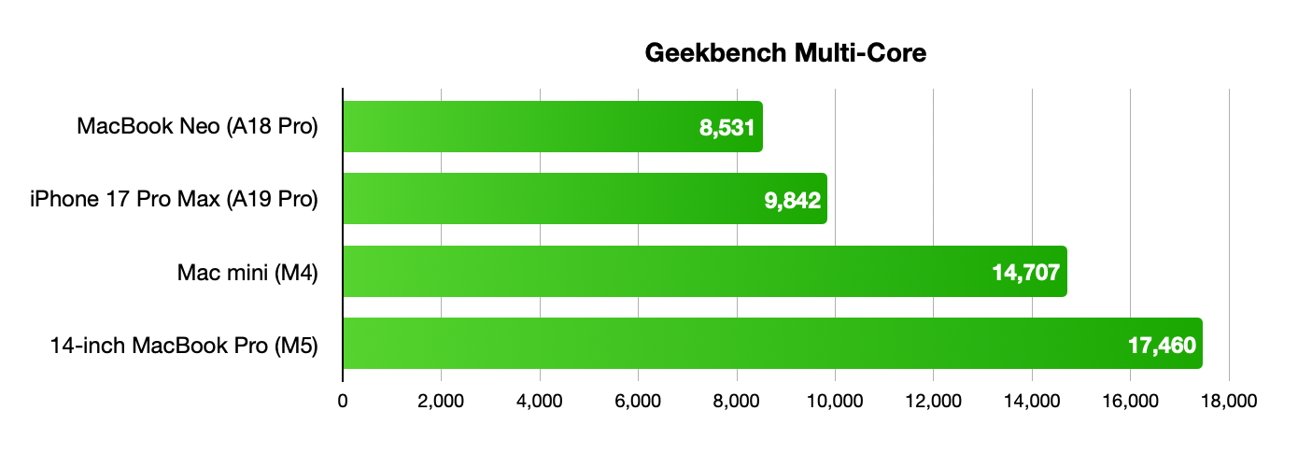
A Mac Neo using an A19 Processor would fall behind on intensive tasks such as video editing - image credit: Malcolm Owen
Save incredible rendering power for the Max and Ultra chips. A19 Pro would be just fine for most uses, and faster than the M2 mini.
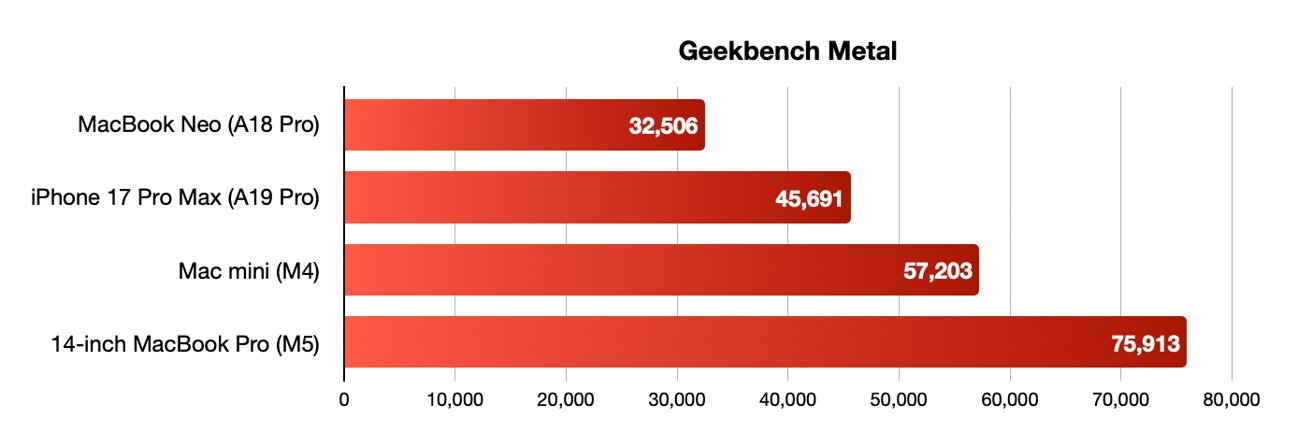
The performance difference between a Mac Neo and other Macs would at times be appreciable, but only at times - image credit: Malcolm Owen
And that's fine. Like the MacBook Neo, not everything needs to have gobs of RAM. Not everything needs to be an AI powerhouse with now very expensive RAM.
Using an A19 Pro processor with a fixed 12GB of RAM, instead of 16GB or more in the Mac mini would mostly keep it out of the hands of the AI-devout. It remains that even as it stands now, a Mac Neo with A19 Pro processor would work well for the giant majority of Mac users.
Just as with the MacBook Neo, the fact that a Mac Neo wouldn't be right for everyone, doesn't matter. It might even help Apple and its users, because the distinction between devices is clearer than ever.
If you're doing video, audio, math, or science work, you would go for the Mac Studio or the Mac mini. Simple.
If you're not, if you're using a Mac for everyday tasks, you could buy a Mac Neo. And if you do, you probably won't have to fight AI fans to get one.
For Apple, more users on different classes of hardware, means a further amplification of Services revenue. Sooner or later, Services will cross iPhone sales for the biggest profit-maker for the company, and a Mac Neo will only help.
Apple has a chassis choice
There is an argument that Apple could build a Mac Neo into the chassis of the Apple TV 4K. We'd very much like this.
A small size paired with the right price would open up the Mac Neo for things a Raspberry Pi gets harnessed for now, with less DIY.
We'd even go for a return of a dual interface in conjunction with the macOS desktop, like Front Row used to live aside macOS X 10.3.7 in the G4 days.
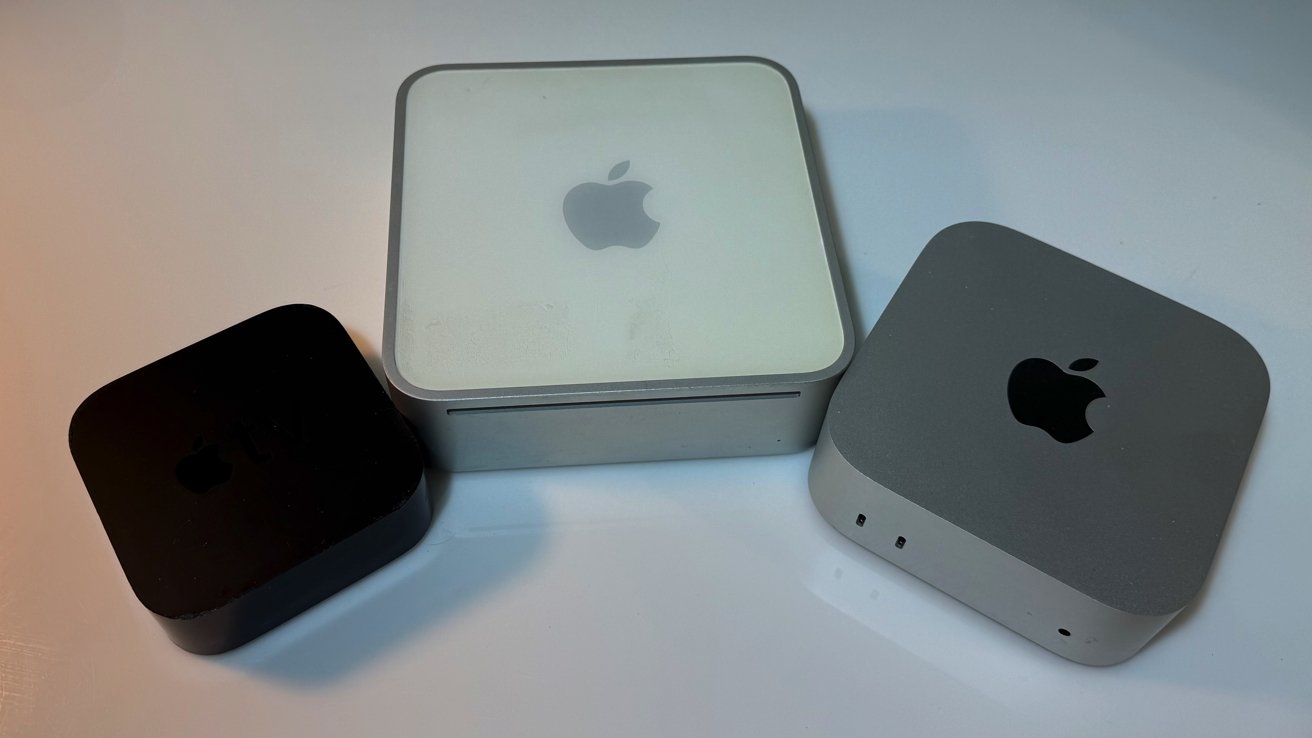
Left to right: Apple TV HD, G4 Mac mini, M4 Mac mini
The original Mac mini had an infrared receiver, and that could come back with this dual interface paradigm. One of the authors of this piece hooked up this original G4 Mac mini to his television, and controlled playback using just that.
That is, when he wasn't messing around on it using Apple Remote Desktop 2.0 from his G4 Mirrored Drive Door tower, and then his G5 tower.
There is even precedent for ports on this form factor. The second and third generation Apple TVs had the now antiquated micro USB, and the original Apple TV HD featured a USB-C port.
At the time the USB port of any flavor was for diagnostics and firmware recovery. It's all still there now, just in fancy pins above the ethernet port only accessible by a custom cable.
With A19 Pro, given what we know about PCI-E allocation, we'd expect a pair of 10 gigabit USB-C ports. Power demand being what it is, 35W USB-C power delivery would be fine to power the device from either a 10 Gbit dock, of which there are plenty, or a AC adapter.
And that lower peak power, means that Apple wouldn't have to have a relatively large AC to DC power supply inside the enclosure.
Keep the fan, though, regardless of enclosure. Let's do screws or that easy-open bottom plastic that's on the slim Mac mini chassis redesign to get inside. We've broken so many clips over the years opening up the G4 mini.
What Apple would most likely do, however, is make a Mac Neo very similar to the existing Mac mini enclosure. The MacBook Neo was designed from scratch as a new device, it wasn't that Apple took the MacBook Air and chipped away at it.
But the design of all Apple's laptops is roughly the same, and as such, the design of a Mac Neo could be similar to that of the Mac mini. It would just have fewer ports, given PCI-E allocation.
For this, we're fine with colored plastic. After all, that's how the Mac mini got started.
Pros and cons of the Mac Neo approach
You know Apple has already considered this, there's no way that they haven't. The company has already probably run the numbers, projecting costs versus estimated sales, the whole thing.
If the conclusion is that it won't make a Mac Neo, it would probably be over a concern for the rest of the Mac range. At $599, the MacBook Neo is near enough half the cost of the MacBook Air's $1,099, but it's also identical to the Mac mini's current starting price.
The Mac mini is already extraordinarily good value, especially since its M4-based redesign. When you can find one.
The days of the $399 MicroCenter M4 Mac mini are gone. They were ended by OpenClaw meme posts, and RAM shortages. Instead, for the last few months, we've been in that eternal period where any device is weeks or months away from shipping.
With such a narrow gap between the Mac mini and any lower priced Mac Neo, there would be collateral damage. Some potential buyers would go for the lower-cost device, assuming there were any of the higher-cost devices to be had.
And a Mac Neo at that lower price would bring in new users just as the MacBook Neo appears to have done.
If Apple could turn a profit on, say, a $299 Mac Neo, that changes the game for small desktops, again. The Windows PC industry might as well go home for most casual computing users.
And the AI faithful can stick with Mac mini or Mac Studio. Everybody wins.