Apple has unveiled its next Mac operating system, macOS Golden Gate, with Apple promising better performance, the improved Siri, and more.
The new macOS 27 has been revealed during the WWDC 2026 opening keynote, and while not as substantial a new release as macOS Tahoe, it does bring some key new features to the Mac.
It also continues Apple's edging of its platforms closer together, with more iPhone features making their way to macOS. Specifically, the Mac is part of the Apple ecosystem-wide child protection features, such as having parents limiting access to apps.
But it also means that the Mac gains Siri AI, the new cross-platform update to Siri that promises to radically improve it. Instead of the old "Type to Siri" feature, users can now enter prompts into Spotlight.
Spotlight recognizes an AI request and passes it to the Siri AI chatbot. That can now access a user's own data, while preserving privacy, plus it has "World Knowledge" which means it can also retrieve information from the web.
The new Siri AI chatbot allows for conversations, meaning that follow-up questions and prompts can be added. Those conversations are also available across Mac, iPhone and iPad.
Nonetheless, other than Siri AI, this release is refinement more than a departure. That means it does of course retain the Liquid Glass design look that was introduced in 2025.
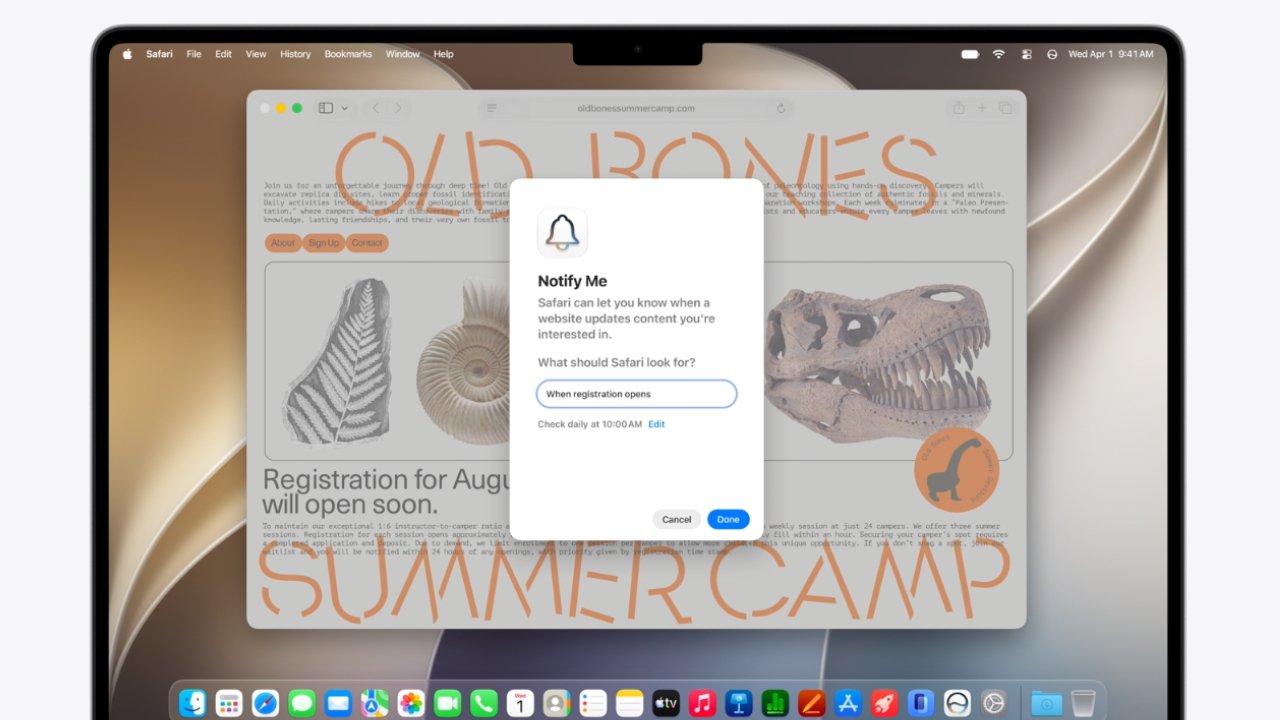
The new macOS Golden Gate can notify users when a selected website is updated - image credit: Apple
That was always going to be the case, even if vocal critics of Liquid Glass wished otherwise. Apple will always iterate, and it will sometimes make larger leaps forward, but it won't go back.
Nor should it. The complaints against Liquid Glass are valid but small, and the new macOS 27 also addresses some of those.
Apple gives and Apple takes away
On the surface, macOS Golden Gate is not as significant an upgrade as macOS Big Sur, or even macOS Tahoe with its Liquid Glass redesign. But under the surface, it is much more significant than it seems.

Safari can now group related tabs into groups automatically - image credit: Apple
Apple has chosen this release to draw a line in the sand. For the first time, the new macOS Golden Gate will not support Macs that have Intel processors.
It's long been the case that Intel Macs have failed to get important new features, because they required Apple Silicon to work. But now there isn't even that.
This is a shame if you still use Intel Macs, of course, but it's a change that is necessary, and has been a long time coming. Six years, in fact.
That's how long ago Apple began the move away from Intel so it's remarkable that it stayed compatible for this long.
Nonetheless, as of when this is released to the public in September or October, no Intel Macs will ever be supported again.
Don't use betas
Every year, the last thing Apple does before publicly releasing macOS is to tune it up for performance.

Craig Federighi introduces macOS Golden Gate - image credit: Apple
So the beta version released today will have none of that. It will drain your MacBook battery faster now than it will in September, for instance.
Plus there will be bugs, there will be incompatibilities. What there won't be is a truly compelling reason for you to risk using a beta test macOS Golden Gate on your work Mac.
That's true now when the developer beta is out, and nothing will change when the public beta is released in a few weeks' time. Developers have to have this version in order to test their apps, but no one else does.
So even while the new macOS Golden Gate does have these features that are very promising, wait until they're released officially. Apple is not paying you to test its macOS and if there weren't a chance you could lose your data, it wouldn't be a test release.