
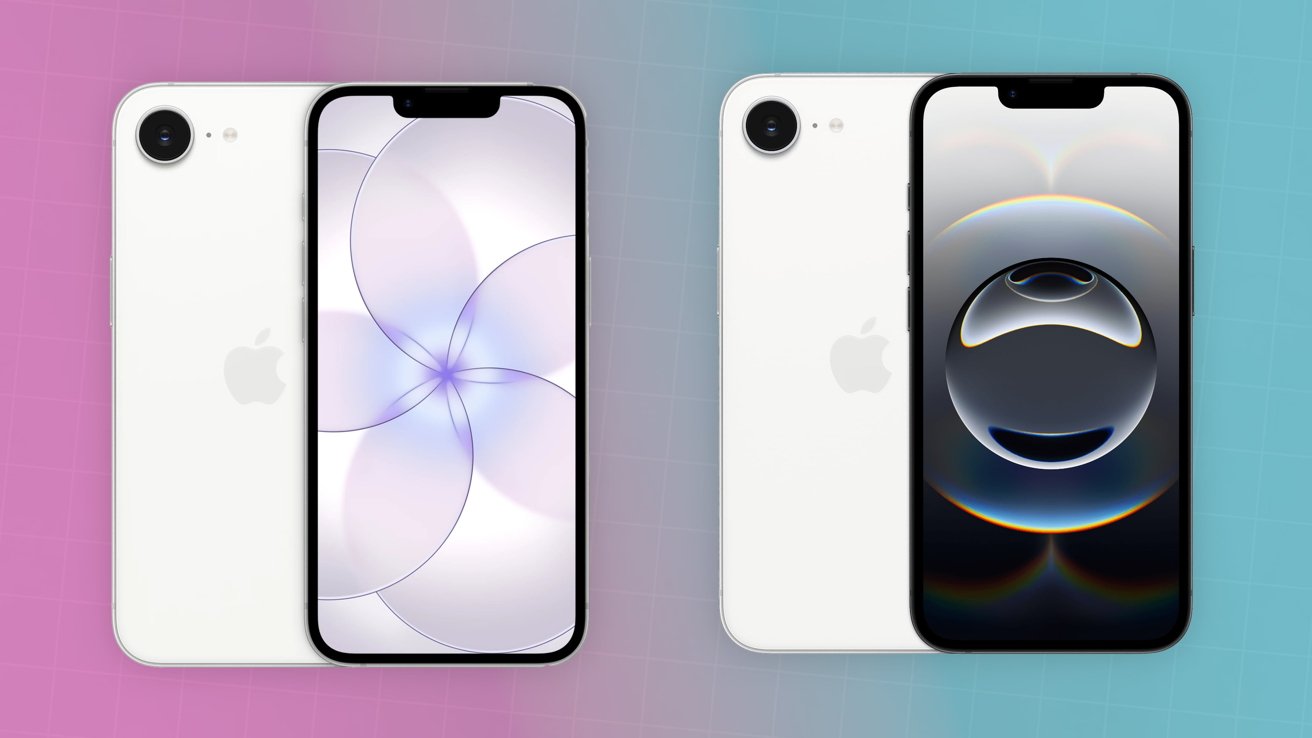
The iPhone 17e is here, and it brings a performance boost and MagSafe to Apple's value-focused smartphone. Here's how it compares to its predecessor, the iPhone 16e.
The iPhone 16e was introduced in February 2025 as a replacement for the iPhone SE line, becoming the budget option of the iPhone roster. There was a suspicion that Apple could turn the once-periodic iPhone SE updates into a yearly affair under the e-line, and Apple has done just that.
One year later, the iPhone 17e now becomes the choice for consumers with a more limited budget. The model that provides iPhone 17-like performance but with enough money to buy accessories and other essentials of life.

However, the now-annual update means the model will have to deal with more granular changes to the format.
Here's a comparison of the spec-sheets of the iPhone 16e and the newcomer, the iPhone 17e, to show how similar or different the two generations truly are.
iPhone 17e vs iPhone 16e - Specifications
| Specifications | iPhone 17e | iPhone 16e |
|---|---|---|
| Starting Price (launch) | $599 | $599 Best iPhone 16e prices |
| Dimensions (inches) | 5.78 x 2.82 x 0.31 | 5.78 x 2.82 x 0.31 |
| Weight (ounces) | 5.96 | 5.88 |
| Side controls | Action Button | Action Button |
| Processor | A19 4-core GPU | A18 4-core GPU |
| Storage | 256GB, 512GB | 128GB, 256GB, 512GB |
| Display type | 6.1-inch Super Retina XDR | 6.1-inch Super Retina XDR |
| Resolution | 2,532 x 1,170 at 460ppi | 2,532 x 1,170 at 460ppi |
| True Tone | Yes | Yes |
| Biometrics | Face ID | Face ID |
| Connectivity | 5G (Sub-6GHz only), Gigabit-class LTE, Wi-Fi 6E, Bluetooth 5.3, NFC Emergency SOS via Satellite, Roadside Assistance via Satellite, USB-C (USB 2) | 5G (Sub-6GHz only), Gigabit-class LTE, Wi-Fi 6, Bluetooth 5.3, NFC Emergency SOS via Satellite, Roadside Assistance via Satellite, USB-C (USB 2) |
| Rear Cameras | 48MP Fusion | 48MP Fusion |
| Video | 4K 60fps, 4K 60fps HDR with Dolby Vision, 1080p 240fps Slo-Mo, Optical image stabilization, | 4K 60fps, 4K 60fps HDR with Dolby Vision, 1080p 240fps Slo-Mo, Optical image stabilization, |
| Front Camera | 12MP TrueDepth, Autofocus | 12MP TrueDepth, Autofocus |
| Battery Size (Video playback time) | Up to 26 hours | Up to 26 hours |
| Wireless Charging | MagSafe 15W | Qi 7.5W |
| Colors | Black, White | Black, White |
iPhone 17e vs iPhone 16e - Physical Dimensions
The iPhone 16e was a smartphone that used the fairly typical iPhone design cues of its more expensive models. Made with aluminum, it has a flat metal band around the outside, with ceramic shield glass at the front and a glass back too.

iPhone 17e vs iPhone 16e: The physical design is unchanged.
On the edges are the usual buttons for volume, waking the iPhone, and the Action Button, while the base has speaker holes and a USB-C connection.
This design has been mirrored by the iPhone 17e. The only real difference is Aple's use of Ceramic Shield 2 for the front glass, which has triple the scratch resistance of the first version.
iPhone 16e
When it comes to dimensions, the iPhone 16e was 5.78 inches long, 2.82 inches wide, and 0.31 inches thick. Unsurprisingly, the iPhone 17e is the same on all fronts here.
The weight of the iPhone 16e was 5.88 ounces. As you can guess, the iPhone 17e is almost identical, but a marginally heavier 5.96 ounces.
In this annual update, there's not really an apparent external difference here. Really, the changes are all internal.
iPhone 17e vs iPhone 16e - Display
The iPhone 16e's Super Retina XDR display borrowed many aspects from its more expensive stablemates. At 6.1 inches, its OLED screen offered a lot of space for users to look at.
Its 2,532 by 1,170 resolution equates to 460 pixels per inch, fitting into Apple's usual pixel density ballpark for its handsets.
All of these are identical on the iPhone 17e.

iPhone 17e vs iPhone 16e: No change to the display either.
When it comes to brightness, the iPhone 16e could manage an admirable 800 nits for typical usage, or 1,200 nits at its peak for HDR content. The iPhone 17e matches this too, along with the 2,000,000:1 contrast ratio.
The iPhone 16e also had HDR support, True Tone, Wide color (P3), Haptic Touch, and a fingerprint-resistant oleophobic coating. All of which is also present on the iPhone 17e.
At the top is where the TrueDepth camera lies in both the iPhone 16e and iPhone 17e. The Dynamic Island did not come to iPhone 17e, as was rumored, so the dreaded notch remains.
iPhone 17e vs iPhone 16e - Cameras
As the budget option, the iPhone 16e didn't surprise anyone by having a single camera on the back. It may only be one, but it was also quite capable.
The 48MP Fusion camera had Hybrid Focus Pixels, a 10x digital zoom, the Photonic Engine and Deep Fusion computational photography trickery, and features like Smart HDR 5, Portrait Lighting, and Night Mode. This also included optical image stabilization for less blurry shots.
It also had a 12MP 2x Telephoto zoom, complete with optical image stabilization and the same feature set as the Fusion camera. However, this was due to it being a little trick to create a virtual camera.

iPhone 17e vs iPhone 16e: It's already a good camera in the iPhone 16e. The 17e sticks with it.
Really, the Telephoto zoom camera is a cropped-down version of the 48MP sensor, so it's just using the middle block of pixels. This does create an optical-like "zoom," but at 12MP, not 48MP.
Apple has done nothing to the hardware in this setup for the iPhone 17e. If it works, why break it?
It does say that there are "Next-Generation" portraits with Focus and Depth Control in the iPhone 17e, but that's it.
For video, the iPhone 16e wasn't a slouch, as it could capture 4K footage in Dolby Vision at 60fps. It could also use optical image stabilization for video, had a 6x digital zoom, and could handle Slo-mo footage at 1080p 240fps.
The video capabilities also included cinematic video stabilization in 4K, continuous autofocus, and a Night Mode with time-lapse. Sound capture extended to Audio Zoom, Spatial Audio with stereo recording, Audio Mix, and wind noise reduction.
Again, the iPhone 17e is capable of all of this.
At the front of both models is the TrueDepth camera, an array that handles Face ID and has depth mapping capabilities.
In both cases, that means a camera system with Deep Fusion and Photonic Engine, Animoji and Memoji support, Portrait mode with Portrait Lighting, Photographic Styles, Night Mode, and automatic image stabilization.
Video for both runs to 4K Dolby Vision at 60fps, and 1080p 120fps slo-mo.
There's no material difference in camera quality at play here, but the iPhone 17e should benefit from its higher grade of processing performance.
iPhone 17e vs iPhone 16e - Processing and Performance
The main difference is in the chip, as Apple has migrated from an A18 in the iPhone 16e to the A19 in the iPhone 17e.
The A18 has a six-core CPU, with two performance cores and four efficiency cores. They are flanked by a four-core GPU, complete with hardware-accelerated ray tracing.
The A19 is a newer version that follows the same pattern of a six-core CPU in an identical core ratio. The GPU is, again a four-core version, which is also one less than the A19 in the main iPhone 17.
However, the big difference here are those GPU cores, as Apple has retained the addition of Neural Accelerators in each GPU core. This will give it a big upgrade to machine learning and Apple Intelligence features over the A18.
The Neural Engine is also identical, using a 16-core version. But again, those GPU cores come into play for the A19.

Geekbench Single-Core benchmarks between the iPhone 16e's A18 and the iPhone 17's A19
When it comes to benchmark comparisons, things get muddier because of Apple's decision to lose a GPU core, which affects some of the results. The demonstrative comparison will use the iPhone 17's Geekbench results, but bear in mind the GPU result will be closer between the e-models.
To Geekbench, and the single-core figures show the A18 in the iPhone 16e as scoring 3,242, versus 3,627 for the A19 in the iPhone 17.
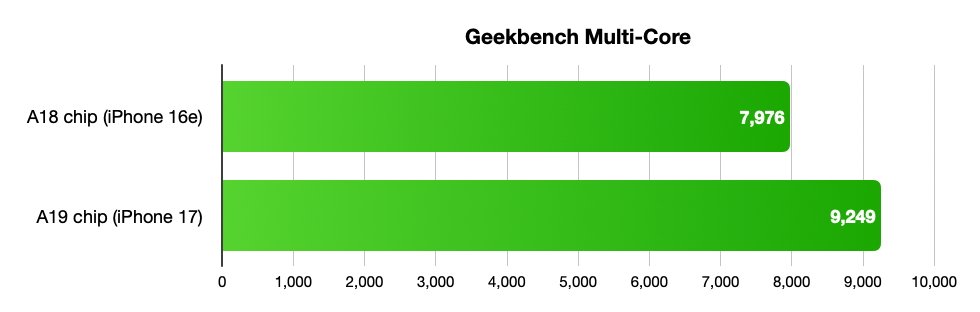
Geekbench Multi-Core benchmarks between the iPhone 16e's A18 and the iPhone 17's A19
For multi-core, the results are similarly staggered, at 7,976 for the A18, 9,249 for the A19. That's a 12% improvement for single-core tasks, 16% for multi-core testing.
When looking at Metal, we see an almost doubling in performance between the hobbled A18 GPU in the iPhone 16e and the supercharged A19 with one more GPU core in the iPhone 17. The score of 23,888 to 37,146 is very one-sided.
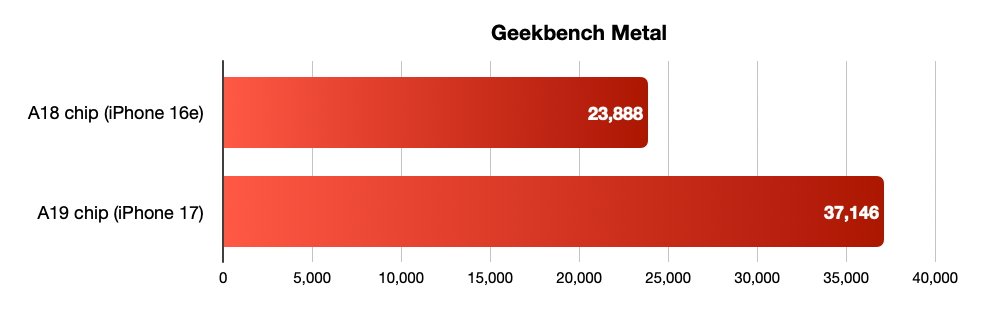
Geekbench Metal benchmarks between the iPhone 16e's A18 four-core GPU and the iPhone 17's A19 five-core version.
It's safe to say that the graphical performance in the A19 for the iPhone 17e will be considerably better when its benchmarks hit. It won't quite be iPhone 17-tier, but it will be substantial.
iPhone 17e vs iPhone 16e - Connectivity
On the physical connection side, the iPhone 16e had USB-C, but it operated at USB 2 speeds. That meant transfers of data at up to 480Mb/s, instead of the gigabit speeds enjoyed by the Pro models.
That port was better off left for charging purposes.

iPhone 17e vs iPhone 16e: USB-C at USB 2.0 speeds prevail.
Apple hasn't improved this element, and it makes sense not to. The iPhone 17 didn't gain USB 3 speeds, so why should the budget option?
For cellular, the iPhone 16e uses the C1 modem, which Apple designed. This meant it could connect to 5G networks with 4x4 MIMO using sub-6GHz bands, but not the faster mmWave bands.
The iPhone 17e doesn't really change things here, as it's still a sub-6GHz connection but on the C1X modem instead.
For more localized connections, Apple uses the N1 wireless networking chip in the iPhone 17e, making it capable of working with Wi-Fi 6E networks and Bluetooth 5.3. The iPhone 16e could use Wi-Fi 6 and Bluetooth 5.3.
Sure, the iPhone 17e could use better classes of Wi-Fi networks and their relative speeds, but you would need that infrastructure to be in place in order to use it.
NFC is present in both models, as well as Apple's Satellite-based connectivity. In both model generations, you can use Emergency SOS via Satellite and Roadside Assistance via Satellite, if you happen to be in a complete signal black spot.
Apple didn't include Thread or Ultra Wideband support in the iPhone 16e. There's no difference here for the iPhone 17e.
iPhone 17e vs iPhone 16e - Power and Battery
With a similarly-sized device and with minimal changes, you'd expect the battery life of each to be in roughly the same ballpark. And you would be right.
For the iPhone 16e, Apple claims its battery can last for up to 26 hours of video playback, 21 hours if streamed. This is the same in the iPhone 17e.
When it comes to charging that battery, you can use Qi on the iPhone 16e, which is limited to 7.5W of wireless charging. However, the absent MagSafe comes back in the iPhone 17e, complete with support for up to 15W.
Using USB-C to recharge hasn't really changed, with each claimed to get to a 50% charge within 30 minutes.
iPhone 17e vs iPhone 16e - Capacity, Color, and Pricing
Apple shipped the iPhone 16e in a spartan choice of two colors: Black or White. There were also three options, with the 128GB priced at $599, the 256GB for $699, and the 512GB for $899.
The iPhone 17e differs here in that there are three colors: Black, White, and Soft Pink. The storage options have also shrunk, with the 128GB gone in favor of the 256GB being the starter at $599, rising to $799 for the 512GB.
The pricing relative to storage capacity has improved, despite the current memory chip climate.
iPhone 17e vs iPhone 16e - An annual spec-bump
When Apple introduced the iPhone 16e, it was a big update from the iPhone SE that preceded it. The change also lined Apple up perfectly to take a more proactive approach to improving the model more frequently, if it did well enough to warrant such an action.
Evidently, it did enough as a budget choice for consumers that Apple decided to do just that.
Since it is an annual update with less time between generations, it does come with the problem of potentially fewer changes to be made to the design.
There are fewer changes, certainly, but they're also in the areas you would expect those changes to be made. Indeed, if you didn't know about MagSafe or the chips inside it, you wouldn't necessarily be able to tell the difference between the two models.

iPhone 17e vs iPhone 16e: Still the budget iPhone option.
As it stands, the iPhone 17e will now replace the iPhone 16e as the lowest-priced current-generation model on the iPhone roster. At least, among those you can buy that Apple currently sells.
Existing iPhone 16e owners won't find much to warrant an upgrade after a year here. If the performance bump was important, they'd be considering the full-bore Pro models instead.
But for owners of much older iPhones, like the iPhone XR or the last iPhone SE, the iPhone 17e is probably the choice to go for now. That is, unless they're willing to splash out on one of the upper-tier options instead.
Where to buy Apple's iPhone 17e vs iPhone 16e
Preorders for Apple's iPhone 17e begin on March 4, with wireless carriers T-Mobile, Verizon, and AT&T expected to offer incentives right out of the gate.
You can also snag a deal on the iPhone 16e at wireless carriers, with prices starting at $0 per month after bill credits.
Get an iPhone 16e from $0/mo
- AT&T Wireless: Grab an iPhone 16e for as low as $0 per month* with bill credits
- Verizon: Save $600* on the iPhone 16e with a new line and select Unlimited plan *Terms and conditions pertaining to each offer can be found on the specific carrier's site.


