Friday, September 28, 2012, 06:27 pm
Apple sued by 'patent troll' over Numbers software
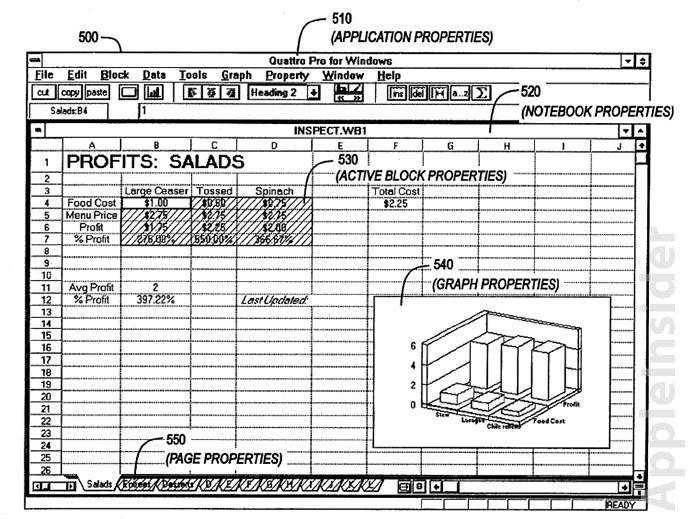
In a court filing on Wednesday, a Texas-based non-practicing entity sued Apple for alleged patent infringement regarding the company's Numbers spreadsheet software.The U.S. District Court for the Eastern District of Texas, Tyler Division, accepted the suit from Data Engine Technologies LLC, which claims Apple's Numbers infringes on a 1995 patent for a "system and methods for improved spreadsheet interface with user-familiar objects," reports CNET.

Illustration from Data Engine Technologies' spreadsheet patent. | Source: USPTO
First discovered by Priorsmart, the suit alleges that Apple had prior knowledge of the patent as early as 2010 and went on to cite the IP in its own 2007 patent for manipulating spreadsheet cells.
The property being asserted is U.S. Patent No. 5,463,724, which was granted to Borland International and later purchased by Data Technologies, a non-practicing entity or "patent troll."
Apple first rolled out Numbers in 2007 as part of the iWork '08 software suite and went on to expand the software's capabilities by introducing it on the mobile iOS platform in 2010.
The suit is seeking damages and an injunction against Apple's infringing products, most likely in the hopes that Apple will settle out of court to avoid a possibly lengthy trial process.
On Topic: patents
- Apple's iPhone e-wallet concept suggests payment options based on context
- Apple's 'social camera flash' connects multiple iPhones, iPads to light a scene
- Apple patent lets users control a device with taps, thumps and scratches
- Apple wins utility patent for MacBook's trackpad design
- Judge orders Google to hand over search documents in Samsung patent case


Will you stop with the silly patent troll nonsense?
The rightful owner of a patent has the right to enforce it whether they are using it or not.
It's like this. Let's say that you inherit a factory from your parents that was used to make widgets and includes all the equipment you need to manufacture widgets. You don't want to make widgets, so you sell the factory to a real estate investor who will then rent it to someone who wants to make widgets.
Does the fact that you don't make widgets mean that someone else can just move in and start using your factory without permission? Does the fact that the real estate investor doesn't want to make widgets mean that anyone can move in without permission and start making widgets? So why should patents be any different? There is absolutely no requirement in US patent law (or any other country that I know of) that only allows you to enforce a patent if you are using it.