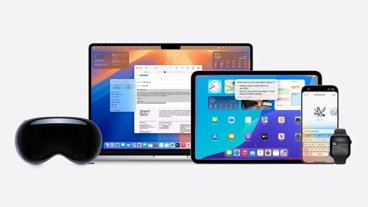
One could argue that Apple's current line of PowerBooks are among the most stylish on the market today, though an even fancier revolution is rumored to be on its way.
According to sources close to the computer maker, the upcoming PowerBook G4, which is code-named Mercury, will adopt several of the iBook's design qualities. For starters, the PowerBook's traditional solid-state recessed trackpad will apparently give way to a version of the iBook's graphite smooth trackpad.
Aside from being noticeably thinner than it's predecessor, Mercury is also said to conform to a rounder iBook-like enclosure, with the bottom of the unit closely mimicking that of the current iBook's. The top of the unit, however, is rumored to have changed only slightly from the current PowerBook design.
Dark blue-grey and graphite panels are said to make up the grip area and accents of the new units, while translucents similar to Apple's new Pro Mouse make up the remainder of the portable's chassis. (A similar enclosure design was developed and tested on Apple's Pismo PowerBooks that were introduced in February, but the design was scrapped prior to their introduction for unknown reasons.)
The current Mercury test units are also rumored to lack the traditional PowerBook latch that secures the display module to the base of the unit when it is close. Instead, Mercury will apparently snap shut like the company's iBook models.
Contrary to reports touted elsewhere on the web, Mercury is not expected to debut running at speeds of up to 750MHz or even beyond that of 500MHz. Test units have been spotted operating at speeds of up to 500MHz, though sources claim that technical issues may limit the portables release to 400 and 450MHz models.
Heat and power consumption limitations have already delayed the release of Mercury for several months, sources said. But a new revision of the 7400 G4 processor — pulling less wattage and producing less heat — has apparently been fine-tuned even further, allowing the computer maker to place the chips inside Mercury's cleverly ventilated enclosure.
"Apple appears to have the overheating problem under control," one source told AppleInsider. And rumors persist, that like Apple's iMacs, Mercury's cooling and ventilation system is produced via Apple's "fan-less technology." With the addition of quieter 10 and 20GB hard drives and lack of a fan, the units are said to be nearly silent.
According to sources, Mercury has yet to be finalized and the development team is apparently still implementing changes.