Apple built a global retail empire to sell iPhone, but most Americans still buy their devices from mobile carriers.
The company's relationship with carriers has been complicated from the beginning. When the iPhone launched in 2007, AT&T was the only option.
AT&T, Verizon, and T-Mobile still handle the majority of iPhone sales, and their influence has only grown. A report from Consumer Intelligence Research Partners (CIRP) shows that between July 2024 and June 2025, carriers accounted for more than three-quarters of U.S. iPhone sales.
Apple's own stores and website sold just 16%, down from 20% in 2023. Best Buy, Walmart, and other retailers lost ground as well, with carriers picking up the difference.
Carriers hold the keys
The numbers are both a strength and a weakness for Apple. Carriers give the company a distribution network far larger than its 250 U.S. stores. At the same time, Apple depends on salespeople whose incentives may favor Samsung or another brand.
Control of the customer's first impression often belongs to the carrier. A salesperson who offers a Samsung Galaxy phone with a slightly better monthly deal can derail Apple's pitch.
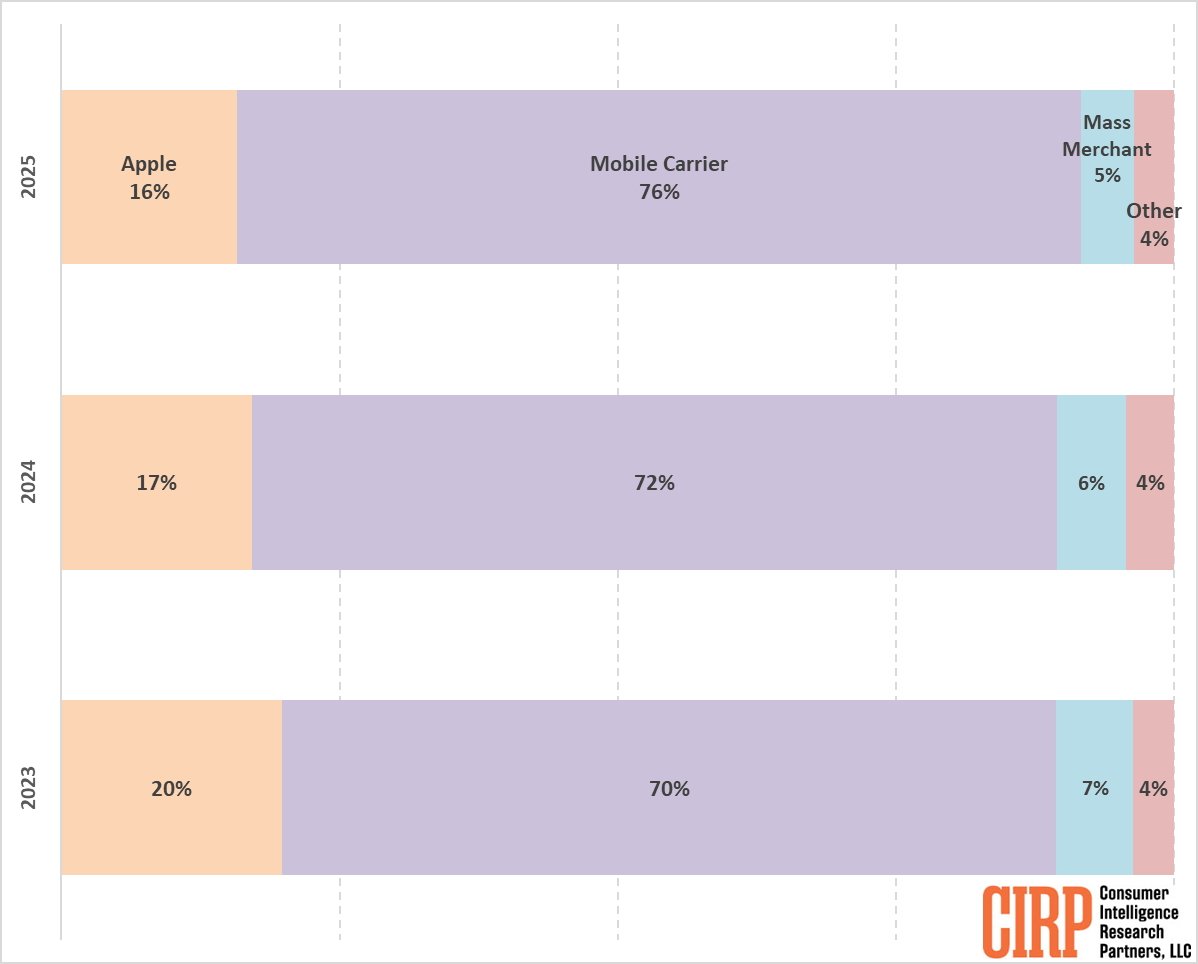
Share of US iPhone Retail Sales (twelve month ending June of each year). Image credit: CIRP
Apple stores, once designed to convert Windows users to Mac, now serve more as showrooms than the primary path for iPhone sales. Convenience keeps most buyers in the carrier channel.
Stores are everywhere, and the ability to roll a new phone into an existing bill is appealing. To many customers, the device feels like another line item for service, not a separate purchase.
Apple has tried to chip away at it with the iPhone Upgrade Program, but the scale doesn't compare with the reach of carrier plans. Even Apple's online store, open to everyone, struggles against "free" phone promotions and aggressive Trade-in deals that obscure the true cost.
A handful of flagship stores in major cities can't compete with the thousands of carrier outlets spread across suburban malls and small towns. For many people, the nearest Apple Store is still hours away. The closest carrier store is often down the street.
What Apple risks
Apple is at the risk of losing influence over the customer journey. Carrier employees may never mention AppleCare+, may downplay iCloud, or may steer a buyer toward a non-Apple smartwatch.
Those small choices shape customer behavior and eat away at Apple's ecosystem. The company has shifted heavily toward services revenue in recent years.
Success there depends on customers fully embedding themselves in Apple's platform. Anything that interrupts that process, like a salesperson pushing Android, threatens long-term growth.
The iPhone is still Apple's main source of revenue, and carriers remain the dominant gatekeepers in the U.S. The balance won't change unless Apple expands its own retail footprint or convinces more customers to buy directly.
Carriers know the power they hold and Apple knows it too. Consumers reinforce the dynamic every time they sign a new contract in a carrier store.