
Meta's new smart glasses are twice the price of the last pair, still look ugly, and Zuckerberg can't stop himself promoting what they don't do yet. But they are also definitely ahead of Apple in wearable glasses.
Having cancelled its competitor to Apple Vision Pro back in September 2024, Facebook parent company Meta is continuing to focus on an equivalent to the long-rumored Apple Glass. Its latest step is the announcement of Meta Ray Ban Display at this year's Meta Connect conference.
That conference opened with a very long and remarkably tedious sequence of CEO Mark Zuckerberg walking from a trailer and eventually stepping out in front of the audience. It was all shown, though, from the perspective of his Meta Ray Ban Display, which overlaid various congratulatory and fist-pumpingly enthused messages in his view.
Only, the sequence started with a shot of Zuckerberg reading his script, and the shot was taken from his glasses just before he put them on. Exactly this was done in fiction back in 1996 with the very first "Mission: Impossible" film, and then as now, it offered a creepy spy angle to the product.
Curiously, that same film had product placement from Apple, which meant Tom Cruise's character did some actual work in it, typing on a Apple Powerbook 540c.

Flash forward three decades, and it's still the case that the Apple Vision Pro is aimed at people working, while Meta's approach is about people watching. Meta's glasses come with safeguards so this isn't a criticism — it's a description of the very different approaches the two companies currently have.
If Apple does ever produce spectacle-like Apple Glasses, it will presumably too present concerns over its cameras.
Zuckerberg announced that what Meta wants is "to build great-looking glasses that deliver personal superintelligence and a feeling of presence using realistic holograms, and these ideas combined are what we call the metaverse."
Superintelligence and metaverse are two buzzwords for the price of one, and neither appear to be catching on. But then Zuckerberg is still promising more than he's delivering. Glasses will "very soon generate whatever UI you need right in your vision in real time," for instance, and there's "a new feature coming soon that is going to be able to amplify your friends' voices in your ear."
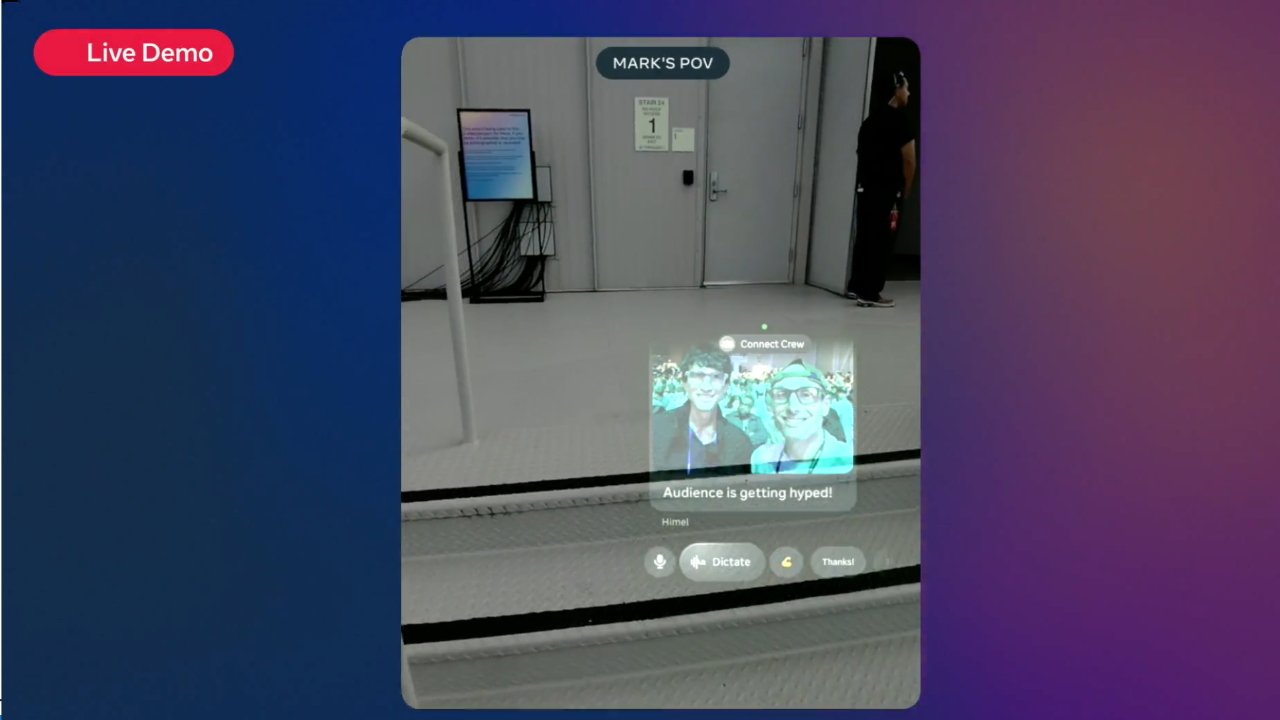
Mark Zuckerberg's view of some exciting steps and a door — image credit: Meta
What Meta is offering now — available from the end of September 2025 for $799 — is:
- 3K video recording
- 12 MP camera
- 3X zoom
- Viewfinder in the one in-lens display
- Double the battery life of the previous model
That battery life is claimed to be "up to six hours of mixed-use battery life per charge." Meta's sales page adds that "with the compact, folding charging case, you can enjoy up to 24 hours of additional use."
Then of course what Apple is offering now is more than four times as expensive. It's also much more a whole headset instead of glasses, so no one is going to walk around wearing Apple Vision Pro in its current form.
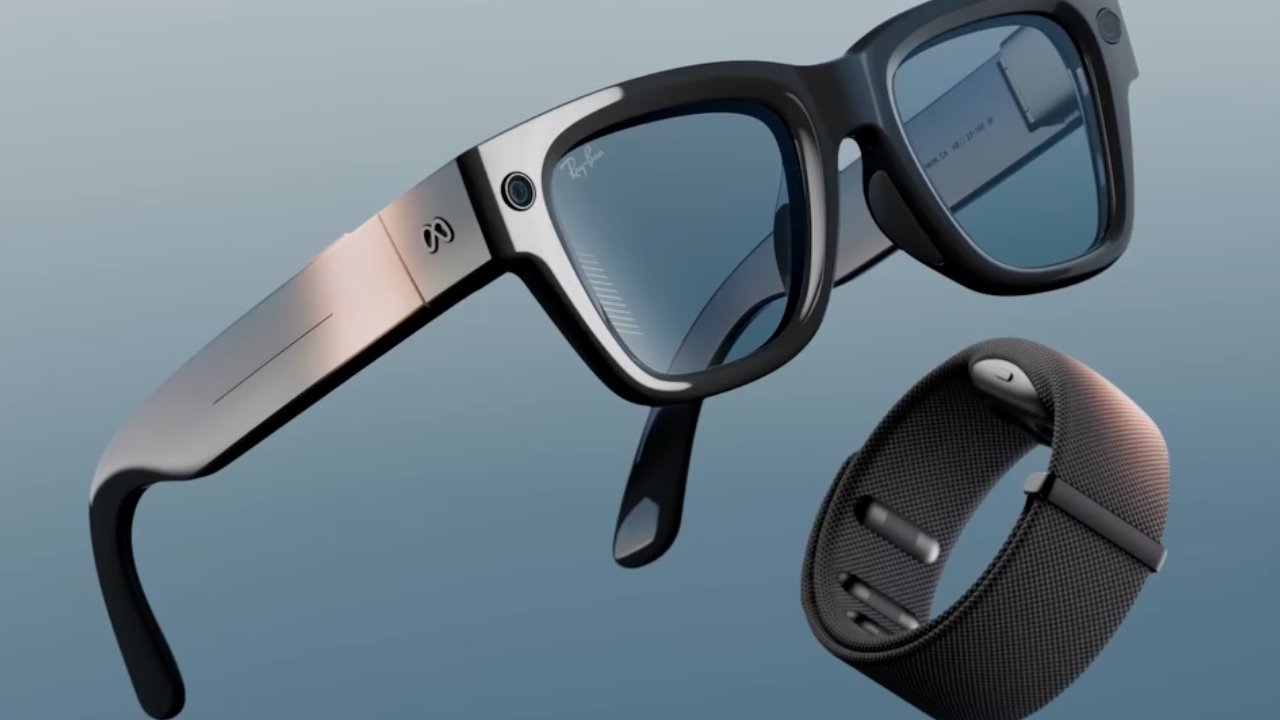
The new glasses come with a wrist-band controller — image credit: Meta
But then, Zuckerberg can say that "the glasses need to be well-designed and comfortable, and if you're gonna wear glasses on your face all day, every day, then they need to be refined in their aesthetics and they need to be light." Despite the implication, that doesn't mean the new Meta Ray Ban Displays are any of these things.
Despite being vastly closer to spectacles than Apple Vision Pro, it's still impossible not to notice that they are smart glasses. If you're of a certain age, you may think of them less as Ray Ban and more as "Joe 90" spectacles.
The future isn't quite here yet
The size of the glasses and the decreased but still present social awkwardness, may blunt sales of the Meta Ray Ban Display. The price, $500 more than the previous Ray Ban Meta glasses, will also be a barrier.
So will the name, for that matter. The Ray Ban Meta ones will continue to be available even as the new Meta Ray Ban Display launches. Maybe there's some significance in the rearranging of the company names, but certainly there's going to be confusion.
Yet if Meta's new glasses do in the real world what they claim to, there is a market here. According to BBC News, Meta is believed to have already sold around two million of its previous glasses.
That's not a very large number compared to, say, the 220 million iPhones expected to be sold in 2025. Especially since the figure may well include every such device, going back to the first Ray-Ban Stories in 2021.
For comparison, Apple is believed to have sold 500,000 of the Apple Vision Pro during 2024. Over the total lifespan of the two products to date, that's about half of what Meta has sold.
But then Meta's devices to date have started at $299, and Apple Vision Pro starts at $3,499. So Apple has to be making substantially more revenue, and presumably more profit.
It's still a very small business for the two companies, or at least certainly for Apple. But if Meta has done what it claims, it has further illustrated just what the future of Apple Glasses might be.