The teardown of the iPhone 17 Pro has provided more answers about scratches on the model, while also giving a close-up view of the vapor chamber cooling system.
The annual marathon of teardowns for the iPhone 17 range has continued. Following after the iPhone Air teardown on Saturday, it's now the turn of the iPhone 17 Pro to go under the iFixit microscope.
It's an exploration that isn't just about the components, but also one about the so-called "scratchgate" surrounding the model.
The teardown itself starts off with prying and suction cups, as well as the discovery of the loss of the dual-entry design. Previously, it allowed the screen or the rear glass to be removed, simplifying repairs.

While you can replace the back Ceramic Shield, the only thing you can do with the rear access is to change out the wireless charging coil. Instead, fixes for anything else in the iPhone will have to be done by removing the display first.
A battery surprise
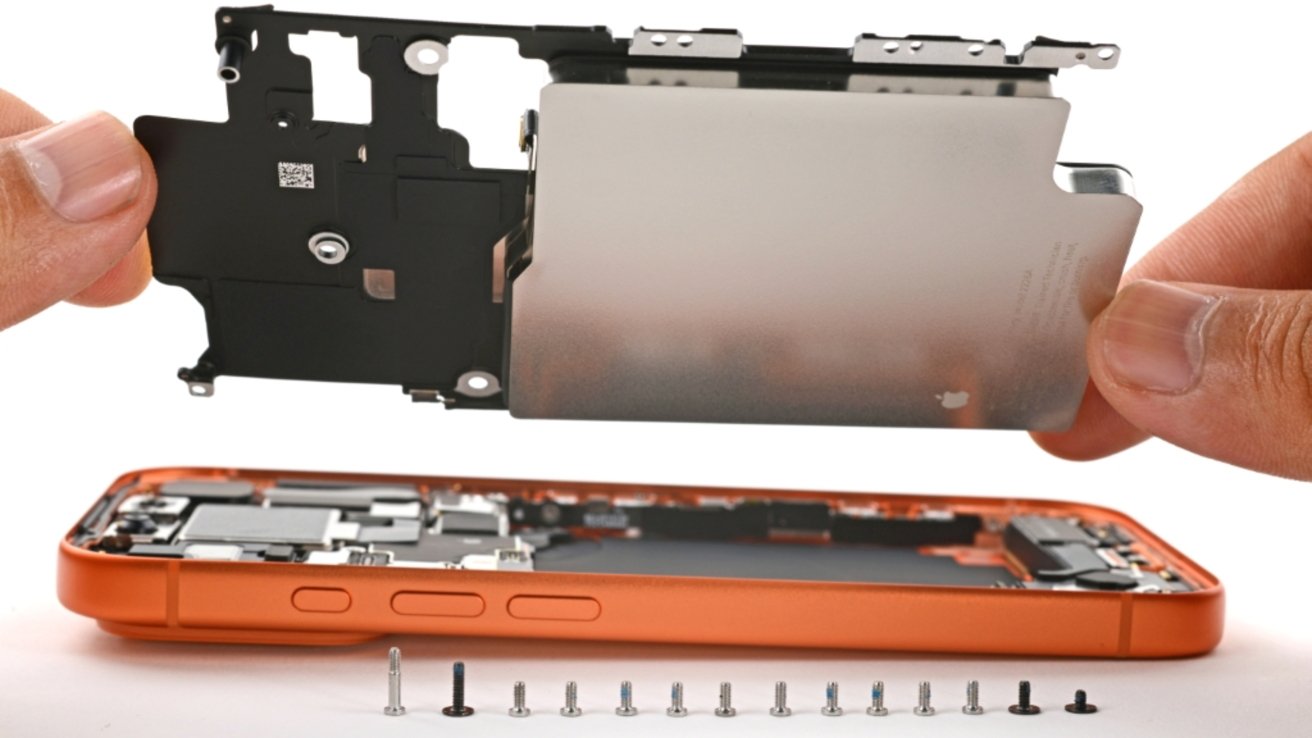
Removing the battery is typically a tricky affair, but this time around, the repair team was surprised to notice 14 new Torx Plus screws. After removing the screws, the battery was found to be attached to a plate, effectively making it a battery tray.
Apple is still using the electrically-debonding adhesive in this model. The purpose of the tray is seemingly to make it easier to apply the adhesive to the battery and the tray, with the possibility that Apple will sell the battery pre-adhered to the tray as a spare part.
The actual debonding process uses 12 volts and takes only 70 seconds to break down the glue.
Vapor chamber
One of the massive selling points of the iPhone 17 Pro is the use of vapor chamber cooling for the first time in an iPhone. The addition is a thermal management technique that uses liquid trapped in a reservoir to wick heat away from connected chips.
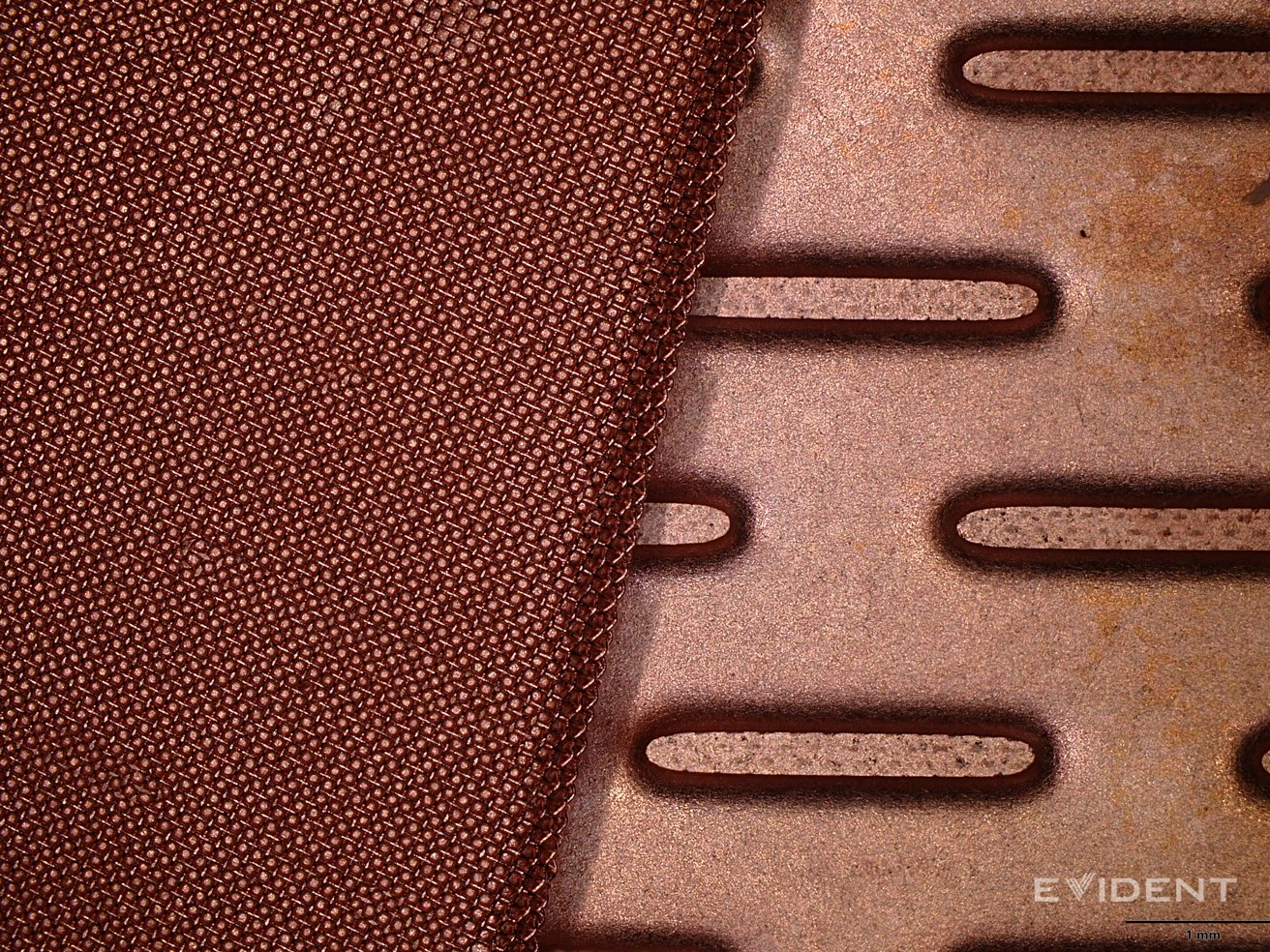
A close-up of the vapor chamber in the iPhone 17 Pro - Image Credit: Evident/iFixit
The chamber is found on top of the A19 Pro, and was shown on thermal cameras to pull heat away enough to avoid throttling, unlike the comparative iPhone 16 Pro Max. While the iPhone 16 Pro Max could get hot to the touch, this phenomenon should be reduced with lengthy iPhone 17 Pro sessions.
A close-up shot of the chamber shows a lattice sandwich that is used to condense the liquid and shift it around the chamber. Copper indentations collect water vapor, which is sent back to the chip along the lattice.
More screws and logic board
The iFixit team often complains about Apple's use of adhesives, but the iPhone 17 Pro is seemingly tending to use screws for fastening instead. A mix of tri-point, Phillips, and standoff screws hold the Taptic Engine in place, as well as the speaker module.
This time, the complaint is that the engineer has to change screwdrivers repeatedly, as well as large quantities of screws. There were 22 in the way of releasing the USB-C port, which is made of plastic and less modular than the iPhone Air's 3D-printed titanium version.
The upper assembly's front sensor array is removed by unplugging two press sensors, while three cables hold the rear camera section in place.
Lastly, the logic board is removed, with press connectors getting in the way. It's a sandwiched board, again located in the top section, which has a little more space thanks to the expanded camera bump, or "plateau."
Scratchable
Following complaints from users discovering the iPhone 17 Pro is easily scratched, iFixit sought answers. In its experiments using a microscope, the team could see how the anodization was weakest on sharp and unchamfered corners, namely the edge of the plateau.
While a scratch by a level 4 Mohs hardness tester on a flat surface is visible, it doesn't peel away the anodization layer. However, on the plateau, the anodization is supported by another anodization layer instead of the aluminum, allowing it to come away.
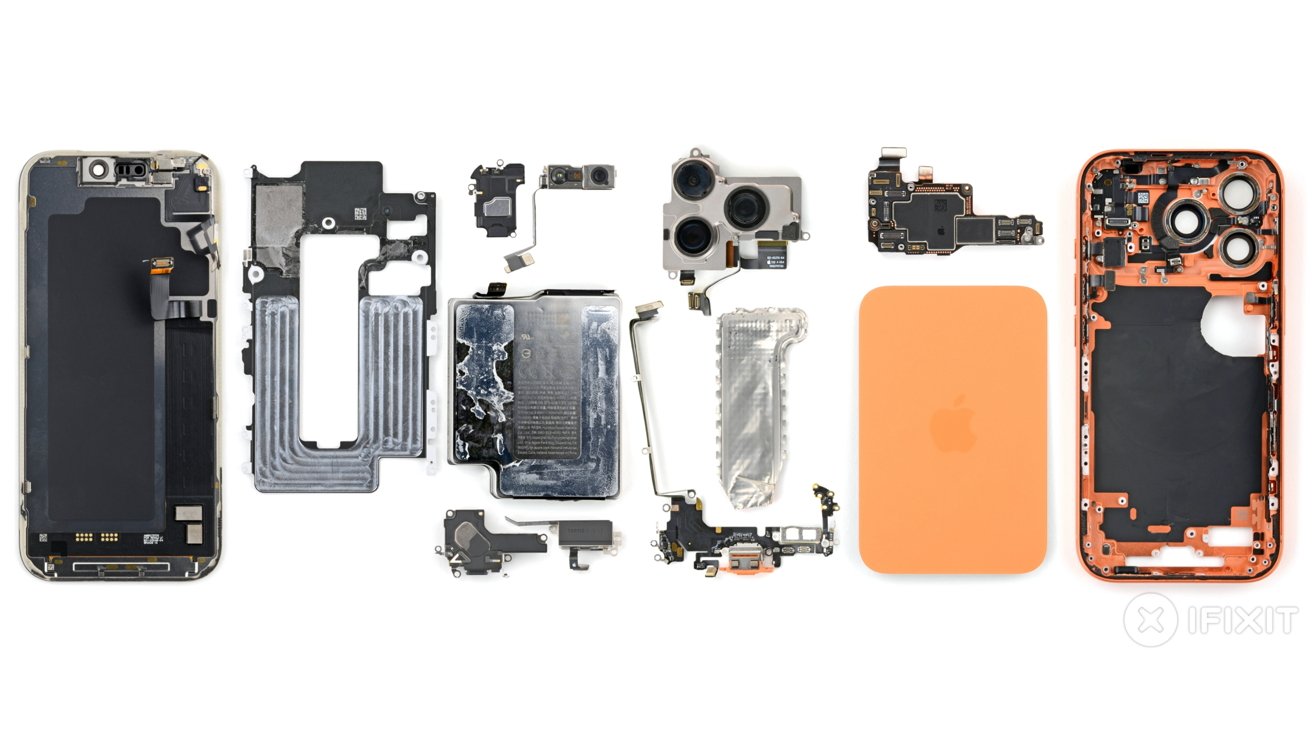
The disassembled iPhone 17 Pro - Image Credit: iFixit
The team talked to Daid Niebuhr of Niebuhr Metallurgical Engineering, and discovered that it is an effect known as "spalling." Niebuhr doesn't believe it's due to a change from titanium oxide to aluminum oxide, but instead the design's sharp edge of the camera bump is to blame.
The brittle nature of the anodized layer, especially when it's not supported properly by the aluminum underneath, can pull away and cause scratches, revealing the aluminum. The scratches on the flat sections without spalling deform properly.
Less repairable than the iPhone Air
In determining its "repairability" score, iFixit had a mixed response to the design changes. The new screwed-in battery system is great for repairs, but there are complaints about the lack of dual-entry and a tedious USB-C replacement process.
Overall, the iPhone 17 Pro is deemed to be marginally less repairable than the iPhone Air, but it still receives a provisional repairability score of 7 out of 10.