-xl.jpg)
Apple has removed mention of carbon neutrality from Apple Watch and Mac mini packaging, but its 2030 initiative is still underway, with emissions down by 60% overall.
Back in 2020, Apple outlined its plan to become carbon neutral across its entire business by 2030. This ambitious strategy encompassed the company's manufacturing supply chain, data centers, and product lines.
In September 2023, the iPhone maker famously marketed the Apple Watch Series 9 as its first carbon-neutral product. The M4 Mac mini was similarly declared the first carbon-neutral Mac," though you won't find that phrasing on the computer's product page anymore.
As spotted by French website WatchGeneration, and reported by MacRumors, Apple has removed or omitted the term carbon neutral from several webpages. This includes those related to the Apple Watch Series 11, Apple Watch Ultra 3, and M4 Mac mini.
In the case of the Mac mini, its product page was modified after Apple's "Awe Dropping" event on September 9. The associated Product Environmental Report, dated October 2024, remains unchanged, with clear references to carbon neutrality.
The Product Environmental Reports for the Apple Watch Series 11 and Apple Watch Ultra 3, meanwhile, contain no mentions of carbon neutrality. Apple's environmental efforts, such as the device's recycled content, are still outlined in the documents, though.
-xl.jpg)
The Apple Watch Series 11 has an emission rate of 8.1kg, which is 0.2kg lower than that of the Apple Watch Series 10. Image Credit: Apple
While the preceding Apple Watch Series 10 had an emission rating of 8.3kg, the current Apple Watch Series 11 boasts a lower rating — 8.1kg. The device's recycled material content is listed, as is Apple's use of electricity from renewable sources for manufacturing.
Aside from the lower emission rating, the only difference between the two documents has to do with the removal of the term carbon neutral.
Imagery and language related to carbon neutrality have also been removed from product boxes.
The Apple Watch SE 2 box, for instance, featured a symbol that indicates the device is a carbon-neutral product, and the M4 Mac mini had a similar label on the back. This is no longer the case for Apple Watch Series 11 and Apple Watch Ultra 3.
The change in wording, however, was far from unexpected, as Apple faced pressure from research organizations and courts alike.
Why Apple no longer advertises its products as 'carbon neutral'
Shortly after the release of the Apple Watch Series 9, the company's claims of a carbon-neutral product quickly became the target of criticism from a Chinese environmental research organization. The institution criticized Apple's move as a form of "climate-washing."

The Apple Watch Ultra 3 is not advertised as a carbon neutral product.
European environmental groups similarly called Apple's statements "scientifically inaccurate" and "misleading." After that, courts in Germany ruled that Apple's carbon neutrality claim was both unfounded and in violation of competition law.
However, this decision alone did not force Apple to remove the phrase carbon neutral from its product pages.
European Directive 2024/825, which takes effect in 2026, explicitly prohibits "claims based on the offsetting of greenhouse gas emissions to assert that a product has a neutral, reduced, or positive impact on the environment."
Offsetting, however, was used by Apple to claim the Apple Watch Series 9 was carbon neutral. The device itself was made with 30% recycled or renewable content, with 100% of the electricity needed for manufacturing coming from renewable sources. 50% of shipments were conducted without air transport, but that doesn't mean there were no CO2 emissions.
Apple planned to offset the carbon emissions through a Paraguay project where the company would plant eucalyptus trees on leased land. Projects that either avoid or remove carbon from the environment provide Apple with so-called "carbon credits."
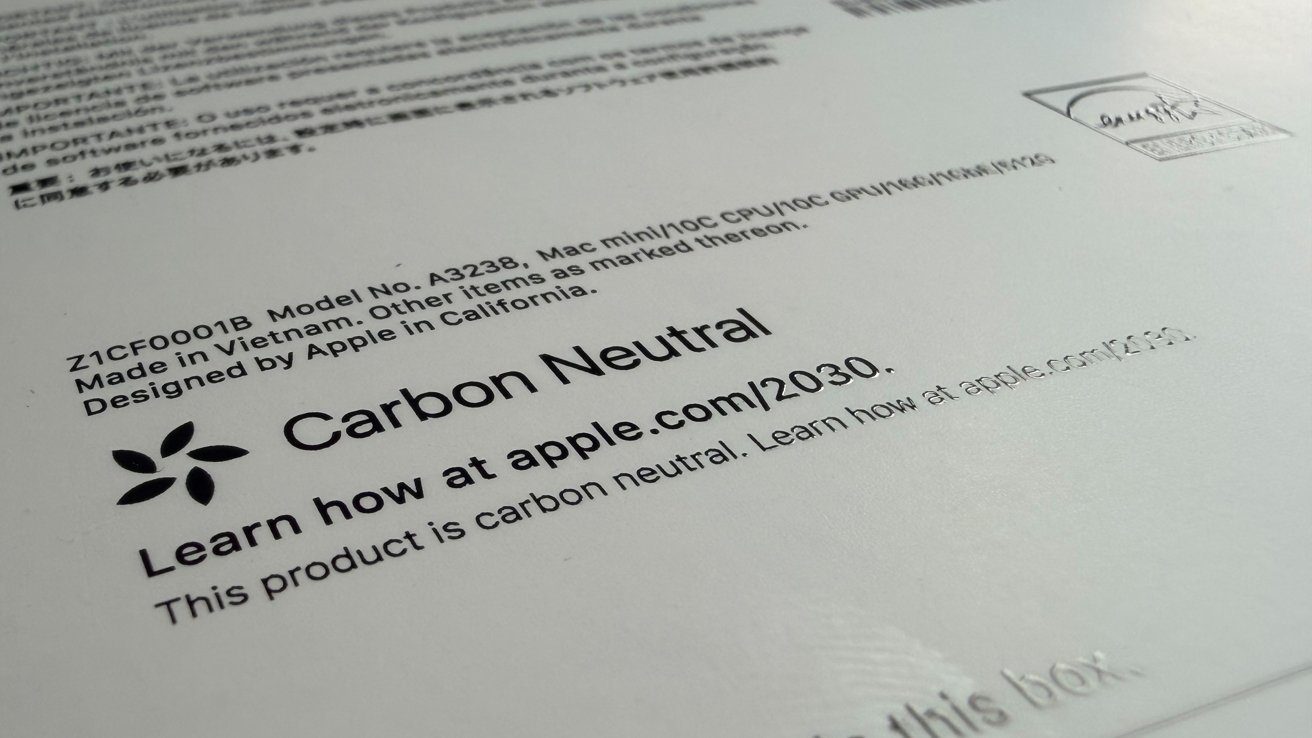
The M4 Mac mini box featured a symbol that indicates the device is a carbon neutral product.
Carbon credits are used to "offset" the carbon a company produces. In theory, if a company produces 14.5 million metric tons of carbon in a year, that company can purchase 14.5 million carbon credits and become carbon neutral.
The reality, however, is not as clear-cut. It's almost impossible to discern just how much carbon a carbon credit project removes. This is why carbon credits are often panned as greenwashing — a strategy designed to signal to the public that the company is environmentally friendly.
Using offsetting to claim a product is carbon neutral goes against European Directive 2024/825, which explains Apple's decision to remove the wording. The move extends beyond the EU, with Apple's product pages across the world lacking the carbon neutral phrase.