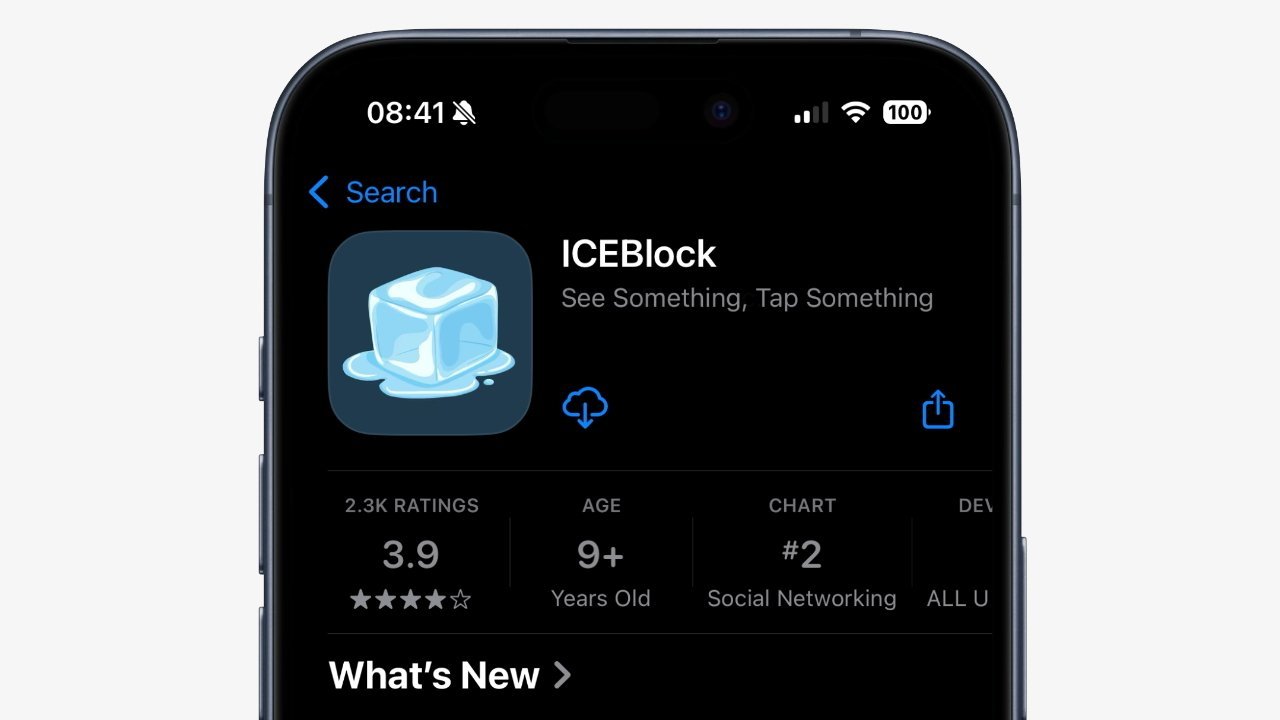
Apple's decisions to remove real-time ICE monitoring app ICEblock, and archival video tool Eyes Up may be good for Apple's global finances, but it's an incredibly bad one for a company that hinges its reputation on claims it stands up for the rights of users.
It's been an interesting couple of weeks as it pertains to Apple, the App Store, and business decisions. Apple and Google caved nearly immediately to the Department of Justice's "request" to pull Immigrations and Customs Enforcement-watching and documenting ICEBlock
They cited the "objectionable content" provisions of the App Store rules. That's generally the rule that Apple uses when they don't have a technical reason to remove something, but want to remove it anyway.
The sections around "objectionable content" in the App Store give examples, like "defamatory, discriminator, or mean-spirited content." Apple reserves the right to kill an app because of perceived safety risks.
A safety risk to the well-armed and armored ICE officers who in some cases have National Guard backup is clearly Apple's reasoning. Instead of being vague about it to the ICEBlock developer, maybe they should have said that, directly.
Anyway, it's pretty clear that the real reason was to continue the appeasement of President Trump beyond just a gold and glass plaque.
So, it's obvious that the removal of ICEBlock and Wednesday's pull of Eyes Up, which wasn't a real-time tool, are business decisions. They were very clearly removed to stay on the President's good side, and perhaps give him pause before executive orders are made, or to keep him on Apple's side as it pertains to the European Union Digital Markets Act, or the UK's demands for unfettered access to iCloud data.
If it's just business, then Apple is in the right. It's never just business, though.
Apple has the ability and means to take a stand on this. They just don't want to.
Apple's reputation of trust, and doing the right thing for users
When you hitch a wagon to a company, there are a lot of factors behind the decision. Cost is one, the reliability of the company, the ease you can get support, all of those are clear factors.
Apple has made another two factors — trust and privacy. Customers trust that they'll do the right thing by the consumer, and the belief that Apple is keeping users' secrets to themselves, and not using them for anything nefarious.
Trust has been taking a few hits over the years, after a big boost after San Bernardino in 2015.
That was a long time ago, so let's go over that a bit.
On December 2, 2015, a married couple, one of whom was an employee and a Iraq war veteran, shot up a Department of Public Health training event and Christmas Party. They killed 14 people, and seriously wounded 22.
Behind the scenes, Apple was working with the FBI. Apple discussed four ways to access the data. One of them was blocked by fumbles by the FBI forensic team. Another technical screw-up was made, by ordering the county to reset the password, preventing iCloud backup — which Apple would provide with a subpoena.
Little else is known about what Apple suggested, other than the FBI's gaffe.
On February 9, 2016, the FBI announced that it was unable to unlock an iPhone 5C, used by one of the terrorists. San Bernardino's district attorney made the ludicrous claim that there was some kind of "dormant cyber pathogen" and the less-ludicrous claim that there may have been a third shooter.
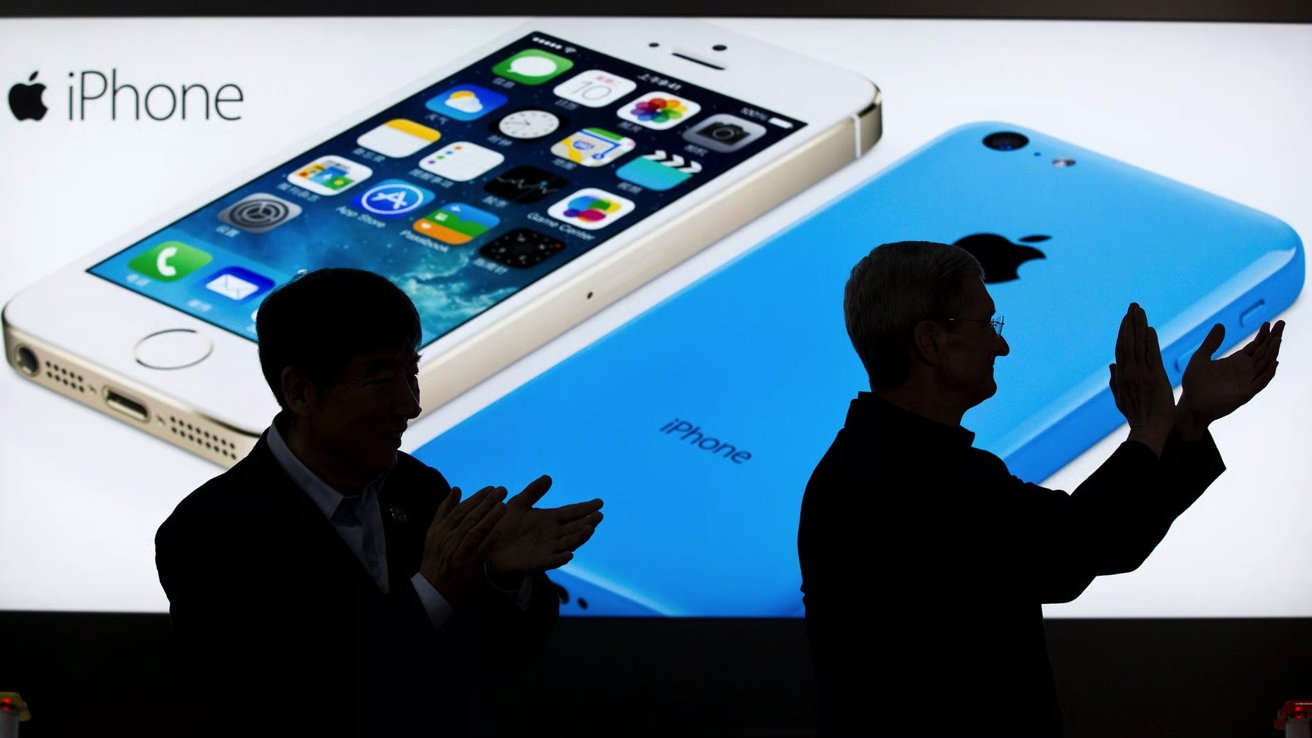
Tim Cook (right) standing in front of promotional materials for the iPhone 5c
Apple was ordered under the All Writs Act of 1789 to make a custom version of iOS that could be used to unlock the device. It had until February 26 to comply.
Apple refused, and said it would fight the order because of the impact to users, everywhere. It started then the general statement that it uses now, that weakening encryption for one, makes encryption weaker for all.
We're going to skip several kilowords of back-and-forth coverage here, in the interest of brevity.
Ultimately, the FBI decided to not have the legal showdown. On March 28, 2016, they said they were able to use a third-party contractor to break into the phone.
Nothing of any use was found. There was no grand conspiracy, no wide terrorist network calling the shots. Just some "homegrown violent extremists," murdering people after being radicalized from social media.
The point is, Apple stood its ground, despite the public mostly not being on its side. Polls at the time put 50% of the country on the FBI's side, and 45% on Apple's. There was no clear party affiliation on the poll results.
There have been other trust hits over the years, such as Apple Intelligence failures, not telling owners about a battery patch that might slow devices to deal with a chemically depleted battery, and more.
The issue isn't ICE, it's the First Amendment
I am not here to discuss what ICE is doing at the President's behest. There's a whole conversation that could be had about no due process and no explicit warrants issued for folks that overstayed visas thereby breaking the law, or smuggled themselves across the border illegally. That discussion is beside the point of this article, believe it or not.
Apple may have had a leg to stand on, and given some benefit of the doubt with the law enforcement safety reasoning for the removal of ICEblock, laughable as it may be. That leg got kicked out from underneath them when they pulled an after-the-fact video archiving tool dedicated to ICE actions.
Despite most of the eligible voter base not voting in the last election, it's safe to say that the country is pretty evenly divided across ideological lines. Tensions have been constantly inflamed by every politician and demagogue making increasingly short sound bites that Carl Sagan feared was coming, amplified by the social media outrage machine at this point.
Apple has decided, likely based on who's in charge of the country, what side of that line that they want to stand on with these decisions that have little to do with safety.
The First Amendment is on Apple's and the developer's side on this. Legal precedent and the actual law about citizen monitoring of law enforcement monitoring is very clearly on Apple's side.
Apple didn't care about either. The company is fully aware what side the law is on as it pertains to citizen monitoring of law enforcement given that they display citizen-provided information about speed traps in Maps. Apple took a "request" that didn't wind through the court system to skirt around First Amendment issues, and acted on it.
I'm a veteran, and when I was in boot camp what feels like a lifetime ago, our instructors made it clear what we signed up to perhaps sacrifice our lives for. They made absolutely damned sure we knew the broad strokes of the Constitution and the amendments. The First Amendment is and was the clearest of the bunch.
Despite what some have said, the First Amendment doesn't apply to the legally-required moderation of Internet forums, or social media and the like. It does very clearly apply to any potential Federal court order that didn't happen and Apple didn't require to remove ICEBlock. It applies even stronger to Eyes Up.
Here's the First, in its entirety.
Congress shall make no law respecting an establishment of religion, or prohibiting the free exercise thereof; or abridging the freedom of speech, or of the press; or the right of the people peaceably to assemble, and to petition the Government for a redress of grievances.
Notably the feds did not order Apple and Google to remove the apps. They asked. The feds are skirting First Amendment implications by leaving the pull demand as that ask, and not a court order.
What's yet to come
I suppose it could have been worse. Apple or Google could have flipped the remote-kill switch and completely exterminated the app. As it stands, the app still works, and does what it says it will do.
Apple certainly did some kind of focus testing evaluation of the pros and cons of the decision. Every company does when it's thinking of doing something that will be polarizing and unpopular.
That said, I've long said that if Apple saw some kind of mass advantage to being the "we kick puppies" company, they'd do it, and go down the road that Meta and Google have already gone down.
Meta has gone the user-exploitative direction. Google has said in court that the Internet is in decline because of things that they've done, so they're now fine with being evil, apparently.
And now here we are with Apple, tiptoeing up to that line that Meta and Google are far, far on the other side of. When faced with a non-legal, First Amendment-skirting request, Apple was fine with complying.
The question remains, where does Apple and its customer base that have made decisions to stick with the company on trust, go from here?
What will Apple do when the developer makes ICEBlock a progressive web app? The company's terms of service allow it to block that too, if they so choose.
This isn't a gaudy glass dinner plate and gold stand to curry favor. This is worse. I'm curious what Apple's next cost of doing business will be.
I've sent this to Apple. We'll let you know if they respond.