The initial reviews for the M5 iPad Pro line have surfaced, with early reviewers praising an incremental performance update on an already great tablet.
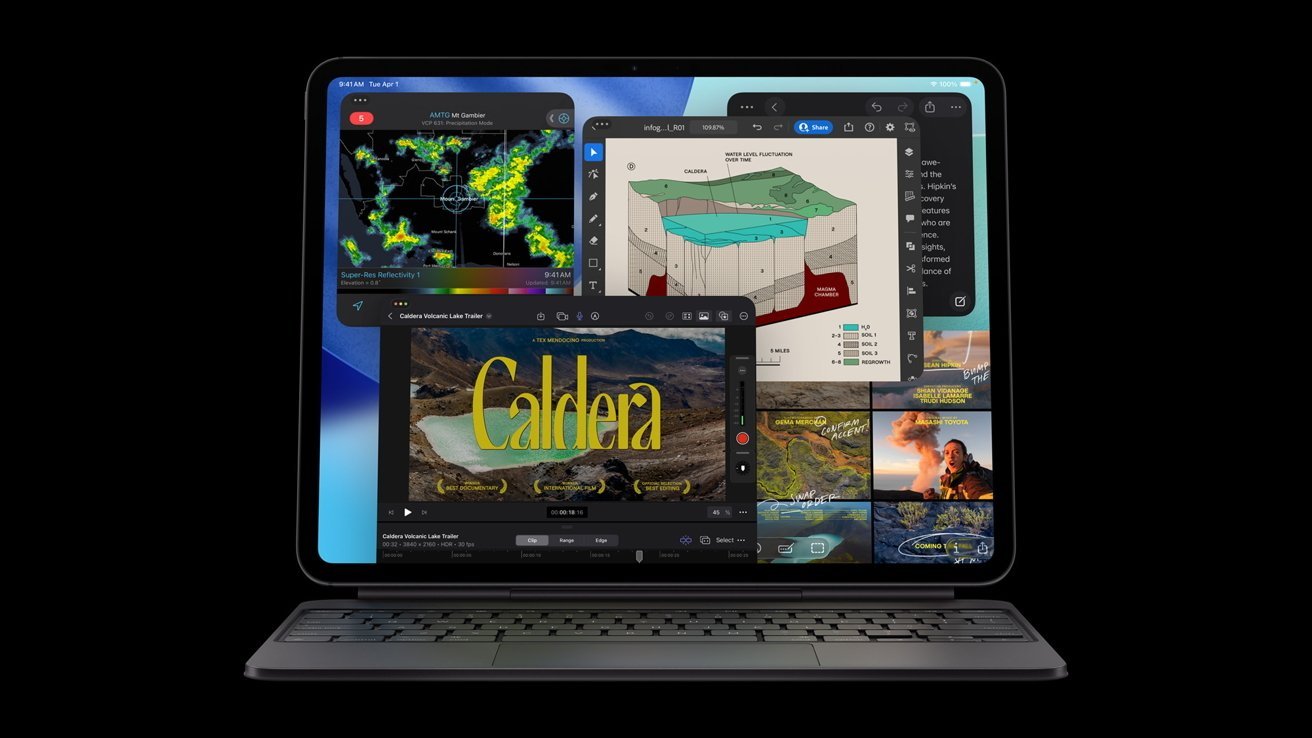
The iPad Pro didn't undergo a cosmetic change for 2025, but it did receive the Apple spec-bump upgrade treatment with the M5 chip. The new model's processing and graphical capabilities are now faster and better than ever, maintaining its position as the most powerful model on Apple's tablet roster.
The first reviews to come out for Apple's new model follow a fairly familiar pattern, with the general consensus being that there's not much change. What has changed is still important.

M5 iPad Pro
The Verge
David Pierce for The Verge recounts the overhaul of the M4 model as being the best iPad ever at the time. While previously wondering how Apple could improve, Pierce believes the answer was "it couldn't."
The lack of change isn't a problem for the model, which is "still gorgeous," despite losing the "iPad Pro" name on the back. The changes are internal, such as the switch to M5 and Apple's C1X modem, as well as N1 for Wi-Fi and Bluetooth.
"Everything's a little faster," he admits, but "none of it makes any practical difference in your day-to-day use of the iPad." The update to iPadOS 26 is a bigger change, with its more notebook-like features making it more productive.
Pierce even goes as far as to say that, while it is a "teeny-tiny upgrade," there's still the "glimmer of something bigger here."
Gizmodo
The Gizmodo review from Kyle Barr starts off by admitting there isn't any other tablet that they would use over the iPad Pro. It's still "prettier than the rest" on the market.
However, the lack of changes means that the 2025 iPad Pro is "everything I said about last year's model," Barr writes. The general upgrades are very minor, and still very much an internal affair.
The M5 is the biggest upgrade, especially its graphics performance, but that difference is going to be app dependent. The OLED screen is still "sublime," with the four-speaker system still "plenty loud."
The 12MP rear camera is going to be a letdown for anyone expecting iPhone 17 Pro-level photography, with flat and dull images and a grainy digital zoom.
Ultimately, the updates are so slight enough that, for five-year-old device upgraders, the real selling point is still going to be that OLED screen introduced in 2024, not the M5.
Engadget
Nathan Ingraham's iPad Pro review for Engadget starts off pointing out the minimal surface-level changes, while the main show here are the internals. Compared to the 2024 update, this is "very much a minor spec bump."
The neural accelerator in the GPU cores gives a lot more muscle for graphical duties, while AI benchmark results revealed considerable increases for the new model. That said, the M5 is "overkill" for typical iPad users.
The hardware and display are "still stunning" if unchanged. The iPadOS 26 update is more useful, with Apple addressing "nearly every big software complaint users have had."
In summing up, the iPad Pro hasn't changed since the 2024 model. It's still a design that feels "almost impossible," but at a price that is very hard for anyone to stomach.
CNET
Writing for CNET, Scott Stein was cynical about the M5 model's announcement as being the same iPad, "just faster." However, after using the 13-inch iPad Pro with iPadOS 26, the view has softened.
Elements of the iPad Pro are better than his notebook, such as Face ID, the OLED screen, and the fast M5 chip's performance. He does credit the positive changes as being "mostly to iPadOS 26," rather than the hardware.
The main takeaway from the review is that, while the iPad Pro is more premium as an experience, it's not quite worth the same premium price tag, but it is getting there. Most people "will be better served" by a cheaper iPad model, he adds.
Wired
Starting off by displaying a score of 9 out of 10, Julian Chokkattu's review for Wired starts by questioning whether a user should want a MacBook Pro or an iPad Pro. With the lines blurring over the years, the iPad Pro's use of iPadOS 26 helps make the tablet feel "more capable than ever."
There are not "massive" changes compared to the M4 model, but the internal chip changes were still useful. Cellular worked without issue, battery life was strong, and the OLED is still "wonderfully bright."
Users are not necessarily going to see a "dramatic boost" from the M4 with the M5, though there was an uptick in benchmark performance and in AI image generation.
In summary, the iPad Pro is for a "specific type of person," and the iPad Air would be "more than sufficient" for typical users. The Pro is more for people using intensive apps like Final Cut Pro, who would benefit from the performance improvements.