Spatial has launched two new apps that connect Apple Vision Pro and iPhone in a shared 3D workspace for professional designers.
On October 28, the company introduced Analogue 26 for Apple Vision Pro. They also launched Analogue Portal 26 for iPhone, broadening their immersive collaboration suite on Apple's newest devices.
Using the pair of apps, can design and review 3D models together using an Apple Vision Pro or an iPhone for those without headsets. The updates support Apple's enterprise spatial computing efforts and make remote collaboration easier.
Designers can work from anywhere without needing everyone to have the same gear.
Precision tools meet cross-device access
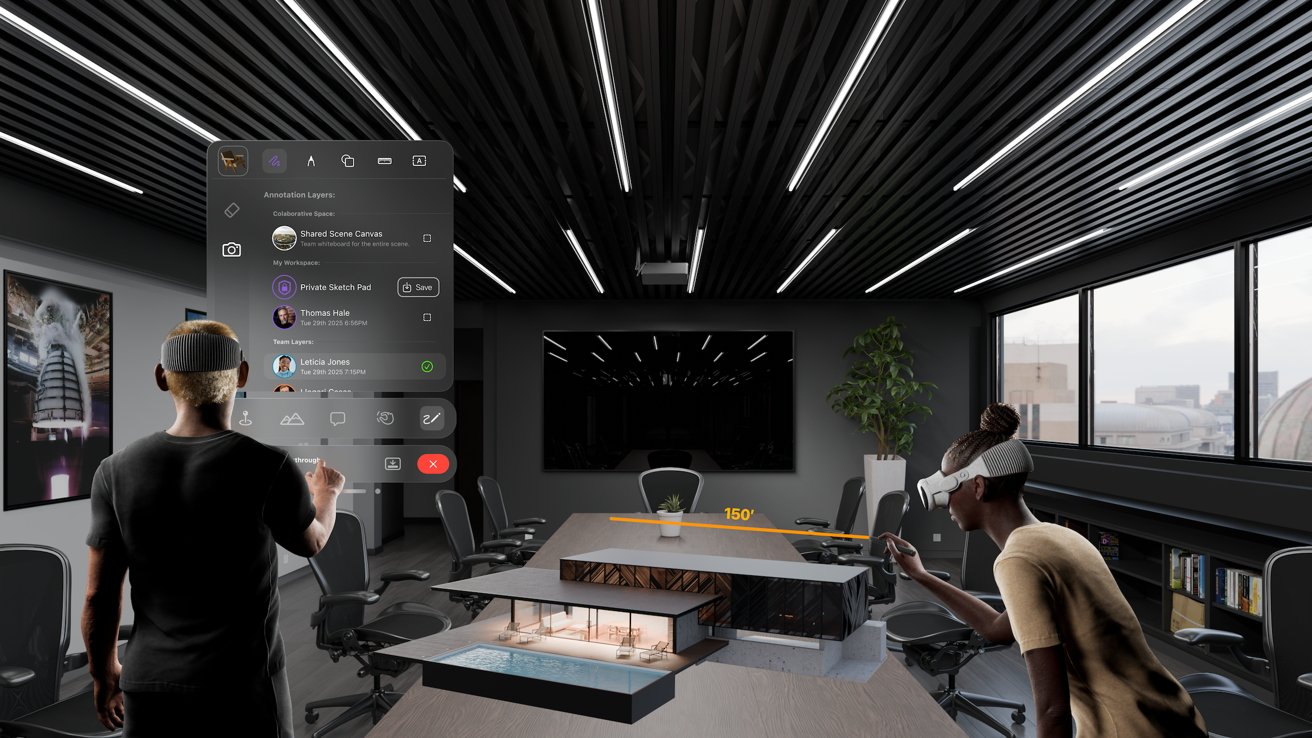
Analogue 26 now includes the Logitech Muse stylus, a pressure-sensitive pencil for precision. That transforms the Vision Pro into a virtual drafting table.
Architects, industrial designers, and engineers can sketch directly in 3D space. Colleagues can mark up models on private layers or collaborate on a shared canvas.
Spatial calls it "pen on paper, in midair." The stylus works natively with Apple Vision Pro, allowing for tight control when placing annotations, highlighting features, or leaving text notes within the 3D environment.
Feedback becomes visible, immediate, and spatially tied to the model.
Teams can design and review 3D models together using a headset or an iPhone.
Teams can discuss specific elements from different angles. Annotations stick to the object, so no one has to guess what feedback refers to. It's a more intuitive way to collaborate, especially for distributed teams.
iPhone joins the design process
With Analogue Portal 26, Spatial brings immersive design to the iPhone for the first time. The app works as a 2D window into the 3D workspace and is optimized for iOS 26 and the iPhone 17 Pro.
It lets clients, executives, and teammates review designs without a headset. Users can rotate, scale, or reposition 3D models using touch gestures or precision controls.
The app also supports guided walkthroughs, letting designers highlight specific viewpoints or stages of a concept. Clients can tap on a part of the design to leave comments or start discussions.
Feedback stays attached to the relevant asset, making reviews more focused and less fragmented. It closes the loop between creative teams and decision-makers.
Rethinking remote collaboration
Immersive design once required everyone to be in the same room, using the same gear. Now, a client with just an iPhone can be part of the same process as a designer using Apple Vision Pro and Logitech Muse.
The apps reduce friction and speed up feedback, which can cut down on costly miscommunications and rework. That's the pitch from Spatial's team.
It is particularly effective in industries such as automotive design, architecture, and high-end product development. In these fields, delays can be costly, and clear design is essential.
Spatial's Analogue 26 and Analogue Portal 26 mark a turning point for mixed reality in the workplace. Instead of treating the Apple Vision Pro as a standalone tool, they treat it as part of a broader system.