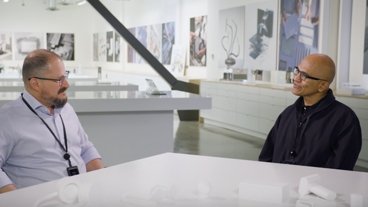

In a rare interview from 1996, Steve Jobs talks about getting involved — and keeping his distance — in order to make "Toy Story" studio Pixar a success.
These days Apple celebrates "Toy Story" with ideas like the Apple Watch faces that feature the film series's characters. But before he famously returned to Apple to bring it back from the brink, Steve Jobs also bought Pixar.
To mark the 30th anniversary of the first "Toy Story" film, the Steve Jobs Archive has released what it claims is a never-before-seen 1996 interview with Jobs. There are a lot of similar interviews from around the same time, but this is the first extended one in which he talks about "Sillywood."
Apparently that was a name given to companies when a technology firm bought into a filmmaking one. It was a name for those technology companies that figured they just had to throw money at the screen to make memorable movies.
"'Sillywood' is a term that was invented for the space that a lot of companies were in, so they could raise investment, but they never produced any products," says Jobs in the interview. "You know, it was sort of technology meeting Hollywood."

"And Pixar is the only company I know where Silicon Valley in Hollywood have met, where there's actually been any offspring that have been successful," he continued.
The interview was expressly about Pixar — and it was reportedly conducted just a few weeks before Jobs returned to Apple. Maybe he was in a particularly reflective mood, too, because he a little unusually self-deprecating in the piece.
At one point, he maintains that Pixar has what he calls an inverted hierarchy with himself, as CEO, at the bottom.
"I sort of feel like I work for most of these people, because they're the ones that are doing all the brilliant work," Jobs said.
He praises the staff at Pixar constantly, speaking especially of president Ed Catmull. Jobs does also praise director John Lasseter, which is not a point that has aged well.
Yet so much of the interview hasn't dated, and in fact now seems prescient. While media companies are being bought and sold all the time now, it remains the people doing the creative work that made those firms worth buying.
Speaking of artists in film making — although "it's the same in software" — Jobs talked about the difference in how these creatives are handled.
"Hollywood uses the stick, which is the contract, and Silicon Valley uses the carrot, which is the stock option," added Jobs.
He said that after a great deal of consideration, Pixar preferred the Silicon Valley method. But that was in part because of what it means the company has to do in order to keep hold of key employees.
"Every single day, we worry about how can we make Pixar a better company so that nobody will ever want to leave... and we don't take anybody for granted," said Jobs. "Because if they don't want to be at Pixar, then probably they should leave anyway. Whether or not they would ever have a contract."
It's about the technology
Naturally, in an interview with Steve Jobs about the first-ever fully computer-animated movie, the subject of technology comes up a lot. And for the most part, Jobs is happy to discuss certain details, particularly about how Pixar was pushing technology forward.
He revealed that for Pixar's "Luxo Jr" film in 1986, it took computers three hours to render each individual frame. It's the two-minute short that shows a parent lamp and a child one, playing with a ball.
"Now, fast forward to today," he says, "[And with] 'Toy Story,' computers are 100 times faster. And yet in Toy Story, it [still] took three hours on average to render each frame."
He said that was because the "frames were 100 times more complex in many cases." Jobs revealed that Pixar's then next-movie, "A Bug's Life," had twice the computing power — but he expects it to still take three hours per frame.
Jobs said he saw that as a measure of how Pixar's ambitions were "growing as fast as the technology can feed them."
It's not about the technology
So there is Steve Jobs praising technology and slightly mocking the "Sillywood" approach of other tech firms. Perhaps most revealingly, though, he said that art and filmmaking lasts longer than any technology.
"It's not clear whether you'll be able to boot up a Macintosh five years from now or not," he said. "[All] these technology boxes... if it has a life of a year or two, you're very lucky."
"But sooner or later, they all become part of the sedimentary layer, which is the foundation for new innovation," he continued. But then he compared that to Disney, which "released its first animated feature film, 'Snow White,' in 1937 — that's 60 years ago."
Jobs estimated that the last time Disney released "Snow White" on video, it had made around a quarter billion dollars of profit.
There was still the Jobs ego in there somewhere, though, because he ended with a plug for Pixar's movies.
"I think people are going to be watching 'Toy Story' in 60 years," he said. "Not because of the computer graphics, but because of the story about friendship."
For what it's worth, "Toy Story 5" will debut on June 19, 2026. The general theme is how devices like Jobs' iPad has replaced conventional toys.
The interview has been released by the Steve Jobs Archive. It was founded in 2022 by Laurene Powell Jobs, Tim Cook, and Jony Ive.