
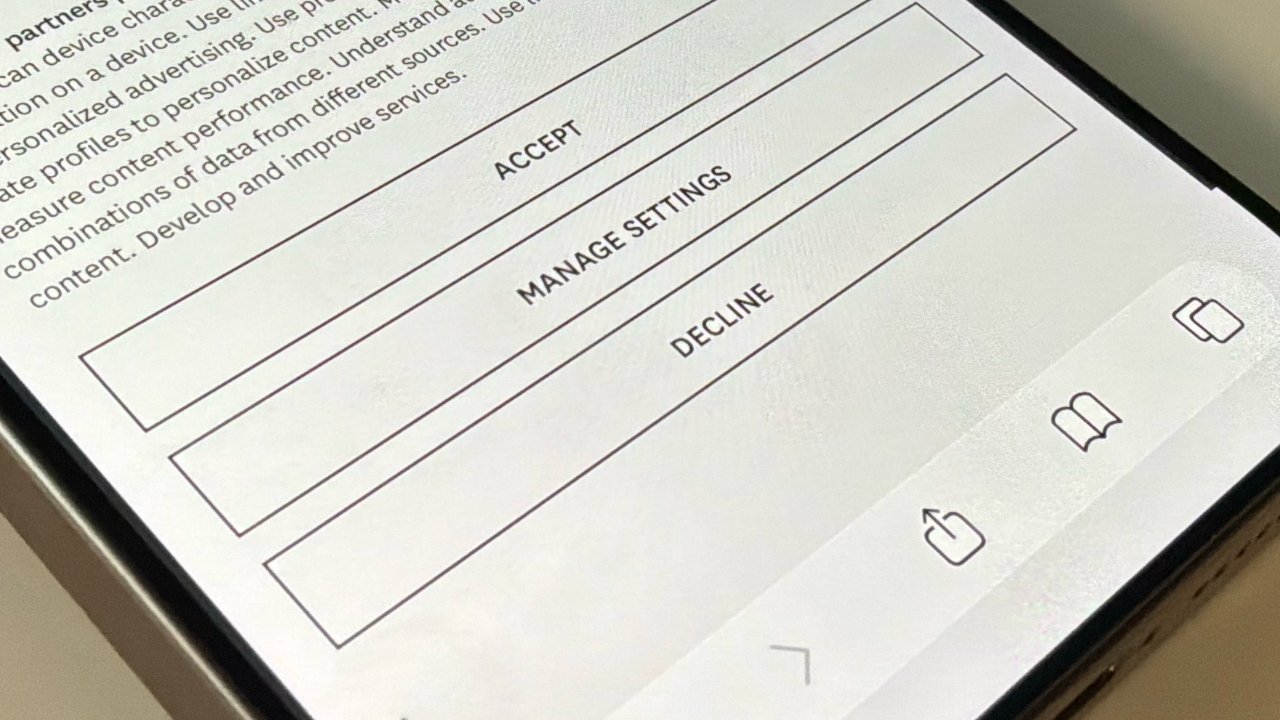
Under a new policy proposal, the European Union hopes to make saying no to cookies be a one-time thing instead of a nearly constant stream of requests while surfing the internet. The goal seems good, but the actual implementation seems optimistic, at best.
Back in 2020, Apple blocked third-party cookies on Safari and Google promised to do the same with Chrome, before changing its mind. Cookies were meant to make it convenient when you returned to a site, but companies abused them, and that's why Apple steadily started blocking them.
Subsequently, this has become why logging in to a new site now always has an extra step as officially you have to choose to accept or reject cookies. According the EU, you make no such choice — and instead just click the nearest button.
Sites definitely used that to their advantage, and hid the opt-out button. But now the EU has proposed legislation that would severely reduce the number of times a user is asked.
As spotted by The Verge, it aims to reduce that number to exactly one. The full Digital Package proposals state that they aim to "modernise 'cookies rules'."
Users remain in control of who can access their device, with a one-click consent," says the full documentation, "and central settings of preferences for how they want their data to be shared and processed."
This means that browsers such as Safari would be required to ask users up front about cookies. Instead of accepting or denying each site in turn, Safari would ask for a blanket yes or no.
That seems like an obvious improvement for users, although it's hard to see anyone ever selecting to accept all cookies from all sites. It's harder still to see what the benefit to website companies would be, but the EU insists that it will be good for them.
"Updates to the 'cookies rules' will alleviate cookie banner fatigue with a simpler design that allows users to make real choices," it continues, "and will generate more than 800 million [euros or $927 million] in savings for businesses annually."
Part of this saving will be to do with how businesses in Europe have to abide by the General Data Protection Regulation (GDPR). The EU says the new proposals reduce the compliance burden, and also somehow enable "new opportunities to create value on top of personal data."
What happens next
The new proposals have been made by the European Commission. But the European Union is a collection of 27 member states and now each of them must consider this new Digital Package.
Presumably advertisers and browser companies will want a say in it. But it's that debate within each member country and then their debate back with the European Commission that will take the time.
It could easily take years, but the EU documentation appears to hope for a quick acceptance. Because it gives figures for how its Digital Package saves firms money "between now and 2029."