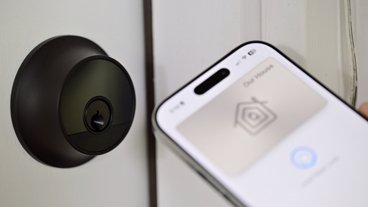
The Connectivity Standards Alliance has made Matter 1.5 official, including the adoption of cameras. Chris LaPre from the CSA joins for a special episode of HomeKit Insider to discuss the milestone update.
Chris LaPre previously served as the Chief Technology Officer for the CSA and now is the Alliance Technology Strategist. As a key member of the organization, he provides an inside look at the development of its latest update.
The 1.5 release is the third update for Matter in 2025 and will could see rapid adoption in the smart home space. Devices have already been announced, including the Ulticam V2 from Xthings that will ship with Matter support.
The full interview can be found on the latest episode of HomeKit Insider and has been edited below for readability.
Interview with CSA's Chris LaPre
Andrew O'Hara: Welcome everybody to a super exciting supplementary special edition episode of HomeKit Insider!
Joining me is Chris LaPre from the CSA, the Connectivity Standards Alliance, to talk about Matter 1.5, which is a massive update. Chris, thank you so much for joining me.
The cameras have been the one thing we've been waiting on for so long. Before we get into that, you want to give everyone a refresher on you and your role at the CSA?
Chris LaPre: Not so much a refresher — an update. I used to be Head of Technology, and that had a program element for supporting Matter and all the different working groups.
Now I am Head of Strategy. It's more about finding the members that fit categories that are underrepresented — like energy management, and as of tomorrow, cameras will fit into that bucket as well. I'm really excited about this new role.
Andrew: I'm excited. So you're saying you're the one I need to text when I'm like, "I can't find a good one of these in Matter, can you go do it?" And then you go find it for me?
Chris: Yeah, I mean that's my job! But you know it's harder than picking up the phone and calling someone at company X and saying "support Matter."
Everyone has their strategies, their own business, their own contexts of where in the world they play and which ecosystems they care about. It's more complicated than I thought. This was always part of my job, but now it's full time.
The complexity of everyone's business decisions has it's exciting, actually.
Andrew: Well, I feel like it's now an even better time for you to be reaching out to more companies when we've had an influx of supported accessories. And now this update is bringing multiple new accessory types besides cameras.
That's the big news, but that's not the only thing in Matter 1.5. We're venturing more into the garden, there are more closure types I'm really excited for some of these extra little categories here.
Let's get into the big one — cameras. High level, and you fill in the blanks: cameras are here, they support real-time streaming for both audio and video. They're using WebRTC. There's two-way talk.
There's local and cloud recording options with both event-based and continuous recording. There's PTZ support. There are detection zones and privacy zones. There's a lot here. If everyone supported all of these things — you know, Apple — that would be a lot of new features.
Chris: Right, and that's just it. What the team wanted to do was support everything that everyone does. It's all optional, but we wanted to make sure you're not going to lose features if your camera goes from "not Matter" to "Matter" and you lose X, Y, Z.
Everything that could be done before can be made possible within Matter. But that doesn't mean a camera that didn't have pan-tilt is suddenly going to grow a motor. But yeah — it's all there.
Andrew: The other thing I'm excited about is Matter isn't defining any requirements for resolution, frame rates, aspect ratios, anything. Which means theoretically, if a company supported all of this, we could finally be getting 2K, 4K video in — perhaps Apple Home!
Chris: This is exactly it, yeah. I just saw an FAQ fly by about "2K, 4K" and I kind of chuckled — probably not anytime soon — but you're right. The protocol is future-proof for that. And if you've got an Apple TV and it supports 4K, that's exactly what you'd want if you bought premium cameras for your home.
Andrew: Absolutely. What makes me nervous is how robust this looks for a first rollout. I'm not seeing anything missing in terms of the specs.
But what makes me nervous is the optional aspect. Apple could say "we support Matter cameras" and still stick at 1080p. Or a company like Aqara could have a PTZ camera that you can view static frames in Apple Home, but you'd need the Aqara app for actual PTZ control and high-res.
So I'm hoping this means Apple will support more, but the optionality scares me.
Chris: Yeah — optional features aren't friendly to interoperability. But the goal was to support everything the camera does, everything the ecosystem does, so you don't have to down-sample functionality.
I can't speak to what ecosystems will support or when. Fingers crossed that someone like you — who knows Apple's ecosystem inside and out — gets what you want. But other than praying with you, I can't do much.
Andrew: You mentioned something before we hit record. Whenever we see updates, the first question is when? You seemed to think this was designed to easily move onto existing cameras, right?
Chris: Right. Let me clarify: I've heard from engineers working on this that the design is compatible with where lots of existing cameras are. I'm not a camera engineer — I used to be an embedded engineer — and we saw in early Matter days that some companies couldn't support Matter on older devices.
But here, the team says they intentionally designed it so many existing cameras could support it with software updates.
But it's a business decision. Companies need to choose whether to update existing hardware. But yeah — I love when devices suddenly gain features through updates. Hopefully we see that here.
Andrew: For sure. I'll read the tea leaves for you. Companies like Aqara who are aggressive with updates — yeah, I expect them to roll this out. If this doesn't require new hardware, we should see this pretty quickly.
Chris: I hope so too. Stay tuned. I think we'll start hearing about that sooner rather than later.
Andrew: I hope on the next episode or two I'll have announcements of companies committing to support Matter cameras. But of course that's just half of it — ecosystems also need to support it. Who knows when Apple, Google, Amazon, Samsung will roll it out and at what level.
I assume Samsung is going to announce first — they always update quickest — then Amazon and Google, and hopefully Apple in the spring with that rumored smart display situation
Chris: I'm kind of hoping someone supports a Matter NVR at some point. That would be exciting. But again — I'd love it, but who knows.
Andrew: I know, I just want announcements. Spoilers for the next episode — I grilled George Yianni from Signify/Philips Hue on whether they'll support Matter cameras.
He basically said they're rolling out Apple Home support first, then Matter cameras, because he said Matter cameras were taking too long — not your fault — it's a miracle this many companies work together. So they abandoned Matter for now to do Apple Home, and then they'll come back.
Chris: Right. And we've seen companies like Eve do that during delays — say "okay, Apple Home is our base," and go back. It makes sense. But good that they'll come back, and we'll see where that lands.
Andrew: We've got closures, water stuff, and energy management left, but I'm so excited. If Apple rolls this out, we'll finally be able to view Apple Home cameras on any other smart display supported by Matter 1.5.
That's what I've been hoping for. Now we just need updates and commitments. And since this category can be retroactively added more easily than others, I'm hopeful after such a long wait that rollout won't take as long as other device types.
Chris: Not tied to your specific comment, but yeah — with the Philips Hue announcement, the IKEA announcement, the affordable Matter lock, affordable thermostat — momentum is happening.
All these rumors and things lining up. And now cameras really add to that momentum. Everything looks good.
Andrew: I agree. It's just the ecosystem support. Certain accessory types are in Matter but not in Apple Home yet. And I think — as I keep saying — they're waiting for that smart display and the next-generation assistant because that's how most people control their homes.
Chris: I mean, yeah having done this before in a much lower-stress environment than Apple — it's hard. It takes a lot to get the UX right.
Apple puts UI/UX extremely high. It takes time, a lot of testing, and sometimes you realize something is wrong and that adds months. And that's just one device type — now multiply that by 10 or 20 across ecosystems.
It's roadmap, business plan, UX — a lot to juggle, and everyone wants to get it right.
Andrew: I agree. And Apple loves a narrative — things launched together, products that make sense in context. A smart display that controls your home would pair nicely with new accessories to control.
Even if the control comes to iPhone and iPad too. And we've got rumored Apple cameras coming. So the timing could be perfect.
Chris: Right. And going back — Matter has momentum now. We're feeling things happening. Cameras could move fast. It positions us very well for next year. Excited about that.
Andrew: For sure. I'm so excited. Now I have to be patient again — not my strong suit.
Let's talk about other things. We have more in 1.5. We also have closures. What went on there? There was closure support before but now it's revamped.
Chris: Yeah, a bit of a redo. Blinds had started down a path, and the team wanted to add more things, and it was easier to start over. So instead of changing blinds, they added closures.
Now closures supports garage doors, gates, automatic doors — we've been hearing a lot about "my phone unlocks my door but my hands are full and I still have to open the door." Automatic doors could solve that. So closures supports that too.
Andrew: Which is great, because everyone makes smart locks for front doors but nothing for sliding doors. Why can't I lock my sliding door? I can run my goodnight scene and lock everything except the sliding door. There's no sliding-door lock!
Chris: Really?
Andrew: Yeah. There's a motor I got for pet collars where sliding doors open automatically, but it wasn't supported by any ecosystem. I'd love a sliding-door lock, or motorized sliding door opening.
Chris: Yeah I don't know.
Andrew: There's a company for you to call — find sliding-door lock manufacturers and get them onboard!
Chris: On the energy management side, I'm excited about windows that open — in Europe they've got the multi-position windows that tilt this way and that way. If those were motorized, that would be great for efficiency.
Too hot? Open the top. Too cold? Adjust it. Before turning on AC. Matter could enable that too.
Andrew: For sure. And in the press release, closures include window shades, drapes, awnings, gates, garage doors, and different motion types — sliding, rotating, opening — and support for single, dual-pane, nested mechanisms. So that encompasses a lot.
Chris: Yep. A do-over so they could be more flexible.
Andrew: Outside closures and cameras, we also have soil sensors. I know this is one both of us are excited about. Tell me about them.
Chris: Yeah — soil sensors. We talked about this before, when it was "way in the future," and now it's here. I'm a plant guy — you buy one, you end up with 30.
And now I'm in Dubai, no idea if my plants are dying. Having a cheap soil sensor in each plant, feeding data to my phone, and maybe even connecting to valves — great. I personally don't want automated indoor watering — I've flooded my house twice. But I'm excited for soil sensors.
Andrew: They also mention "smarter water management." I assume that's pairing sensors with irrigation valves we already have. I have multiple garden beds — I want to know when to water. Weather-based watering isn't always accurate at my exact house.
Chris: Right. I have one of the old Orbit sensors — it says "you're getting rain, we're not watering for a week," and then it doesn't rain where I am. Then everything dies. Sensor-driven is much better.
Andrew: I would love third-party apps reading soil sensors and giving recommendations by plant type. Do you remember the old Parrot plant sensor? I loved that thing.
Chris: Yeah. There were expensive ones. I tried to build one in my previous life and it was too expensive — $20 per plant. When the plant costs less than the sensor, people won't buy it.
Andrew: Exactly. So I'm excited. And I'm already planning when I'll get these — probably spring 2027 if announcements come in 2025-26 and then shipping. That's my guess.
Chris: We still need more for outdoor irrigation — scheduling and such — but it's on the roadmap.
Andrew: Perfect. Last thing: advanced energy management. What's going on here?
Chris: Price is the big one added. A bunch of things for tariffs — complicated regional structures. EV charging enhancements too.
The broad takeaway is: if utilities want to talk to my home, now all devices can access that data and automate things. That's where we're moving: utilities talking to homes. Instead of utilities controlling one device (thermostat, water heater), they could tell the home "shed X load," and the home decides how.
That's the direction.
Andrew: They also list state-of-charge reporting, bidirectional charging, EU requirements, prep for V2G, etc. Energy management has grown a lot in recent updates.
Chris: Yeah — we're trying to add support for all the little regional variations. Europe is big on bidirectional charging. It's still rare today, but Matter is getting ahead of the curve.
Andrew: When are we going to see more energy companies opt in? Apple supports energy reporting from one California provider and that's it.
Chris: Hard to say. Every country is different. Even regions of the U.S. differ. Some utilities can't engage consumers directly, so they rely on third-party "middleman" companies. California and Texas can do it directly; the Midwest often can't.
Apple's approach doesn't work everywhere. It's more complicated than I thought when I moved into this role.
Andrew: Are you seeing more interest?
Chris: Definitely interest. The question is how we get Matter to the utilities that want these capabilities. But there's capacity and architecture for it. I'm excited.
Andrew: I'm fascinated by this stuff. Even device-level energy monitoring has been a tough uphill battle to get manufacturers to adopt. Hopefully more devices support it and more utilities surface data. Matter is laying the groundwork.
Chris: Yep. It's the groundwork. Now we wait to fill it out.
Andrew: Cool. This update was huge. Cameras are fantastic. I'm going to keep bugging everyone about when support is coming. Anything you want to leave us with before you get to your flight?
Chris: I think we covered it all. I'm excited about what this enables. Energy management was already close, and cameras now put us in a position where we've enabled what consumers want. I've had companies say, "If you support cameras, we'll do X." Now I can call them back and say, "We're ready."
Andrew: Fantastic. Chris, thanks so much for taking the time. Everyone, I'll have a link to the Matter 1.5 announcement in the show notes.
Make sure you tune in Monday for the episode with Signify/Philips Hue founder and CTO George Yianni — it's a great conversation. Chris, thank you as always. Hopefully I'll see you at CES.