
Recent reports about low iOS 26 adoption failed to pick up on a crucial mistake with the source data. It's a reminder to be careful about third-party sources for Apple statistics.
An early January report claimed that Apple is struggling to get people to upgrade their devices to iOS 26. It's a story that seemed to have come from a reputable source of data, and it quickly spread across the Apple news sites.
However, it seems that there was a major flaw in the original data that wasn't taken into account by any of the publications. All told, it was an event that serves as a reminder that third-party data sources making claims about Apple are not necessarily going to be entirely accurate.
In one detailed breakdown published by Jeff Johnson of Lapcat Software, it's shown just how inaccurate things can get, especially if there's a problem with the data itself.
Flawed adoption
On January 8, Statcounter released its Mobile & Tablet iOS Version Market Share data, and offered up a curious statistic. According to the data, stemming from browser usage, only a small number of users had adopted iOS 26.
The news was quickly picked up by various Apple-centric outlets, confidently declaring it as proof that users are avoiding Apple's newest operating system release. The introduction of the Liquid Glass aesthetic was raised as a probable reason for the lack of updates.
To the numbers.
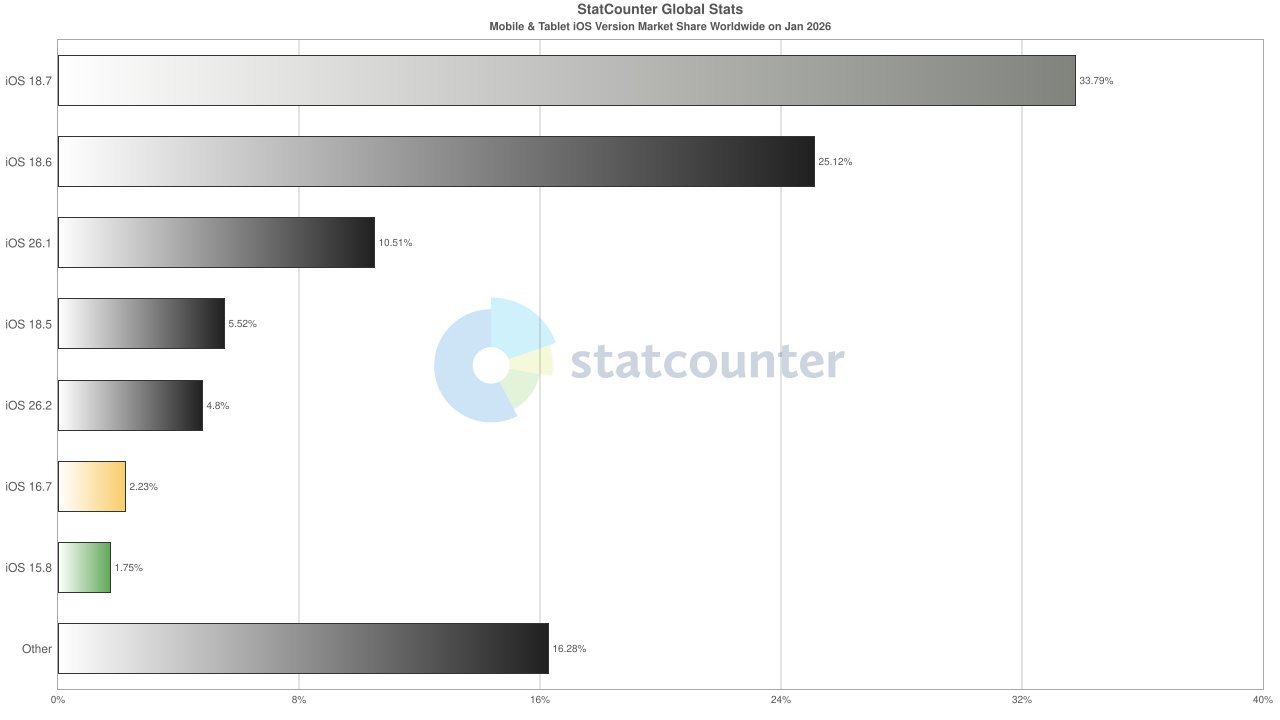
StatCounter's flawed browser stats data - Image Credit: StatCounter
According to Statcounter, approximately 10.6% of detected iPhones were running on iOS 26.1, with a further 4.6% on iOS 26.2. The original iOS 26.0 release was somewhere in the region of just 1.1%, bringing the overall iOS 26 total to about 16.3%.
By contrast, the data said that 33.8% of users were on iOS 18.7 and 25.1% were on iOS 18.6. One year prior, roughly 63% of iPhones tracked by StatCounter were on iOS 18, making the iOS 26 figures seem grim.
A post from MacRumors seemed to corroborate the data, augmenting the site's own visitor stats into the mix. According to the January 8 report, only 25.7% of readers were running some form of iOS 26, versus 89.3% being on iOS 18 at the same point the previous year.
With this seeming confirmation, other outlets joined the dogpile of a sensational story about an apparent Apple failure.
The data had some big issues that many overlooked.
Enemy Agent
In his analysis, Johnson spots that Pixel Envy got it right in pointing out that the "user agent" had a problem. Namely, it was not reporting itself properly.
A user agent is a string of text sent by the browser to the site, which describes the software and browser making the HTTP request. This is what StatCounter uses for its data, as well as various systems used to monitor web traffic.
The problem, as indicated in a September WebKit blog post, was that the Safari user agent was partially frozen in iOS 26. This was a practice that Safari on Mac started back in 2017, but had spread to iOS, iPadOS, and others.
The user string would normally include the operating system version, and that was accurate before iOS 26. With the release of iOS 26, Safari continued to report a previous operating system version instead of the current version.
This was something Apple included in Safari 26.0 release notes, showing it was intentional.
As for the data showing users on iOS 26 versions, the theory is that it's actually for other browsers that continued to show the current operating system version as part of their own user agent strings.
Johnson's inspection of user agent headers in logs for his own site seems to corroborate this line of thinking. User agent logs that referenced "iPhone OS 26" or "CPU OS 26" also included "CriOS" or "FxiOS," meaning they were generated by Chrome and Firefox, respectively.
Despite Apple mandating the use of WebKit for all web browsers on iOS, Safari is the only one to exhibit this frozen version number behavior.
Further experimentation with StatCounter's User Agent detection tool proved that the iOS version wasn't detected right when Safari was used on an iOS 26 version. However, it was correct with Google Chrome under the same circumstances.
It is probable that StatCounter's data is inaccurate when it comes to iOS 26 detection, because it is combining Safari on iOS 26 with earlier iOS releases. It therefore is only counting third-party browsers like Chrome and Firefox towards its iOS 26-version results.
Trust, but verify
News outlets and enthusiast-centric publications are driven to regularly post, and sometimes that means leaning on stories about statistics. Hell, we do it sometimes too.
The problem is that it, in an age where data is easily available and manipulated, there is a need to consider what the data actually says. The continued blight of fake news means readers have to become more vigilant about the information being presented to them, and ideally, to use multiple independent sources before drawing a conclusion.
That should also apply to people writing the news stories in the first place.
StatCounter is generally a well-regarded data source, but one that is limited in scope. It's only using web traffic to determine its figures, which isn't the gospel truth in terms of operating system fragmentation.
Apple is the ideal source for this data, but it's something that the company simply doesn't disclose on a regular basis. The nearest accurate figures from Apple that we have about adoption is on the Developer site, and even that shows data from June 2025, severely predating iOS 26.
With Apple not being a suitable source to check the data, publications have to infer based on what they have available. As mentioned earlier, an attempt was made to analyze a site's traffic logs, but the nature of the user agent freeze meant that the same data problem reappeared.
AppleInsider's editorial team did consider writing a similar story about the data when we spotted it. We too looked at our traffic logs, but after seeing all of the iOS 26 user agent logs were on third-party browsers, we saw that there was a problem.
So, we put it off to do some more research. It was low-priority at the time, given that CES was ongoing, and we're preparing for a slate of Apple releases in the forthcoming weeks.
Fortunately, Johnson's friend had more time on his hands than we did.
Johnson said in his piece, "For a story as surprising and important as this one, I would expect the media fact checkers to look at the raw data, which would likely show that their iOS 26 web visitors were all using third-party browsers such as Chrome and Firefox."
We spotted just that and decided not to pile onto the story. We were going to say something eventually, but everybody has priorities, and digging into why this low-impact data set didn't make sense wasn't crucial.
In a fast-paced online environment where the speed of reporting and being first to a story is essential for a publication's survival, it can lead to work that's not all it could be. In this industry, it's easy to take a trusted source's word and to run with it. But there still has to be basic checks in place, even if it's just a gut check by a writer, about accuracy.
Obviously, in cases where something doesn't quite smell right, there needs to be caution. Anecdotally, adoption of iOS 26 hasn't been record-breaking, but it hasn't been less than half of previous years. That just makes no sense.
Only Apple knows the real number. They'll be taking about it soon, as they always do in January.