Apple's upcoming Creator Studio subscription adds paid features to Pages, Numbers, and Keynote, and we can see the future having a bigger shift in how it treats long-time free apps.
On Tuesday, Apple announced the launch of Apple Creator Studio, a new monthly subscription that gives users access to a host of creativity and production apps. Priced at $12.99 a month — or $129 a year — users get access to Logic Pro, Final Cut Pro, and Pixelmator Pro.
But those aren't the only apps bundled into the suite, either. Apple is also including "premium content" for Keynote, Pages, Numbers, and Freeform — apps collectively referred to as iWork.
Apple has offered iWork apps for free for since 2013, after being paid after the suite launch in 2005. It's been a small but notable reason people think of Apple as a "kinder" company than its main competitor.
And, Apple assures users that it isn't making you them for access to the versions they know and love. In fact, the company says:
Keynote, Pages, Numbers, and Freeform will remain free for all users to create, edit, and collaborate with others, including Apple Creator Studio subscribers.
These apps will continue receiving updates, with the latest versions adopting the beautiful new visual design language with Liquid Glass on all platforms, and supporting the new windowing and menu bar improvements in iPadOS 26.
Instead, users will gain access to "premium features" with the paid subscription. Here's what you'll get for Pages, Numbers, and Keynote when you pay for the bundle.
It's basically what you expected
If you're familiar with AppleWorks, then ClarisWorks, then AppleWorks again, followed by iWork popping in and out of free or paid apps, then you may have seen this coming. Add on Apple as a whole, or the state of the internet today, and none of this will come as a surprise to you.
As expected, Apple was very quick to mention that Pages, Numbers, and Keynote will be getting new premium templates and themes.
Perhaps even less surprising than the templates is the company's continued AI push. Many of the "premium features" Apple is offering are fueled by artificial intelligence — either its own Apple Intelligence, or third-party models like OpenAI.
According to Apple, "advanced image creation and editing tools let users create high-quality images from text, or transform existing images, using generative models from OpenAI."
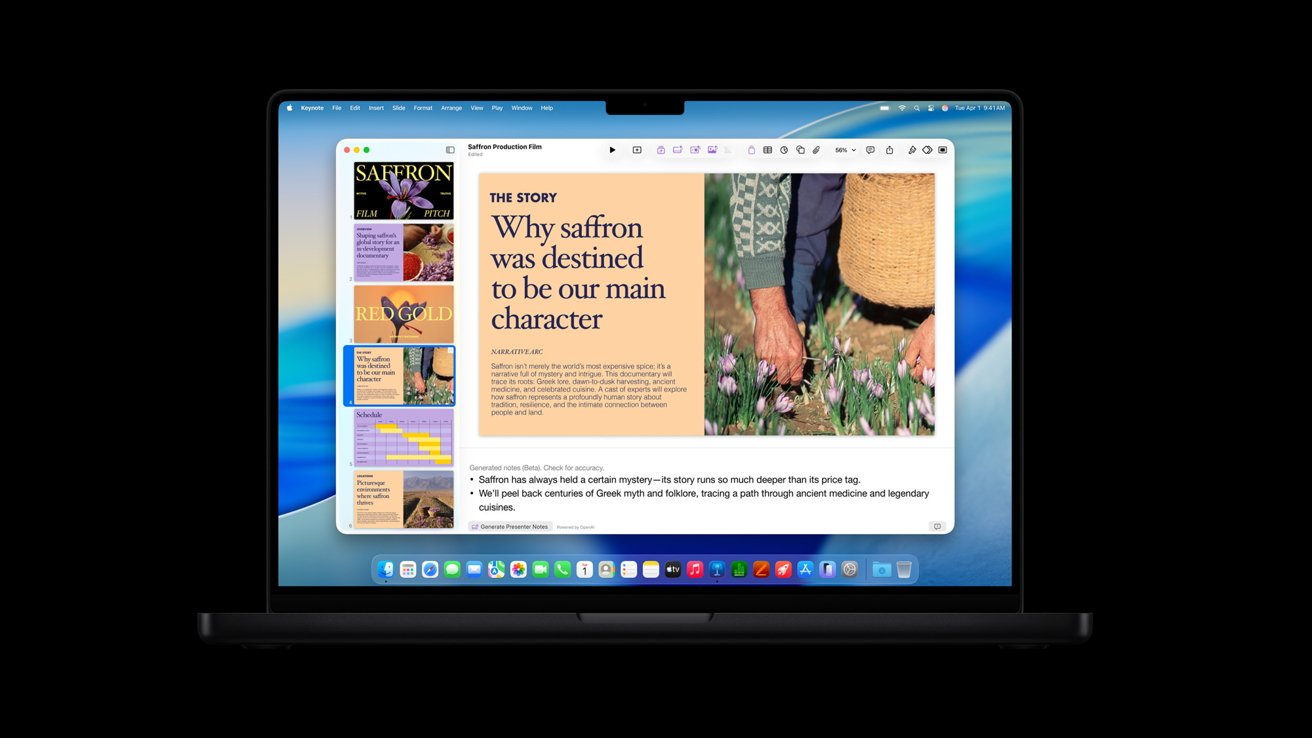
Keynote is set to get premium features on January 29, if you pay for it
It's not only image generation, either. Keynote gains a new feature that allows subscribers to generate presenter notes from their existing slides.
Subscribers will be able to generate formulas and fill in tables in Numbers based on pattern recognition with Magic Fill.
The one feature that genuinely surprised me was the newly announced Content Hub. It's a new space where users will find curated, high-quality photos, graphics, and illustrations.
While I haven't seen it yet, for obvious reasons, it seems like a nascent alternative to Adobe's own Adobe Stock feature. I think part may actually be worth the price of admission if you're someone who routinely gives presentations or makes promotional content using iWork.
Second verse, almost the same as the first
If this makes you feel a little weird, you're hardly alone. It took me approximately 45 seconds to open up Apple's announcement and see that Apple would be adding "premium content" to its previously free apps.

Users can edit images via OpenAI within iWork apps
It's kind of reminiscent of Microsoft's monthly subscription model for Microsoft 365, which it moved to in 2013. Let's be real, Microsoft 365 is pretty much just Microsoft's take on Adobe's Creative Cloud, which launched in 2011.
So, if it leaves a bad taste in your mouth, like it does ours, that's a good instinct to have. There are some key differences, though, that we should delve into.
The very first is that Word and Excel have never been free. Instead, you'd sometimes have them bundled with your purchase of a new computer.
This effectively meant that a PC manufacturer, be it Dell, HP, or whoever, would pay for the license. It felt like it was free, because it was already there — but in reality, it was more a bullet point in a manufacturer's "pick me" list.
It was very possible that if you bought a lesser-known brand or a budget-model PC, you'd have to buy whatever Microsoft Office products you wanted. Either that, or find a free alternative, like OpenOffice.
Additionally — and at least for now — Apple isn't forcing you to pay for Pages, Keynote, or Numbers. It's asking you to pay $12.99 a month — or $129 per year — for those premium features listed above and get Pixelmator Pro, Logic, and Final Cut Pro on top of it.
If you wanted Final Cut Pro and the other higher-end apps, this is a good deal. If you don't, then it isn't.
That doesn't mean that Apple won't move to a subscription-only model for Pages, Numbers, and Keynote in the future. In fact, I'd be surprised if it didn't.
For now, the executives at One Apple Park Way seem to know better than to charge for something users expect to be free. For the moment, that hasn't changed.
The writing is on the wall, though.