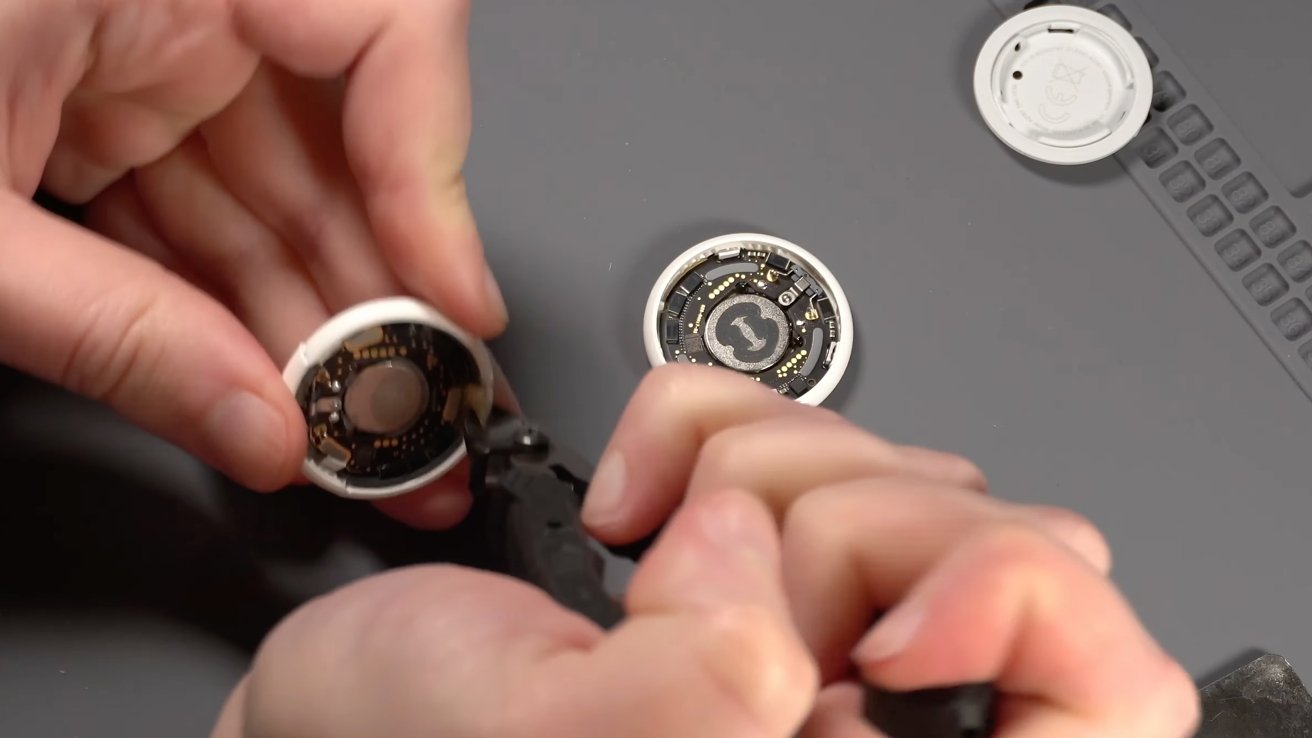
The second-generation AirTag has a few big changes to go with its improved features, with Apple slimming down the motherboard and changing some of the markings used in the new tracker accessory.
Apple updated the AirTag on January 26, with a new version improving some important features, such as an increased distance for finding it with Ultra Wideband to 200 feet. Two days later, one of the first teardowns has revealed what Apple has changed in the compact device for its second release.
The teardown, posted to YouTube by Joseph Taylor late on Tuesday, reveals there are very few externally visible changes to the new AirTag. It uses exactly the same case design as before, both in shape and size, and it still uses a standard CR2032 coin cell as a battery.

Externally, the only real changes are to the text engraved on the metal part of the housing. That text is now capitalized as well as mentioning the water and dust resistance, its use of Find My, and NFC.
Moving inside, the labeling changes continue, as Apple includes a new image that looks similar to a QR code.
Digging deeper, the circuit board used in the new design is a bit thinner than the first model. The board also has slightly different battery connection points, as wel as manufacturing test pads.
To make the AirTag 50% louder, Apple updated the speaker coil to make it physically bigger. Oddly, while the speaker magnet in the original could be removed, it's now harder to shift in this new version.
And there's glue. A lot of it.
Outside of the AirTag itself, Apple has modified the packaging. The new box is narrower, with Apple using paper pull tabs throughout. A set of four AirTags will be sold in a row, rather than in a folio-style arrangement.
We'll be reviewing them shortly, and comparing performance between the first and second generation.