
On February 16, 2016, Apple published a statement it knew would be criticized, and laid out the reasons it would not bow to unfair government pressure. We're apparently in a very different world today.
Ten years ago on February 16, 2016, Apple drew a line in the sand. The FBI had cleverly and even callously timed an attack on the firm to take advantage of public outrage over the San Bernardino shootings.
Fourteen people had been murdered in a terrorist attack in California's San Bernardino in December 2015. By February 2016, then FBI director James Comey told senators that they had one of the killers' phones that they hadn't been able to open.
At the time, what he failed to mention is that the FBI ignored Apple's criminal investigation guidance, and botched entry attempts. Had they not done been so incompetent in this regard, they'd have been given more information by Apple, quickly.
Anyway, in that hearing with the Senate Intelligence Committee, Comey at least hinted that the FBI had been asking Apple to open the phone. Completely misunderstanding the issue, or perhaps with an agenda, we'll never know, he denied on the record that he wanted a backdoor that would allow law enforcement access to any iPhone.
"I don't want a back door," he said missing the entire point of the conversation. "I would like people to comply with court orders, and that is the conversation I am trying to have."
Apple was clear that it gave the FBI every assistance it could, but argued that even it could not unlock iPhones for them, as they did not have the mechanism to do so.
Apple proposed four different options for data recovery, none of which involved building a software backdoor into iOS.
And that botched entry? The FBI shut the door on new information, and tried resetting the password on the device.
That prevented the possibility of Apple extracting data from an automatic, and fresh, iCloud backup had they just brought the device into a known Wi-Fi network and issued a court order for that.
The government did not listen to what it didn't want to hear, and so on February 16, a US magistrate judge ordered Apple to do what it literally could not do.
At least a large proportion of the public was on the government's side, too, since the FBI insisted that crucial information was locked on the shooters' iPhone 5c running iOS 9.
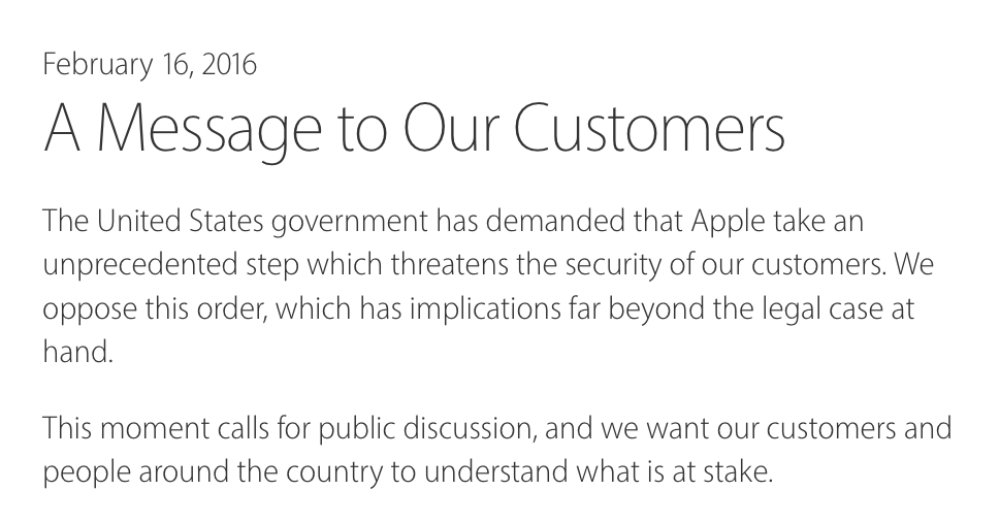
Start of Apple's 2016 statement on why it was opposing government overreach — image credit: Apple
Yet on that same day, Apple went public and published a statement saying no, this is not right. The government should not be allowed to force backdoor access into every iPhone, everywhere.
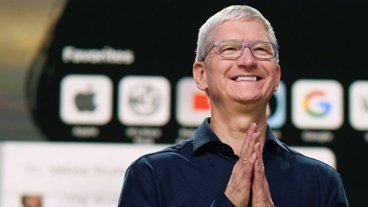
"The implications of the government's demands are chilling," wrote Tim Cook. "If the government can use the All Writs Act to make it easier to unlock your iPhone, it would have the power to reach into anyone's device to capture their data."
"The government could extend this breach of privacy and demand that Apple build surveillance software to intercept your messages, access your health records or financial data, track your location," he continued, "or even access your phone's microphone or camera without your knowledge."
Throughout this statement, Cook praised the rule of law, and he acknowledged that the FBI had good intentions. He also wrote of how the idea that only the good guys would use such a backdoor ignored the reality that it would be found and exploited by more.
But Cook raised the point that the FBI was not asking for Congress to pass legislation, it was attempting to expand its authority through leveraging an act from 1789.
It was also arguably attempting to pass the buck to Apple instead of focusing on failures in its own investigation. For within weeks, it had paid a hacking firm around $1 million to exploit a bug in iOS 9 and unlock the phone.
There was no new information on the iPhone.
At least there was an act
The All Writs Act that FBI had been using to back up its demands against Apple dates from 1789. Tim Cook did not say, and didn't need to say, that an act written in the 18th century was unlikely to be adequate in the 21st.
But the FBI had that act and it was using it. Zoom forward ten years and Apple isn't even facing that — yet it is constantly caving in to the government anyway.
There is no act, no legislation, and the government is also being very careful not to actually expressly order Apple to do things like removing the ICEblock app. They can't, because that would be a clear violation of the First Amendment instead of just a request that Apple do so.
But Apple removed that anyway. We may never know what really happened, we may never know what pressures the Trump administration brought to bear.
What we absolutely know, though, is that Apple gives in to Trump. The core part of that 2016 statement was this paragraph:
Opposing this order is not something we take lightly. We feel we must speak up in the face of what we see as an overreach by the U.S. government.
Not pushing back now against a challenge to what is confirmed to be a right of the people spanning 100 precedents in courts all the way up to the Supreme, is an act of cowardice. Not pushing back against a challenge to a First Amendment right that the people absolutely have is ludicrous.
The feds argue in this case, and in others criticizing them, that the First Amendment doesn't cover things like this, given how old it is. But they know it is, given that they merely asked Apple to take down the app, and didn't demand it through the courts.
If the Second Amendment matters as-is today, and it does, then the First must. It's hypocrisy to say otherwise.
Apple has not spoken up against the current administration's blatant overreach. It has not opposed the request at all and caved almost immediately, and continues to do so with other similar apps.
There's no argument that the apps that Apple have taken down are a violation of federal secrecy, as as soon as a law enforcement officer is visible, then they are documentable by the public in any way that they see fit — that's what the courts have ruled for four decades. It's the same argument and legal underpinning used for speed traps in Apple and Google Maps.
There is a strong argument that in giving Trump pointless trophies and rephrasing existing investment as Trump-inspired, Tim Cook is protecting Apple. There's even a strong argument that he has to, given responsibility to shareholders, and given how the current administration's whims are costing American businesses dearly.
But it's an insult to users. You know, the people that buy the devices and services and generate actual wealth for the company, and not just valuation and wealth for other investors.
It has been reported, for instance, that Trump even created a tariff that would hurt Apple, expressly because Cook turned down a dinner invitation. Then Trump himself has admitted to also doing the opposite, to reducing certain tariffs in order to help Apple.
Make a plaque if you must, give a speech or two if you have to. But in obeying the government's threats, the Apple of 2026 is an embarrassment to the Apple of 2016.