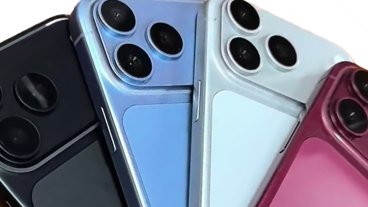
Apple's next pro-level iPhone, the iPhone 18 Pro, could feature a 24 megapixel camera, although what that actually means isn't entirely clear.
On Tuesday, the rumor mill gifted us with a new bit of ephemera to add to the pile. This time, it targeted the iPhone 18 Pro's camera — specifically, what we could expect in terms of resolution.
WhyLab, a previously unknown to AppleInsider leaker, speculated on Weibo that the iPhone 18 Pro would gain a 24MP front camera. According to Google Translate, he said:
"The iPhone 18 Pro will likely be upgraded to a 24-megapixel front-facing camera, which is a significant improvement, compared to the 18-megapixel front-facing camera of the 17 Pro."
However, upon examining his included image, it didn't take long to discover that he wasn't the source. Four days prior, the rumor actually surfaced from ApplesClubs, another small-time leaker who can be found across various platforms.
iPhone selfie camera evolution is about to level up
— Apple Club (@applesclubs) February 20, 2026
iPhone 16 Pro — 12MP
iPhone 17 Pro — 18MP
iPhone 18 Pro — 24MP (rumored)
If this jump happens in 2026, front cameras are finally getting the Pro treatment too. Sharper FaceTime, better low light, cleaner details. pic.twitter.com/DPZ3qpiN20
For what it's worth, we're pretty positive that ApplesClubs doesn't have any insider information, either.
It seems far more likely that the leaker is assuming the same 6MP jump that we saw between the iPhone 16 and the iPhone 17 front-facing cameras. And that's an understandable assumption to make, at least on the surface level.
This isn't the first time we've heard this rumor, and it's not the first iPhone to supposedly get the upgrade. Ming-Chi Kuo had initially said that the iPhone 17 would have a 24MP main camera.
And, to his credit, he wasn't exactly wrong, either.
Technically it already has a 24MP camera... sensor
Cameras are a tricky thing to talk about, though that never seems to stop the rumor mill, either. So when a leaker assumes that there will be a linear jump from one generation to the next, you have to take it with a grain of salt.
Especially because the iPhone 17 already has a 24MP camera.
Apple advertises this as an 18MP camera because that's the resolution of the image the iPhone spits out. The reason for the discrepancy between sensor size and output image is a mixture of things, with the biggest culprit being pixel binning.
Pixel binning is the process of averaging the light values of pixels based on the surrounding pixels. Essentially, the iPhone treats groups of pixels as a single, virtual "superpixel."
Pixel binning is a handy little trick. Each superpixel is more sensitive to light, so you get improved photography in low-light situations.
There are some tradeoffs. Pixel binning kills off micro-detail and, of course, lowers the final resolution.
You could argue that the benefits of binning outweigh the cons when it comes to something like a close-range selfie. Doubly so when you consider that many selfies are taken indoors, where the lighting may not be the best.
It's also what allows Apple's new Center Stage feature to work as well as it does. The binning gives the iPhone extra room to crop an image down while preserving brightness and reducing noise.
Theoretically, if Apple were to cease using pixel binning on its front-facing camera, night-time selfies and FaceTime calls would look demonstrably darker and noisier. Essentially, when all is said and done, the front-facing camera on iPhone 18 Pro could get a 24MP output if Apple decides to jump the front camera sensor to 48MP.