
Apple TV is gaining ground in the U.S. streaming market. Here's how much Apple TV viewership has grown over the last few years, and how the gap is narrowing among the top platforms.
Streaming spent the last decade rewarding scale, with Netflix and Prime Video building libraries so large that finding something to watch became a chore. Scale still defines the top tier, but oversized catalogs now slow people down instead of pulling them in.
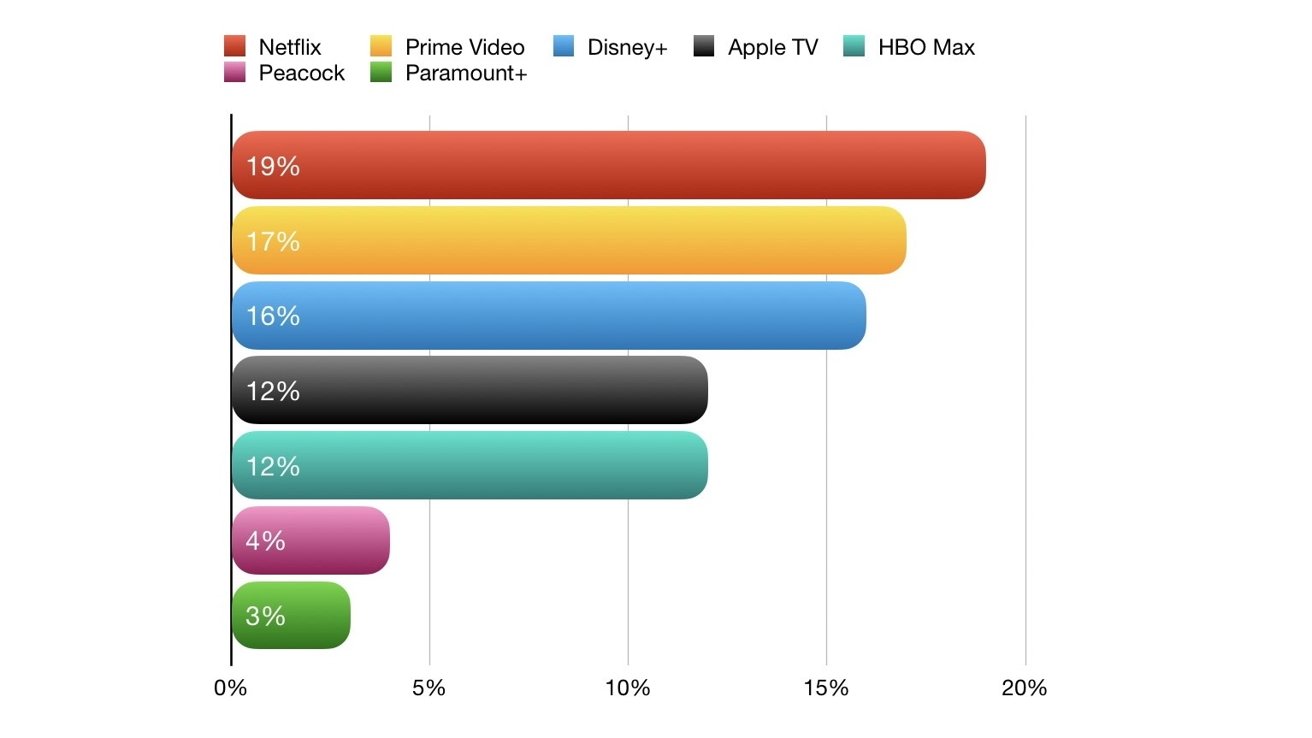
New Q1 2026 data from JustWatch, based on more than 35 million U.S. streaming interactions between January 1 and March 31, shows the gap beginning to tighten. Netflix leads at 19% and Prime Video follows at 17%, while Disney+ holds 16% and Apple TV has climbed to 12%.
JustWatch measures market share based on user engagement, including searches, clicks, and watchlist activity, rather than total subscribers. The dataset reflects viewer interest and intent across platforms, which can diverge from rankings based strictly on paid memberships.
Apple's position is notable, but the speed of the shift is the real story. Apple TV added four percentage points in a single quarter, a jump that breaks from its earlier pattern of slow, incremental gains.
Apple TV's growth took years, then accelerated
The company didn't overhaul its strategy to get there, and the service still leans on a smaller catalog with a steady cadence of high-profile releases. Apple's approach now fits a market where viewers spend more time choosing than watching.
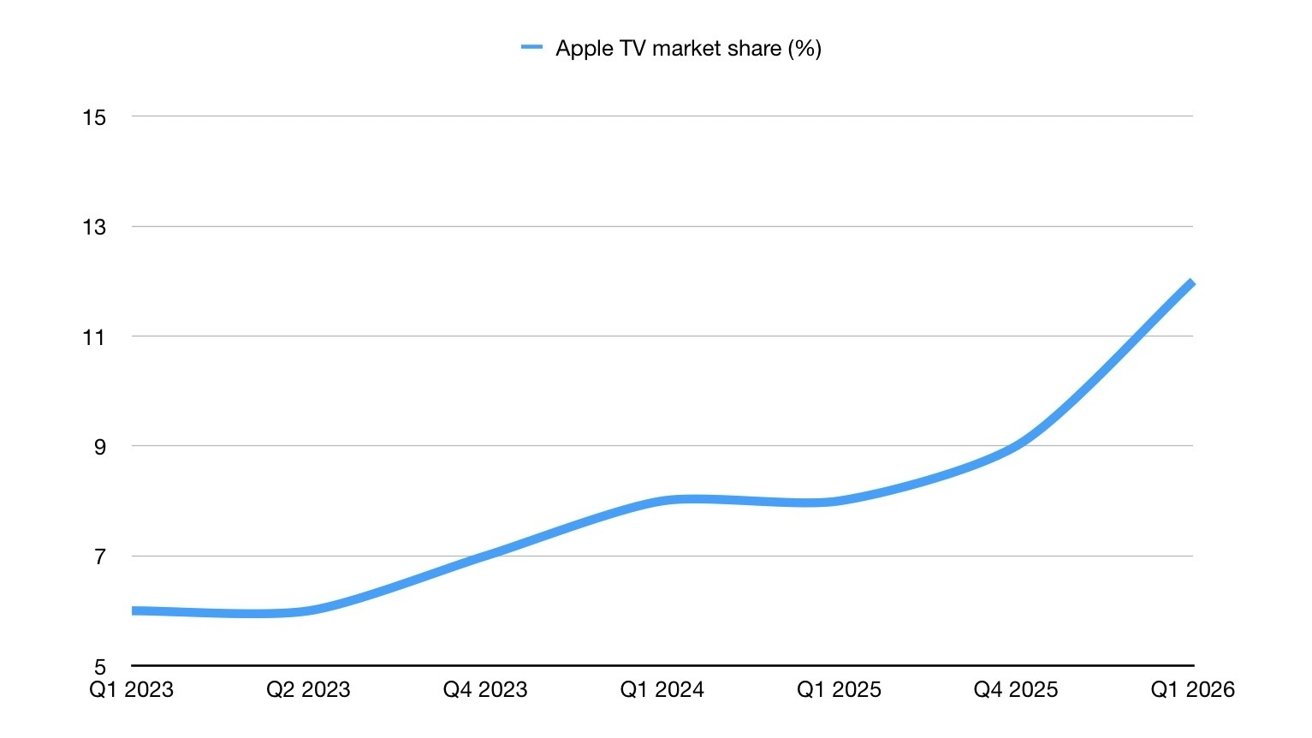
Apple TV's rise didn't happen overnight. The service hovered around 6% through much of 2023 before inching up to roughly 7% and 8% across 2024 and early 2025.
Growth during that stretch remained steady but modest, with gains typically measured in a single percentage point over several quarters. Apple reached about 9% by the end of 2025, which kept it within reach of the top tier without breaking into it.
Apple's move to 12% in Q1 2026 breaks from that earlier pattern. The service gained more share in a single quarter than it did across some full years.
The streaming hierarchy is compressing
The latest data shows a market that is no longer widening at the top. Netflix and Prime Video still lead, but their advantage has narrowed as Disney+ and Apple TV continue to close the gap.
Apple TV's position inside that top group is an improvement. The service now sits alongside HBO Max at 12%, moving out of the second tier after years of trailing the major platforms.
The market is settling into tighter tiers rather than one dominant leader. Disney+ has climbed to 16%, while smaller platforms like Peacock are also gaining ground, helped in part by broader distribution deals.
Apple's move to 12% in Q1 2026 breaks from that earlier pattern
Apple's four-point gain in a single quarter is rare. In a mature streaming market, most platforms move by a single point at a time, if at all. Competition is shifting toward holding position within a crowded top tier rather than pulling away from it.
Apple bet on curation while everyone else scaled
Apple took a different path from the start, building Apple TV around a smaller catalog instead of chasing volume. Netflix and Prime Video filled their libraries with thousands of titles, while Apple focused on a narrower slate of originals designed to stand out.
Early criticism centered on the lack of depth compared with larger competitors. Limited choice made it harder to justify a subscription when rival platforms could offer something for nearly every viewer.
The balance has shifted as streaming libraries have grown harder to navigate. Large catalogs now create friction, and Apple's smaller lineup makes it easier for viewers to find something quickly and start watching.
Engagement data tends to reward services that get viewers to press play quickly. A smaller catalog can help on that front, since fewer choices reduce the time spent browsing.
Netflix and Prime Video rely on scale to keep viewers engaged over longer sessions. Apple's approach is built around quicker decisions, with fewer titles designed to get a viewer watching without much browsing.
Why Apple's growth is happening now
Apple TV's rise reflects a change in how viewers use streaming services rather than a sudden shift in Apple's strategy. The service has stayed consistent, but audience behavior has started to move in its favor.
Hit-driven viewing plays a role, especially when a single show pulls in attention and drives repeat engagement. Fewer releases also mean each title carries more weight, which helps Apple cut through a crowded release schedule.
Apple's results are driven in part by a smaller number of breakout titles that carry more weight
Apple's results are driven in part by a smaller number of breakout titles that carry more weight. Nielsen data shows Apple TV series have strong viewership relative to the platform's size, showing that a few high-impact shows can rival larger catalogs.
Viewer habits have also changed as the number of streaming options has expanded. Many users rotate between services or concentrate viewing on a smaller set of platforms, which rewards services that can deliver a quick payoff.
The pace of Apple's growth points to something more durable than a one-off spike. Moving four percentage points in a single quarter suggests a broader change in how attention is distributed.
Consolidation could reshape the leaderboard
A combined Paramount+ and HBO Max would land around 15% market share based on current estimates, which would push it firmly into the top tier. A move like that would tighten the gap behind Netflix and Prime Video and change how the middle of the market stacks up.
Media companies are running into limits with content alone. Building bigger libraries no longer guarantees growth, so mergers and bundles have become the fastest way to gain ground.
Apple TV benefits from a broader ecosystem linked to hardware and services, allowing it to grow without relying on consolidation. Maintaining that position will depend on whether a smaller lineup can continue delivering hits as competitors expand their catalogs and bundle offerings.