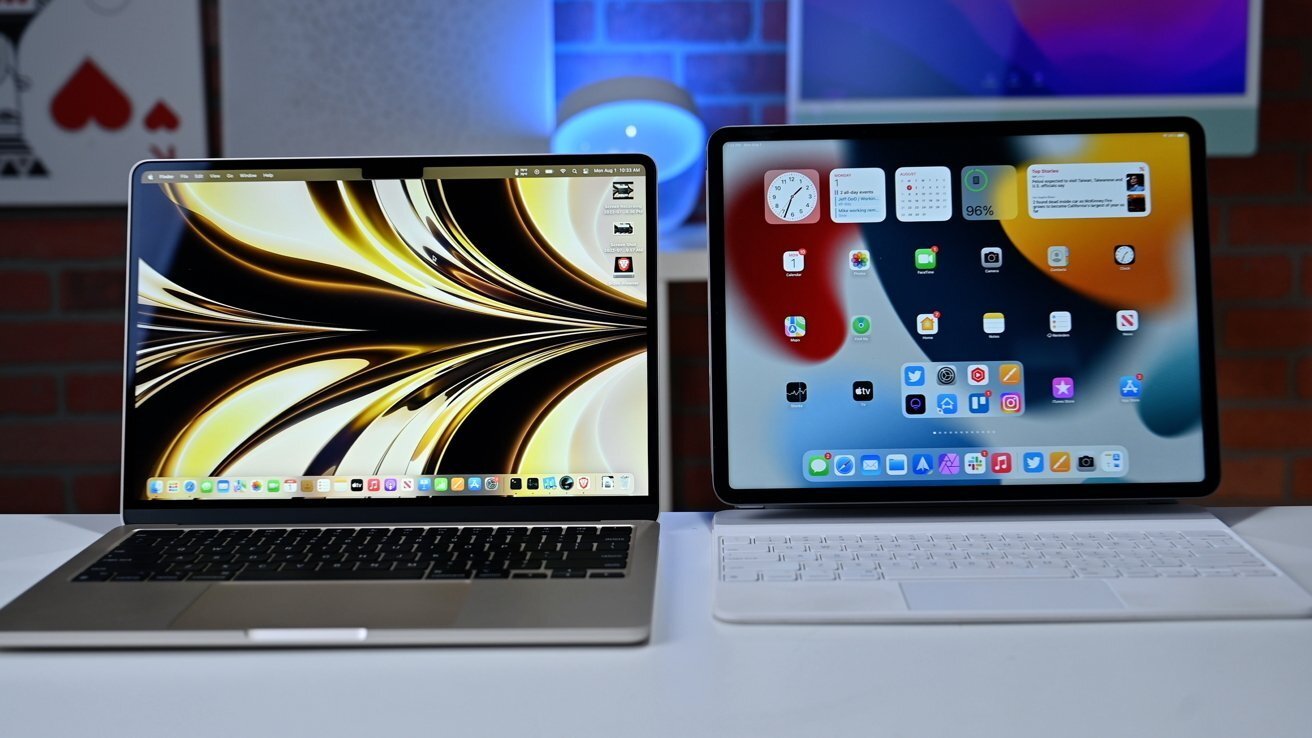
Are you ready for a MacBook Air that outperforms a M3 Pro MacBook Pro? If the leaked M5 iPad Pro benchmarks are accurate, that's what's coming next.
Apple has long been expected to release an M5 edition of its iPad Pro by the end of 2025, but now the first leaks claiming to be about it have started to appear. Most usefully, Geekbench is showing test scores that are promising not only for the iPad Pro, but for an M5 MacBook Air, currently predicted to be released in 2026.
That's because the iPad Pro and the MacBook Air share similar thermal characteristics. They both rely on passive cooling systems, where the higher-end 14-inch MacBook Pro and 16-inch MacBook Pro feature dual fans.
iPad Pro performance under M5
According to the purported Geekbench tests for the M5 iPad Pro, the device achieved:

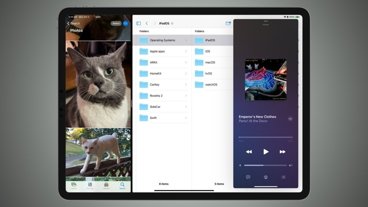
M4 iPad Pro and M5 iPad Pro specifications as shown in a purported leak on YouTube — image credit: Wylsacom
- 4,133 single-core score
- 15,437 multi-core score
The same iPad Pro model with the M4 chip is listed in the Geekbench browser as managing 3,679 and 13,420 for the single-core and multi-core scores respectively. As percentage improvements, the single-core result is up by 12.3% while the multi-core is up 15%.
The multi-core score is, of course, affected by how many cores there are, and the M4 iPad Pro can have 9 or 10. The claimed leak of M5 iPad Pro scores includes the detail that it has 9 cores in total, including 3 performance ones.
That's the same core count as the existing M4 iPad Pro.
Core counts and an M5 MacBook Air
Talking about the M5 iPad Pro results veersus with the future M5 MacBook Air does require further discussion about core counts. It is extremely probable that an M5 MacBook Air will follow the same line and have a 10-core CPU with 4 performance cores.
As a rule of thumb, as you increase core count, performance increases aren't linear, and this was practically demonstrated by the 10-core M4 iPad Pro.
With that in mind, the current M4 MacBook Air's Geekbench results are:
- 3,777 single-core score
- 14,772 multi-core score
What we can get from the single-core M4 iPad-to-MacBook Air comparison is a difference of about 2.7% between the platforms. That 12.3% iPad-to-iPad gain could translate to something a bit bigger, possibly 12.6% overall.
Since single-core benchmarks utilize the fastest available core type on a chip, this is a fairly reasonable assumption to make about performance improvement.
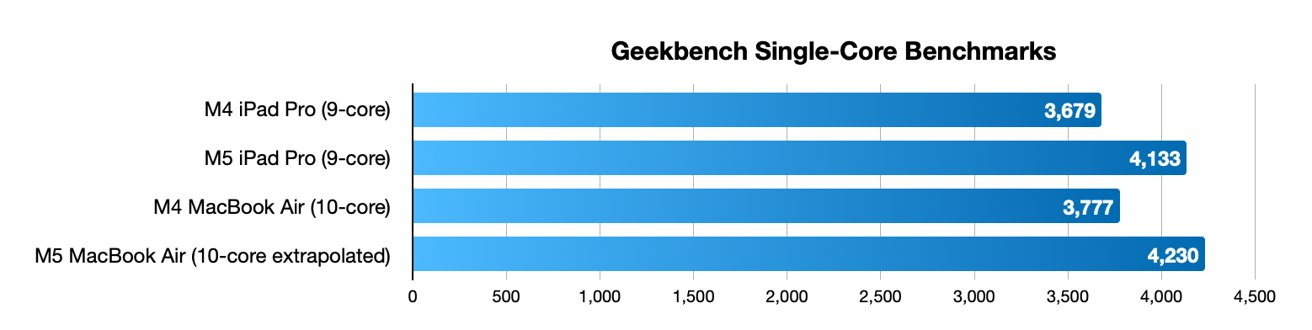
Extrapolating M5 MacBook Air single-core performance based on the M5 iPad Pro leak
We know that the M5 iPad Pro's result is about 4.5% better than the M4 MacBook Air as-is. That doesn't take into account the difference in core counts.
Remember, the M5 iPad Pro as leaked earlier on Tuesday seems to have three performance cores and six efficiency cores. The M4 MacBook Air uses four performance and six efficiency cores.
However, when it comes to multi-core benchmarks, the performance cores are expected to do the actual processing. The efficiency cores are more likely being used to handle background tasks instead of the benchmark itself.
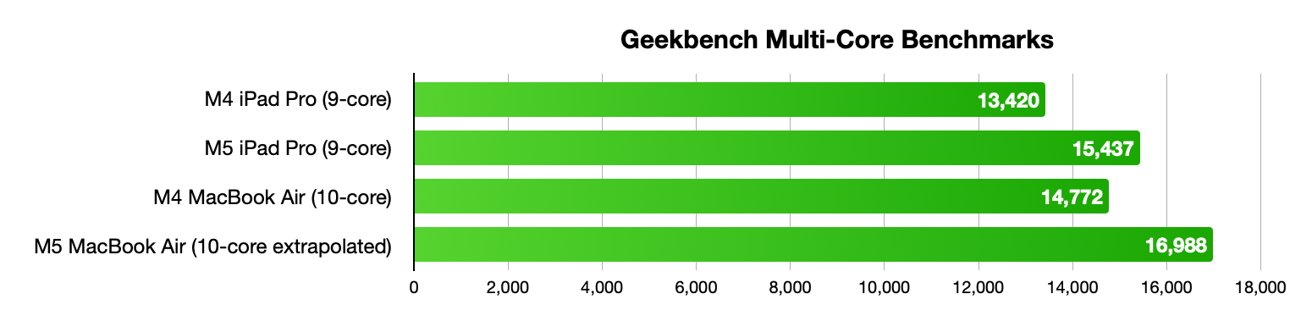
Determining the possible multi-core performance of an M5 MacBook Air
For the purposes of simplification, we are going to do a similar score-improvement extrapolation for the multi-core as we did for the single core. As the difference between the M4 and M5 iPad Pro is about 15%, we can expect at least the same sort of improvement from the MacBook Air upgrade.
With the MacBook Air with M4 starting at 14,722 for its multi-core score, the estimate for the M5 version at 15% higher would be scoring in the ballpark of 16,988.
This is quite a bit of an increase versus the difference between the iPad Pro chip generations, especially when put against the relatively meager difference between the M4 iPad Pro and M4 MacBook Air. Even if reality is tempered a bit from this simple premise, it's still going to be a healthy improvement between chip generations.
A probable noticeable improvement
When it comes to what users will actually experience, the M5 MacBook Air will be better than the M4 version in synthetic benchmarks. In everyday use, it's a bit different.
In general, it takes about a 10% performance increase to be noticeable in day-to-day use.
That said, a noticeable difference won't necessarily translate into the M5 MacBook Air being a must-upgrade release for M4 MacBook Air users.
At about 12.6% for the single-core testing alone, an M5 MacBook Air will be a fair bit snappier when using typical lightweight applications. The improvement may also be visible when using more intensive applications, such as games.
However, the 15% improvement for multi-core testing would bring the M5 MacBook Air into new performance territory. Technically, it would be better than an M3 Pro in a MacBook Pro (15,258), and an M2 Max Mac Studio (14,896).