
Apple's iOS Family Sharing is meant to be a boon for protecting children and managing app purchases, but for one broken family it was turned against them. Unless Apple makes changes, there's not much that can be done about it.
Apple launched Family Sharing in 2014, and alongside Parental Controls, it's all about protecting children and overseeing their use of devices. According to Wired, however, the stringent controls Apple imposes also enables potentially serious problems.
An anonymous woman referred to as Kate, has recounted how Family Sharing was used against her when she separated from her husband. Her ex was the organizer of their Family Sharing group, and refused to remove their children from it.
"I wrongly assumed being the custodial parent with a court order meant I'd be able to have Apple move my children to a new family group, with me as the organizer," she said.
Her ex used Family Sharing to monitor their children's activities, and allegedly would aggressively question them. He also imposed harsher Screen Time constraints on them when they were with their mother, and lifted them on his custody days.
Describing it as "invasive and coercive," Kate said that it was "frightening and insanely frustrating to realize we were still not free."
Ultimately, Kate says that her children began responding to every contact from her ex by telling him to disband the Family Sharing group. Eventually, he did.
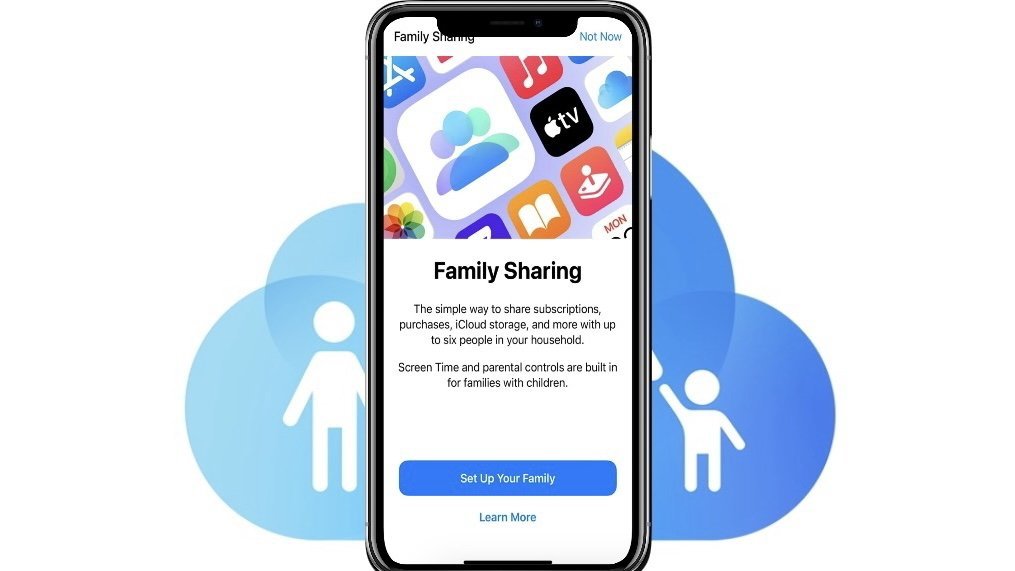
Apple introduced Family Sharing in 2014
"Finally, we could all exhale," said Kate. "But kids should not have to parent their own parent because tech companies are severely lacking in policies for cases like ours."
Location sharing
The changing of Screen Time limits was a clear punitive attempt to get back at his ex. But it appears that it was location tracking that was particularly key to Kate and her children feeling under siege.
Any iPhone user can elect to share their location with another Apple user. When they do so, it is actually one device being shared, and also for specific and limited periods of time.
Under Family Sharing, Kate's ex was able to use Find My to monitor the location of their children at any time. It was not possible for them to prevent this, short of turning off their devices.
At the same time, as Kate was not the organizer of their group, she would not be able to use Find My if she needed.
What Apple could have done now
While Apple did not comment on the Wired report, Kate says that its support staff were sympathetic — yet unable to help her. Until her ex willingly released their children, she was told, there was nothing she or Apple could do.
However, this was not a situation where the parents should have been able to amicably sort it out. This was a case where Kate had a court protective order.
Apple should have split the family share, as it keeps saying for other situations that it complies with court orders. And if there were some technical reason it was impossible, then Apple has had nine years in which to make it possible, or say why it isn't.
What Apple should do in future
Kate was advised that she could create a new Family Sharing group. But it would require each child to have a new account, meaning losing their existing apps, and message history, for instance.
Before the relationship broke down, it would have been possible for Kate to be granted certain controls. There can only ever be one organizer with full access, but Kate could have been granted the ability to:
- Manage Screen Time
- Approve app purchases
That might have helped with the Screen Time changes, but it could also just have resulted in her ex repeatedly undoing any change she made.
Nonetheless, it means that Apple has at least considered situations where more than one person needs certain capabilities.
Yet it still has not enabled joint organizer status. As well as situations such as Kate's, there are doubtlessly also cases where the organizer dies and his or her password is not known.
Consequently, Apple must get requests to allow joint control. After almost a decade, it can't be that there is a technical barrier to doing it, it has to be a policy choice.
Apple is currently adding new tools to protect children from external problems, such as inappropriate advertising.
But at the same time, Apple is entirely failing to protect children from problems that are internal to families.