
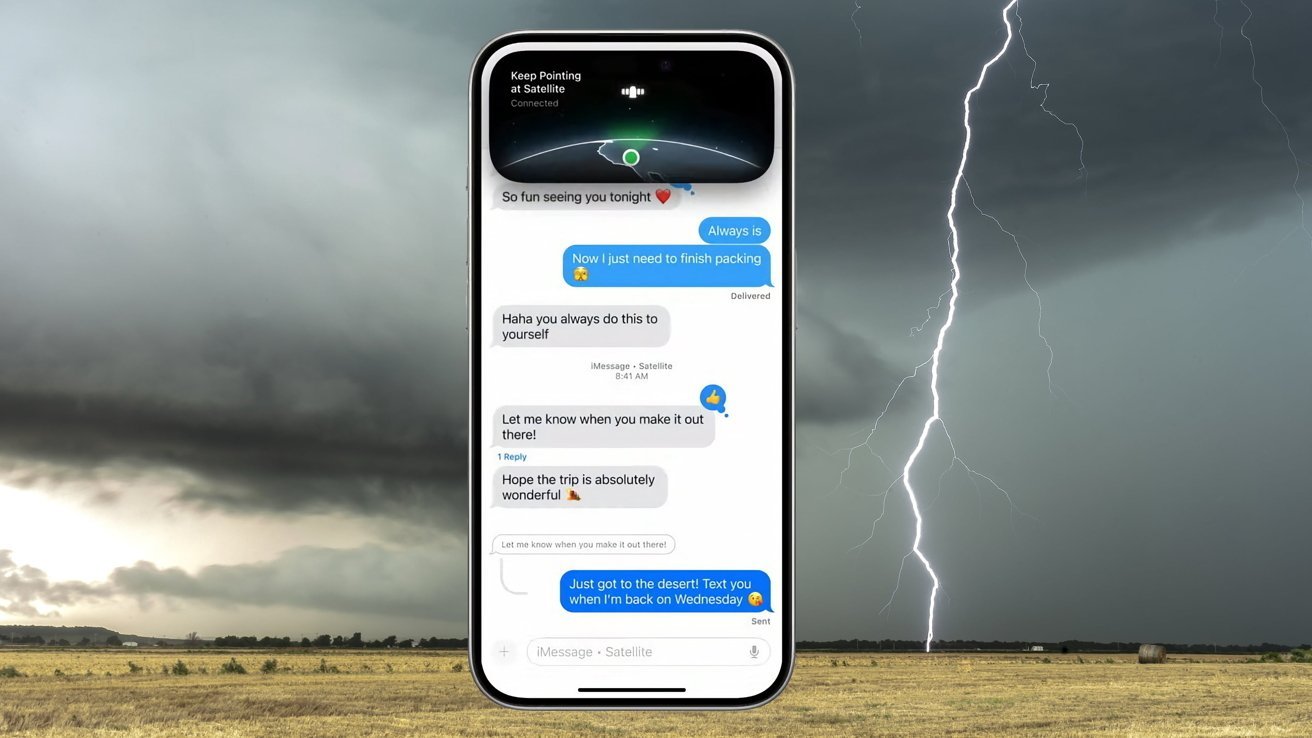
Apple is examining how to take more advantage of the constellation of satellites orbiting the Earth on a future iPhone, including one where it will connect without needing to come out of your pocket.
Apple's inclusion of satellite connectivity in the iPhone, such as Emergency SOS Via Satellite, has proven to be extremely useful in a difficult situation. However, while handy when a cellular signal is not available, it can always be improved to expand what it offers to consumers.
In Sunday's "Power On" newsletter for Bloomberg, Mark Gurman writes about some of the satellite-centric features that Apple is working on. This includes expanding the functionality of satellite connectivity so it can be used by third-party apps.
This will apparently involve the creation of an API for app developers to use. However, it's warned that not every single Apple-created satellite feature will be made available in this way.
Expanding the existing Messages via Satellite function is also a possibility. Apple is reportedly trying to add support for photos, bringing it beyond basic text messages.
Likewise, Apple is also apparently hoping to make Apple Maps work with it. While satellites are used for positioning data, Gurman's post implies that map data could be delivered to the user over the satellite connection.
Establishing that connection is also intended to be improved. Currently, users are expected to be in an area with an unobscured view of the sky, and are instructed to physically point the iPhone in the vague direction of in-view satellites.
However, Apple wants this to be a more "natural usage" process for users. This would entail allowing the iPhone to connect to satellites while in a pocket or a car, without necessarily requiring the user to handle the iPhone in a specific way.
Doing so should allow for updates to the various satellite-based features to occur without user intervention.
To help get this underway, Apple's 2026 iPhone range is anticipated to include 5G NTN (Non-Terrestrial Networks) support more broadly. Specifically, allowing for cellular towers to use satellites for increased device coverage.
Continued satellite expansion
The claimed inbound satellite features are a continuation of Apple's work to expand its non-cellular offerings to consumers.
When it comes to non-emergency-based new features, there was an initial hint of what was to come in the iOS 26 developer beta back in June. Weather Updates via Satellite would receive weather updates in a similar manner to Emergency SOS via Satellite.
The iPhone would pull in updated weather data and relevant alerts for the user's location. This would be handy for hikers, campers, climbers, and sailors who depend on accurate local weather forecasts in areas that may not have reliable cellular service.
As for hardware support, Apple confirmed at its September 9 "Awe Dropping" event that the satellite features for the iPhone 14 and iPhone 15 will continue for another year at no additional charge.
Earlier, in May 2025, Apple expanded its carrier-provided satellite features to all iPhone 13 models as part of iOS 18.5.
As for the actual satellite connection itself, that may also be improved. While Apple currently relies on Globalstar's aging spacecraft, there are ever-present murmurs that Apple could end up working with Starlink in the future.
Apple has invested a hefty $1.1 billion in Globalstar, but that hasn't stopped the rumors of Globalstar selling itself off to a potential suitor. The more probable buyer is Starlink-owner SpaceX, not Apple, as the iPhone maker is reportedly keen to avoid becoming a carrier and face that regulartory burden.