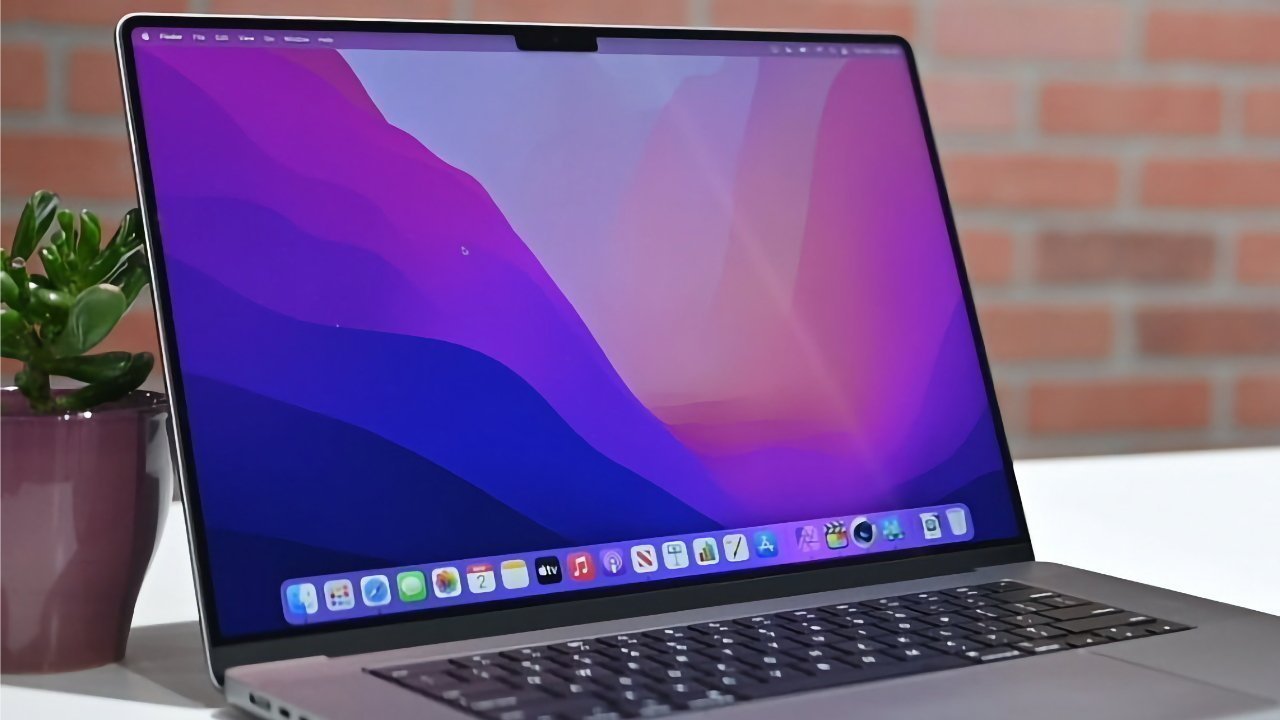
The M6 Pro and M6 Max versions of the MacBook Pro could also be the only models to have OLED, giving consumers more reason to pay for the premium options.
Apple is rumored to be working on an OLED upgrade to the MacBook Pro, with a revised display model expected to arrive in late 2026 or early 2027. However, it may not be made available across the entire range.
According to Mark Gurman's "Power On" newsletter for Bloomberg on Sunday, the OLED upgrade of the MacBook Pro will be more gradual than usual. Instead of being on all models, Gurman specifies OLED as being a feature of the M6 Pro and M6 Max versions of the MacBook Pro.
If it is limited only to the upper chip tiers, that would mean the lower-level M6 model will use the usual LCD TFT screen.
The model will also enjoy a revamped design, as also rumored for the M6 iteration. That includes a thinner chassis as well as a recently-revived rumored upgrade to a touchscreen.
As for the release, it could arrive as soon as late 2026, but an early 2027 release is also a possibility.
The M5 Pro and M5 Max versions, which will use the current MacBook Pro design, are anticipated to launch in the first half of 2026, alongside an M5 MacBook Air. The middle of the year will feature the M5 and M5 Pro versions of the Mac mini and the M5 Max and M5 Ultra Mac Studio.
After that, Apple will start the M6 launch cycle with an entry-level 14-inch MacBook Pro.
Not an unexpected design choice
Apple's apparent decision to make OLED a feature of the M6 Pro and M6 Max MacBook Pro isn't entirely out of the ordinary for the company. Indeed, it could be considered an expansion of an already existing technique to massage its pricing ladder.
Consumers are already familiar with the idea of the Pro models having specifications and features that are better than other non-Pro versions. This is evident in the differences between the MacBook Air and MacBook Pro lines, or even the Pro and non-Pro iPhone models.
However, using OLED would be a small shift to apply the same policy within the same product range for once. One that could help justify jumps in price.
The current M5 14-inch MacBook Pro starts from $1,599, with the M4 Pro chip change starting $400 more at $1,999, which also bundles in a bit more memory to the equation too. While this is between the M5 and the M4 Pro, it's not difficult to expect a similar pricing jump between the M5 and M5 Pro, and for the M5 Max too.
The entry-level M4 Max version raises the storage by half a terabyte and adds more memory again alongside the chip change. But even that is a $1,200 jump from the Pro chip level, or a total of $1,600 on top of the overall entry-level model.
For a consumer, seeing an OLED screen in a future Max model could make the premium MacBook Pro tier more justifiable to purchase than at present. Performance improvements are good, but a more visual change has a lot more impact on purchasing decisions than speed boosts alone.