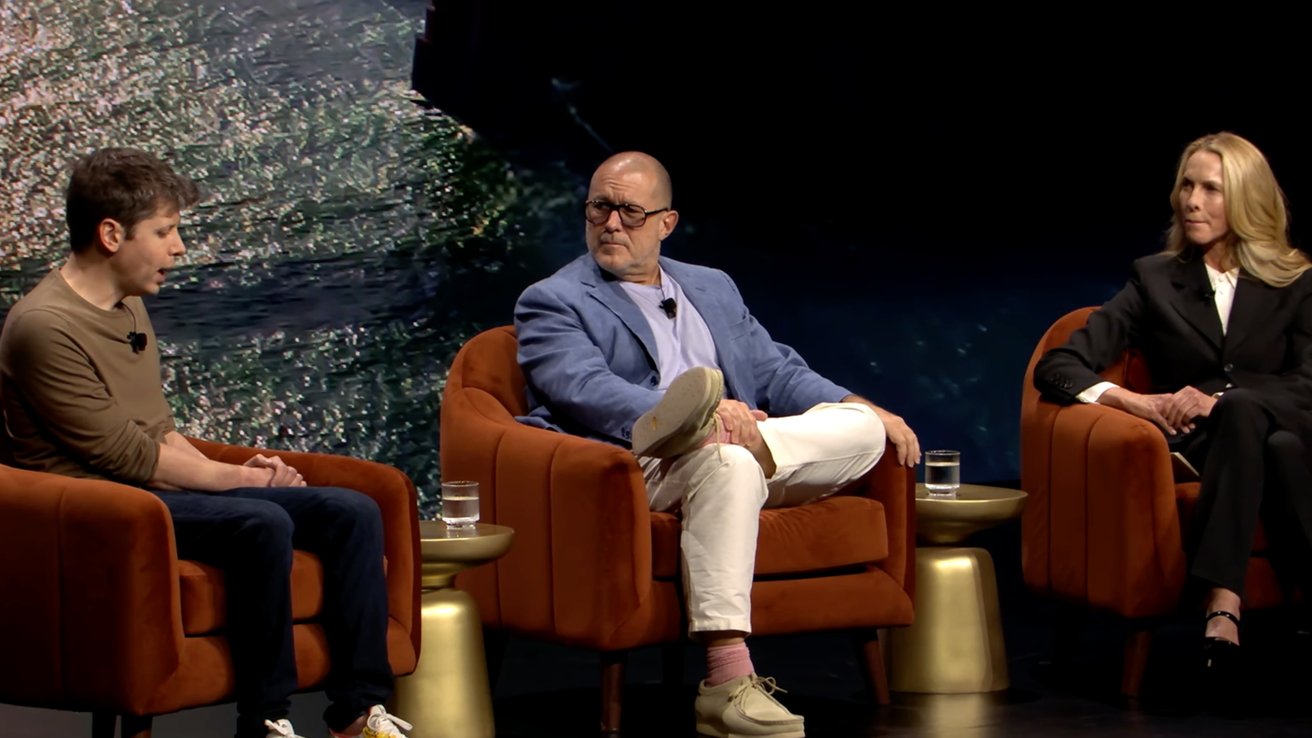
In an interview hosted by Laurene Powell Jobs, Jony Ive and OpenAI CEO Sam Altman have confirmed that a prototype for the first OpenAI device does actually exist, and may ship as soon as 2027.
Former Apple design chief Jony Ive is actively working with OpenAI on some form of hardware that uses artificial intelligence. In a conversation with Laurene Powell Jobs, Ive and OpenAI CEO Sam Altman revealed that the effort has apparently settled on a design for the device.
The conversation with Powell Jobs at the Emerson Collective Demo Day, published to YouTube on Monday, took some time to discuss their work under "io," a startup that was bought by Altman's OpenAi for $6.5 billion in equity.

While few details about the hardware are actually known about, The Verge reports the duo said that prototyping is underway for the hardware. As for when it can actually ship to consumers, Ive added it could become available in "less than" two years.
Design philosophy, no detail
During the conversation, Altman said the current design of the prototype is "simple and beautiful and playful," without going into actual detail. He adds that an earlier prototype was exciting, but it didn't give him the feeling of "I want to pick up that thing and take a bite out of it."
Curious edible descriptiveness aside, Altman at least insists the new design "got there all of a sudden."
This is not the first time that a prototype has been mentioned, as Altman did say earlier in 2025 that he had been able to "live with it" at home.
For Ive, he sad that he prefers hardware that appears "almost naive in their simplicity," as well as designs that "you want to touch, and you feel no intimidation." He hopes for a design that users will want to use "almost carelessly, that you use them almost without thought, that they're just tools."
Current speculation for the device effectively describes it as being smartphone-like but without a display. This may put the item in the same category as other physical AI devices, like the ill-fated Humane AI pin.
The attempt to avoid that fate has started strong, with OpenAI securing some of Apple's hardware team for the project. The effort is led by Tang Tan, OpenAI's chief hardware officer and a 25-year Apple veteran with experience working under Apple hardware chief John Ternus and Jony Ive.
However, it may take a lot more than keen design, OpenAI's smarts, and a ton of cash to make a dent against the smartphone market as a whole with a market-adjacent device. There's always a possibility of OpenAI doing on-device AI processing better than Apple's Siri, but it'll take a lot of work to actually achieve.