FileMaker Pro is the biggest Windows app that Apple makes, it and its Mac version are a crucial part of businesses large and small — and it was nearly owned by Microsoft. Here's the story of the huge Apple hit you might never have used.
It's also possible that you've used FileMaker Pro without actually realising it. Not because you didn't look up to see the app's name in the menubar, but because it is a tool for making other tools.
FileMaker Pro is used to make database apps, many of which just run inside this one, but many others are sold separately. If you develop FileMaker Pro databases, you could roll them out across your company, or your customers, you can have it power websites and iPad data-collecting apps.
This FileMaker Pro is so crucial in so many businesses that there are people whose entire careers have been spent working in it. And then at the same time, there are individual users who have come to rely on it for specific projects.
BBC uses FileMaker Pro
When I was at the BBC, there were two FileMaker databases. One controlled all research for a specific and very, very large project, while at the same time managing the vacation entitlements and other business of the corporation.
And the other was mine.
For five years, I wrote a daily TV history column in Radio Times, the UK equivalent of TV Guide, and I ran it through FileMaker Pro. I can tell you that it was a fantastic database app, because just now I opened it up and have not one thin clue how I made it.
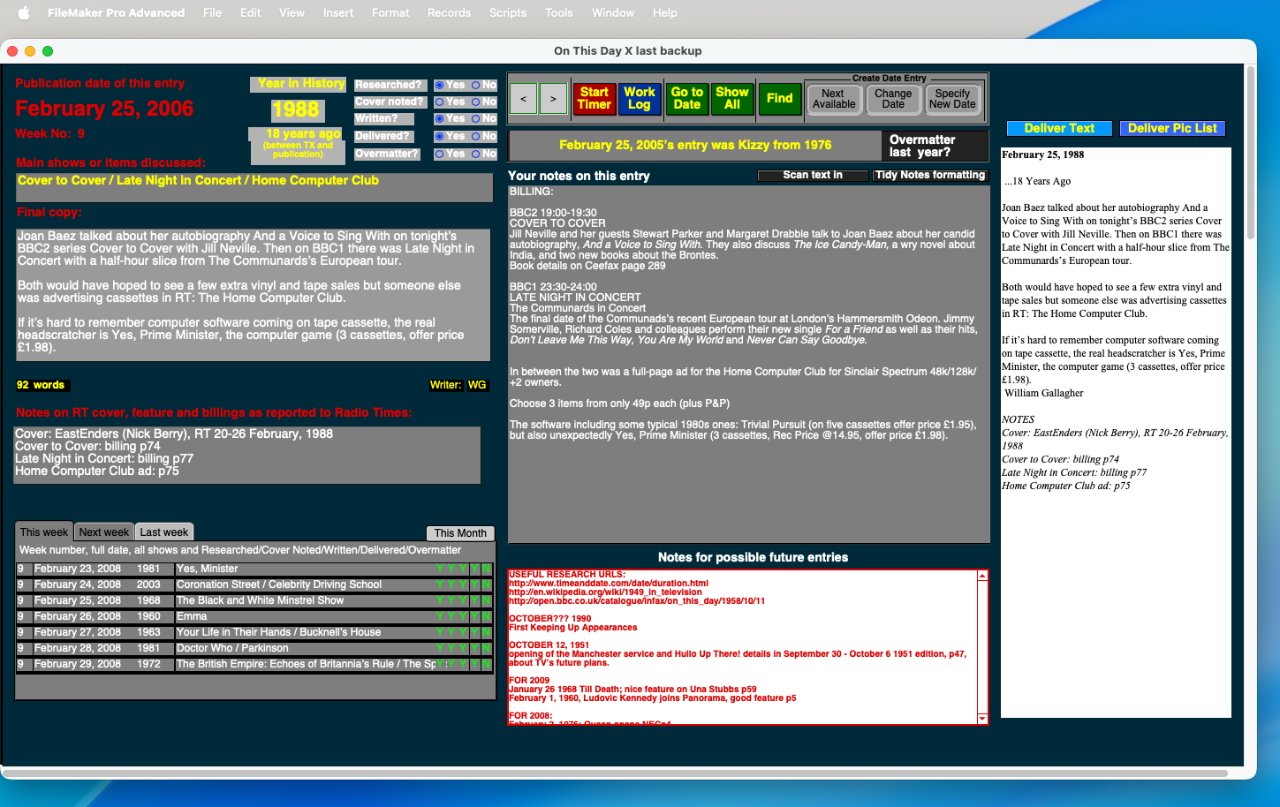
My Radio Times research database in FileMaker from from the mid-2000s - image credit: William Gallagher
Back then, I could search for, say, every time I ever mentioned "Doctor Who." I could look each entry I'd written for, say, February 25 and whether I'd written about children's show "Kizzy" or prestigious drama "The Glittering Prizes," which both started on that date.
It had space for my research notes, it had space for my final copy. It showed me a formatted preview of how that text would look in the magazine.
The same database also tracked my working hours so I could report them. It showed me every entry for this week, last week, and next week, or the whole month.
And it had a button to email the final text over to the Radio Times production desk. There was actually more, and I neither remember how I designed it, nor now understand why I made it look so ugly.
The thing is, there was no one to stop me. Not with my choice of yellow text on black backgrounds, not my choice of buttons, not the tick boxes that I seemed to be really into back then.
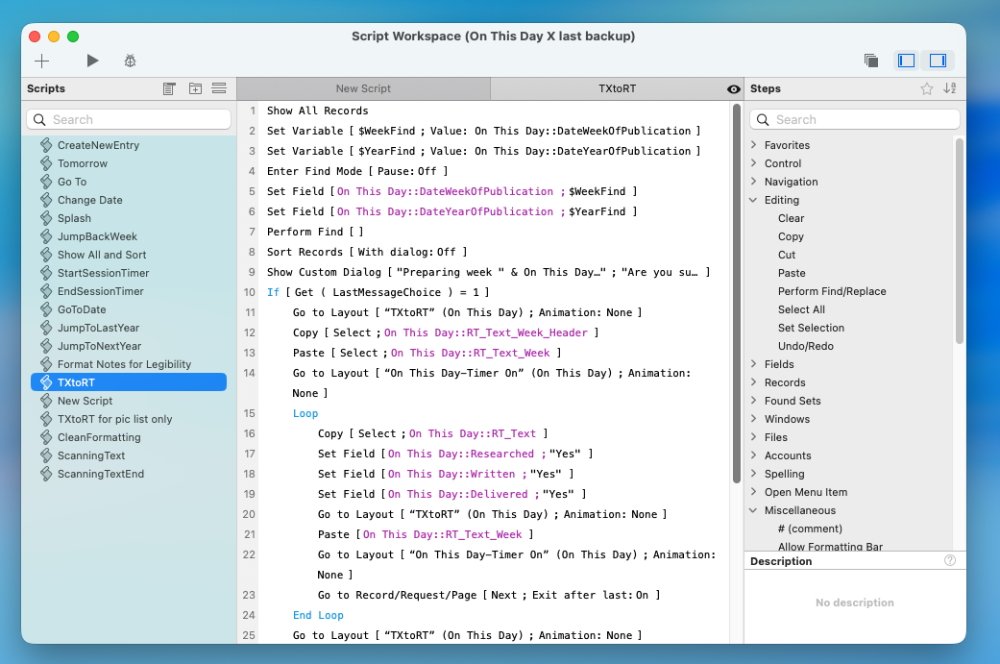
I used to know how to do all this stuff- image credit: William Gallagher
And that's because, if nothing else, FileMaker Pro is flexible. It always has been, too, right from its start way back in the 1980s.
Origin story
Before there was a FileMaker database app, there was Wang. In the 1980s, Wang Laboratories was making word processors — not apps to run on Macs or PCs, but hardware word processors.
It made so many different products over its 40-year history — and was extremely successful at it. But it didn't make four of its employees very happy.
Spec Bowers, Alan Albert, Dan Chadwick, and Jega Arulpragasam were to say later that they felt that they had nowhere to go in the company. They had ideas for new software, but it's been claimed that Wang just wasn't listening.
In practice, Wang listened a little, and it tried a few small ideas. But in 1982, the four decided to break out on their own — and also to break out of what was becoming an overcrowded word processing market.

For details of the earliest days of FileMaker, the Dallas FileMaker Pro User Group has made a video on its history. It includes an entertaining explanation of the tortuous naming system that saw FileMaker 4 superseded by FileMaker II.
But broadly, what drove the original design is what still makes FileMaker Pro exceptional. That includes two things about the fields in a database — the headings into which you could type — that today seem obvious:
- Database fields can be any length
- Every word is indexed
Back in the 1980s, even more limiting than having no mouse or graphical input, was the way that databases tended to be fixed. This surname field, for instance, could be so many characters long and that could never be changed.
At some point I remember being pulled off writing a technical manual for some computer company and asked to test out their latest software. It had something like 20 characters for a surname, so I found a name with 25 characters and pointed it out.
I also typed digits into that surname field — and their software crashed.
FileMaker would always have shrugged. If you want to waste your time writing digits into a name field, go ahead.
Unless you chose to have them, there were no limits on what you could type into any field.
And that point about indexing was equally important. It meant that if you entered anything into the database, FileMaker could later find it when you searched.

Just a selection of FIleMaker packaging through the years — image credit: Dallas FileMaker Pro User Group
Right from the start, that was FileMaker Pro — except it wasn't FileMaker Pro. It wasn't FileMaker either.
It was Nutshell.
For the PC.
In and out of a Nutshell
If Wang wasn't looking to expand its range, Nutshell being distributed by a firm called Leading Edge, which sold PCs and was solely interested in them. It did like the name Nutshell, though, so it kept it when the four developers decided to make a Mac version.
They still didn't distribute their apps themselves, though. Instead, they renamed the app FileMaker and from around 1985, worked with a firm called Foresight.
Or they did until Microsoft bought Foresight in 1987. Press reports at the time do specifically say that this meant Microsoft now owner the Mac app "FileMaker Plus."
And it says that Microsoft intended to develop FileMaker. It even intended to phase out its own Microsoft File database app.
Maybe Microsoft was concentrating too much on the other app it got from Foresight, the forerunner to Microsoft PowerPoint. But for whatever reason, FileMaker was out on its own.
Now that the four developers were working without Foresight, Leading Edge, or Microsoft, their business had to gear up. The Dancing-Data website goes into details over the business changes that were required, but we can skip ahead to when all of that was sorted out.
And when Claris came knocking.
Enter Claris — and Apple
The developers had self-published and distributed FileMaker 4 and as they did so, Apple had formed a subsidiary named Claris. The point of Claris was to take over development of Apple's own Mac apps, such as MacPaint and MacWrite.
At the time, there was this idea that third-party rivals wouldn't or couldn't compete with Apple's own apps. And that was certainly an issue, since just as today, Apple preinstalls these apps.
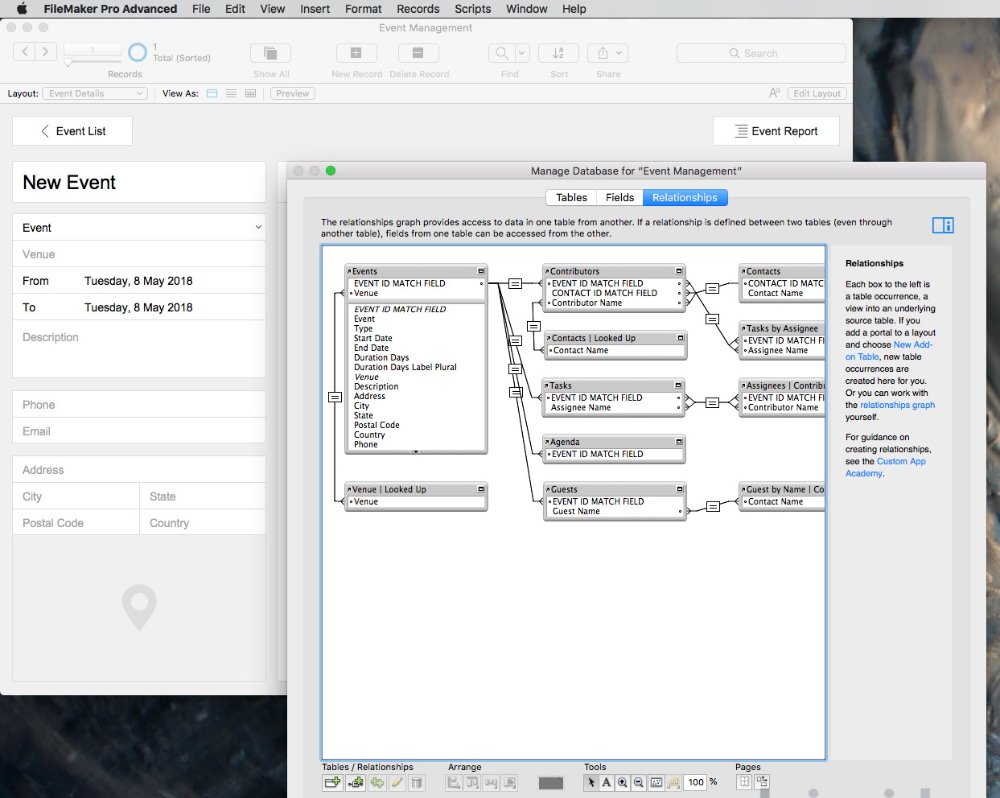
FileMaker Pro is a relational database — you can link contacts to tasks to events and back again
But it was also true that this was 1987 and these Mac apps were several years old. There was also only so much further they could be developed.
Claris was intended to be a wholly autonomous subsidiary and in either 1987 or 1988 — sources vary — it decided to exercise that autonomy. Claris chose to buy FileMaker 4.
It also bought what would become ClarisWorks, but FileMaker became its key app. Rebranded as FileMaker II so that it matched the Macintosh II range of the time, the app was originally no more than the existing one in a new box.
That wasn't the case for long. Claris developed FileMaker and by the mid-1990s, that was about all the company had going for it. In 1998, Claris even renamed itself as FileMaker, Inc.
And by then, FileMaker Pro had long been on Windows. Since 1992, this Apple subsidiary has been making a enormously successful Windows app.
Plenty of apps start on one platform and get ported over to another, but most of the time, you can tell. Mac users know when a firm is trying to pass off a Windows app, and presumably vice-versa.
But in this case, Claris made true Mac and Windows apps — and it also worked to make sure that the databases created on either side looked the same. If you developed a FileMaker Pro database on your Mac, it would look the same, down to the pixel, to the person who runs it on a PC.
Then as well as the external appearance, the internal structure of a FileMaker Pro database was the same regardless of the platform.
And every year, Claris brought out a major update to FileMaker Pro simultaneously on Mac and PC.
Or it did until we neared 2020.
The software world changes
For in 2019, the company FileMaker, Inc, was renamed again. This time, it went back to its original Claris name.
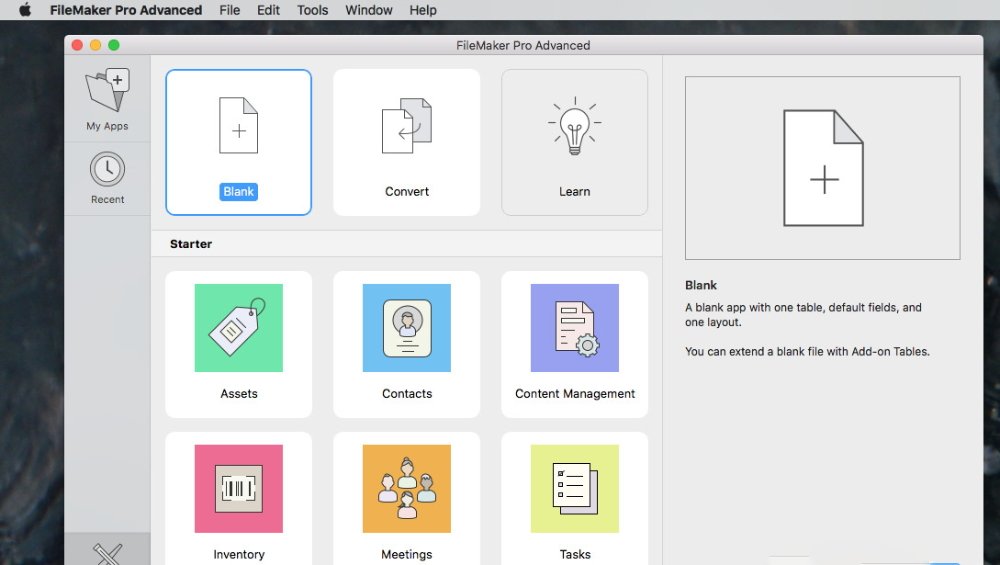
Rather than databases or solutions, Claris now talks about apps
The company also stopped talking about databases. It was always a potentially confusing term, as if you said "database" you could mean FileMaker Pro itself, or you could mean a database that you created in the app.
So longtime users had tended to refer to "database solutions," when they meant the database they'd developed to do a job for you.
But maybe that term didn't travel well, or maybe it was just a little bit of fashion. For Claris began tending to refer to apps instead of databases.
It's fair enough. My Radio Times database was arguably an app — I ran it on my Mac, for instance, it wasn't that I logged into someone else's database.
And if I'd been doing that particular work a few years later, I could've run it as an iPad app using the mobile FileMaker Go.
Yet this really was a repositioning in the market. It was a repositioning so that not only did you forget about databases, you forgot that FileMaker was now over three decades old.
And if Claris was lucky, you saw it as a very fast and modern way to develop apps.
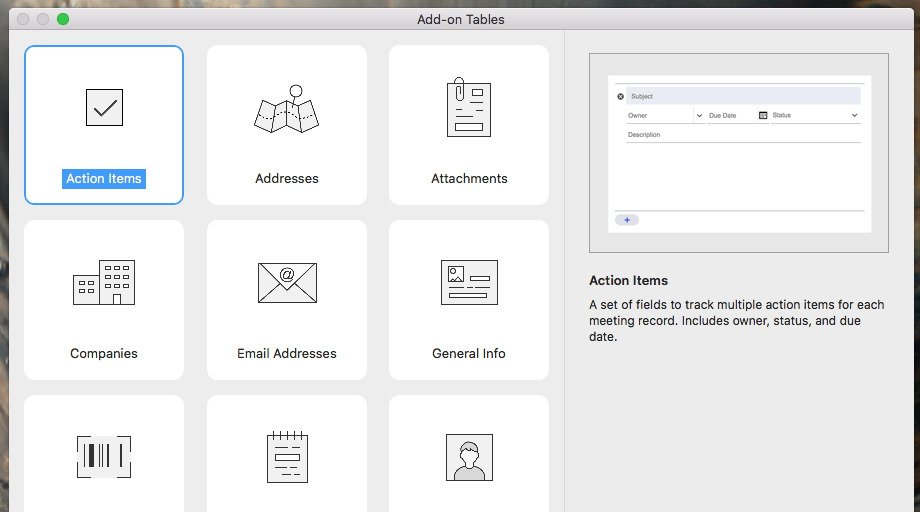
You can write scripts within FileMaker, but you can also point and click to get started
Then Claris also did away with something else that you expect from old-style computer firms. It stopped making annual releases, stopped the one-time purchase it always had, and moved to subscriptions.
So FileMaker Pro version 19 was released in 2020 and officially was the latest edition for three years. In 2023, though, the company resumed annual releases.
The closest Claris has come to explaining the switch back came from CEO Brad Freitag during the Claris Engage 2024 conference. "Our aim is to be more than your tech vendor — it's to be your steady ally," he said.
Just as all subscription companies promise, FileMaker Pro had been continuously updated. The idea of a subscription is that it helps fund a company so that it can issue significant updates when ready, rather than saving them up to make a compelling paid upgrade once a year.
But presumably that wasn't chiming with customers, and if there's anything to know about FileMaker, it's that its customers are not casual ones. That 2024 conference had 600 developers, at least the greater number of whom solely work using FileMaker.
FileMaker Pro is truly a career kind of app, and it is one that makes its users passionate. It is truly an Apple-style product, and it is made by Apple, yet few people realise it — and Apple seems quite happy about that.
Apple's software suite
Apple has long developed its own word processor with Pages, spreadsheet with Numbers, and presentation software with Keynote. That's the trio it promotes together, and that's the trio that Windows users always think is lacking something crucial.
The iWork suite is lacking a database. While Windows has the Microsoft Access database alongside Word, Excel, and PowerPoint, Apple has nothing.
Yet it has FileMaker Pro, and it has had it since the 1980s. In comparison, it's only had Keynote since 2003, Pages since 2005 — and Numbers didn't come along until 2007.
That means FileMaker predates all of Apple's current productivity software, and it has survived since the days of Apple's first-ever Mac apps.
There's an argument, then, that FileMaker Pro is the greatest single application that Apple has ever made. It's just made it for Windows, too.