

In order to correct for the overambitious firings of so many federal technologists, the Trump administration has announced a new initiative called the "Tech Force," and is calling on Silicon Valley to staff it.
The United States government has gone through some tumultuous months after a new administration took over, created the Department of Government Efficiency, and promptly fired thousands of federal employees. The haste and seeming randomness of the dissolution of so many teams, programs, and initiatives left the United States floundering on the world stage as it attempts to compete.
According to a report from Nextgov, big tech companies will play a role in helping the US government create the Tech Force. Donated senior managers from tech firms would work for the government and be given a leave of absence or sabbatical from their home companies for two years.
Recruits employed by the Tech Force can make between $150,000 and $200,000 annually. These are expected to be pulled from conventional recruiting methods in the public sector.
"We need you," said Scott Kupor, the director of the Office of Personnel Management. "The U.S. Tech Force offers the chance to build and lead projects of national importance, while creating powerful career opportunities in both public service and the private sector."
The following companies were announced as supporting the project, with more to follow:
- Adobe
- Amazon Web Services
- AMD
- Anduril
- Apple
- Box
- Box
- C3.ai
- Coinbase
- Databricks
- Dell Technologies
- Docusign
- Google Public Sector
- IBM
- Meta
- Microsoft
- Nvidia
- OpenAI
- Oracle
- Palantir
- Salesforce
- SAP
- ServiceNow
- Snowflake
- Robinhood
- Uber
- Workday
- xAI
- Zoom
The government website clarifies what partnering companies provide to the initiative.
Companies can partner by providing technical training resources, mentorship programs, nominating employees to do stints of government service, and committing to consider Tech Force alumni for employment after their government service.
Specifics about which company was providing what weren't given. Positions at Tech Force are not political appointments and serve nonpartisan roles focused on technology implementation.
One goal of the Tech Force is to help improve the United States' standing in AI implementation. Other goals include revamping portions of the government with new technological systems, where many are still run on aging systems or even paper.
A post-DOGE Band-Aid
The Department of Government Efficiency, or DOGE, was created and helmed by Elon Musk. Their charge was to find "waste, fraud, and abuse" and eliminate it to save the United States up to $2 trillion annually.
The effort was created to cover the cost of the Trump administration's desire to extend tax cuts for the ultra-wealthy, which had to be paid for somehow. Ultimately, the effort was a failure, with DOGE spending money at nearly the same rate it was "saving" it via cuts, and leaving critical holes in places like the Nuclear Regulator Commission that had to be re-hired almost immediately.
The DOGE efforts began at the start of 2025, and even their most exaggerated claims of savings are only a tenth of their $2 trillion goal. President Trump's "Big Beautiful Bill" passed and most of it goes into effect on January 1, 2026.
The US national debt has increased to $38.5 trillion in 2025 (and counting). There are still some days left in the year, but as of now, that's $4.7 trillion more debt added when compared to the same time period in 2024.
The national debt is expected to skyrocket in 2026. Estimates place the deficit nearing $2 trillion for the fiscal year.
Among the many things cut were the few remaining technology-focused government initiatives. The Tech Force is seemingly a replacement for everything that was cut.
However, this team isn't a one-to-one replacement for all of the federal employees fired from tech positions. For example, the entire 18F team was dismantled, the IRS lost over 2,000 tech workers, and the original US Digital Service created under President Obama is what became DOGE, which serves an entirely different mission today.
The biggest concern with the new Tech Force is a conflict of interest. By bringing in yet another group of young individuals led by tech giant managers, there could be bias in what technology is recommended and installed across the United States government.
Elected officials have always struggled to understand and implement tech
Every attempt to create teams of technologists to aid the government in consultation and education has been met with resistance. The first of such initiatives was created in 1972.
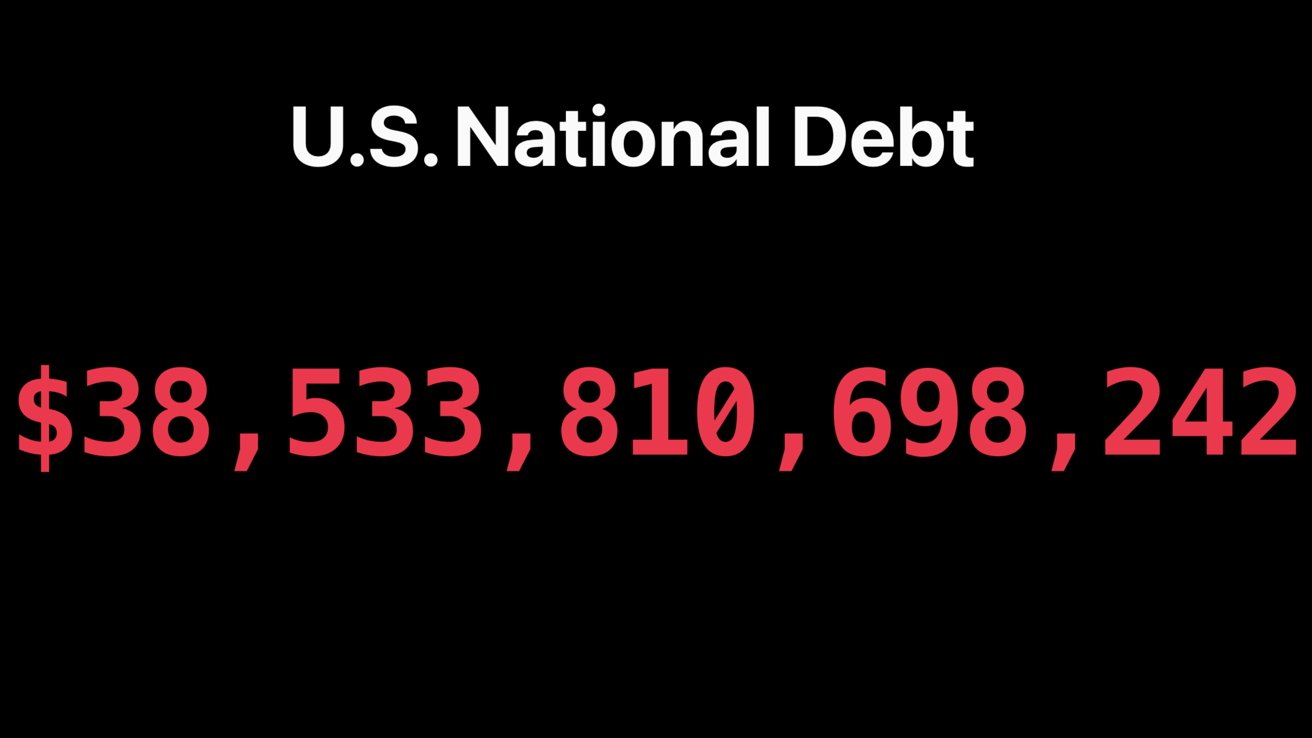
The US national debt on December 15 is $38,533,810,698,242 at 1:12 p.m.
The Office of Technology Assessment was created with the goal of educating and briefing both the House and Senate on complex scientific and technical issues of the day. This team was governed by 12 members of Congress split down the middle on party lines.
It cost $22 million per year in the early '90s, but was cut in 1995 due to being "wasteful." The argument was that government officials could learn about technology themselves, and paying for such consultation wasn't needed.
That didn't work out that well. It led to things like one notable instance where the internet was called tubes, and other more egregious policies and discussions.
There are still some technologists available for consultation in the US government, but it hasn't been maintained as any kind of official team. The problem this has created is exemplified every time a member of Congress asks Mark Zuckerberg if he can help them with YouTube.
The fundamental misunderstanding of technology and its implementation in the government has reared its head for the last three decades. We've heard White House officials share absurd ideas about automating nuclear power and more lately converting entire organizations into AI-powered chatbots.
It remains to be seen exactly what the Tech Force might accomplish, but only time will tell. There is no doubt that there are portions of the government that could benefit from technology being implemented efficiently, but sadly, the bets for such advancement are put on the wrong horses.